| Princess Mononoke | |||||
|---|---|---|---|---|---|
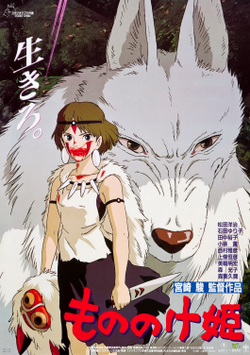 Theatrical release poster | |||||
| Japanese name | |||||
| Japanese | もののけ姫 | ||||
| |||||
| Directed by | Hayao Miyazaki | ||||
| Written by | Hayao Miyazaki | ||||
| Produced by | Toshio Suzuki | ||||
| Starring | |||||
| Cinematography | Atsushi Okui | ||||
| Edited by | Takeshi Seyama | ||||
| Music by | Joe Hisaishi | ||||
Production company | |||||
| Distributed by | Toho | ||||
Release date |
| ||||
Running time | 133 minutes | ||||
| Country | Japan | ||||
| Language | Japanese | ||||
| Budget | ¥2.35 billion | ||||
| Box office | US$231.3 million | ||||
Princess Mononokea is a 1997 Japanese animated historical fantasy film written and directed by Hayao Miyazaki. Set in the Muromachi period of Japanese history, the film follows Ashitaka, a young Emishi prince who journeys west to cure his cursed arm and becomes embroiled in the conflict between the forest of the gods and a nearby town, as well as the feud between Lady Eboshi, the town's leader, and San, a human girl raised by wolves. Produced by Toshio Suzuki, animated by Studio Ghibli, and distributed by Toho, it stars the voices of Yōji Matsuda, Yuriko Ishida, Yūko Tanaka, Kaoru Kobayashi, Masahiko Nishimura, Tsunehiko Kamijō, Akihiro Miwa, Mitsuko Mori, and Hisaya Morishige.
Miyazaki began developing early concepts in 1980 and later considered basing a film on the Hōjōki (1212), a Japanese literary classic; elements of both evolved substantially into the eventual film. After taking a break to direct On Your Mark (1995), he led the production with a budget of ¥2.35 billion, making it the most expensive animated film at the time. Some computer-generated imagery and other digital techniques were used in conjunction with hand-drawn animation, a first for Miyazaki. The film explores themes of environmentalism and societal diversity, partly inspired by Miyazaki's readings into novel historical and cultural studies, and presents a feminist portrayal of its characters. It also blends fantastical elements with its depiction of medieval Japanese history, influenced by the jidaigeki style. The score was composed by Joe Hisaishi, a longtime collaborator of Miyazaki's.
Princess Mononoke was theatrically released in Japan on July 12, 1997, and broke several box office records. Suzuki led the film's marketing, then the largest advertisement campaign in Japan. It eventually became the highest-grossing film in the country. Following a distribution deal struck between Tokuma Shoten and Walt Disney Studios, it was the first of Studio Ghibli's films to be released internationally and was given to Miramax Films to be dubbed into English and distributed in North America. Neil Gaiman wrote the translation, making significant alterations for its American audience; the dub underperformed at the box office. As of 2026, the film has grossed US$231.3 million through various theatrical and home media releases. It received a broadly positive critical response in both Japan and the United States and earned a number of major Japanese accolades, including top awards at the Mainichi Film Awards and the Japan Academy Film Prize. Its sustained popularity and cultural impact have since made it a cult film.
Plot summary
In Muromachi-era Japan, the last Emishi prince, Ashitaka, kills a gigantic demon to protect his village, but his arm is afflicted by its curse. The demon, once the boar god Nago, was corrupted by an iron ball embedded in its body. Learning that the curse will eventually kill him, Ashitaka is exiled to the west, seeking a cure by uncovering the source of Nago's hatred.
On his journey, Ashitaka discovers that the curse grants him supernatural strength. He encounters a monk named Jigo, who advises him to seek answers in the nearby mountains from the Forest Spirit – a deer-like god of life and death that transforms into the giant Nightwalker at sunset. Guided by tiny kodama, Ashitaka passes through the forest of the gods, where he catches a glimpse of the Forest Spirit. Meanwhile, Lady Eboshi and her men repel an attack by a pack of wolves led by the wolf goddess Moro and her adopted human daughter, San.
Ashitaka arrives at Irontown,b a settlement that has deforested the surrounding area to mine iron, leading to conflicts with the animal gods of the forest. The town shelters former prostitutes and people with leprosy, who work to manufacture firearms. Eboshi, the town's leader, admits to shooting Nago, instilling the hatred that corrupted him. She also reveals her plan to kill the Forest Spirit, hoping to eradicate the gods and enable Irontown to prosper. Though Ashitaka's cursed arm tries attacking Eboshi, he resists its influence. Eboshi is collaborating with Jigo, who stands to be richly rewarded for delivering the Forest Spirit's head – believed to grant immortality – to the Emperor.
The wolves attack; San, whom the townspeople call "Princess Mononoke", infiltrates Irontown and duels Eboshi. Ashitaka subdues them both, but a townsperson shoots him. Strengthened by the curse, he takes San out of the town before collapsing. San threatens to kill him for sparing Eboshi, but is taken aback when he compliments her beauty. She brings Ashitaka to the Forest Spirit, who heals his wound but leaves the curse. The next day, a boar clan, led by the blind god Okkoto, declares their intention to attack Irontown, preferring to die in battle rather than allow their kind to diminish. Ashitaka recovers and implores Moro to let San escape with him, but is banished from the forest instead.
The boars assault Irontown's forces but are annihilated by their weaponry. San and the mortally wounded Okkoto retreat to the forest, unknowingly followed by Eboshi and Jigo, who use the blood of the fallen boars to deceive Okkoto into leading them to the Forest Spirit. San tries stopping him, but his pain transforms him into a demon, engulfing her. With Moro's remaining strength, she and Ashitaka free San. The Forest Spirit grants peaceful deaths to Okkoto and Moro. As it transforms into the Nightwalker, Eboshi beheads it. Its body explodes into a dark, chaotic fluid that expands in search of its head, killing everything it touches – including the forest – and briefly reanimates Moro's head, which bites off Eboshi's arm.
Though reluctant to help the humans, San joins Ashitaka in pursuing Jigo to recover the Forest Spirit's head. Ashitaka evacuates Irontown as the Nightwalker's body floods it, and together, he and San retrieve the head from Jigo, returning it to the Nightwalker. As the sun rises, the Nightwalker dies and dissolves into the wind. In its place, the devastated land is renewed with abundant flora, and Ashitaka's curse is lifted. A repentant Eboshi resolves to rebuild Irontown better, and Ashitaka chooses to remain and help. San, while admitting to Ashitaka that she loves him, is unable to forgive humanity and stays in the forest. They promise to meet as often as they can.
Voice cast


| Character name | Voice actor2 | ||
|---|---|---|---|
| English | Japanese | Japanese (1997) |
English (1999) |
| Ashitaka | Ashitaka (アシタカ) | Yōji Matsuda | Billy Crudup |
| San | San (サン) | Yuriko Ishida | Claire Danes |
| Lady Eboshi | Eboshi Gozen (エボシ御前) | Yūko Tanaka | Minnie Driver |
| Jigo | Jiko-bō (ジコ坊) | Kaoru Kobayashi | Billy Bob Thornton |
| Kohroku | Kōroku (甲六) | Masahiko Nishimura | John DeMita |
| Gonza | Gonza (ゴンザ) | Tsunehiko Kamijō | John DiMaggio |
| Toki | Toki (トキ) | Sumi Shimamoto | Jada Pinkett Smith |
| Wolf | Yama-inu (山犬) | Tetsu Watanabe | Unknown |
| Nago | Nago no Kami (ナゴの守) | Makoto Satō | John DiMaggio3 |
| Cattleman Leader | Ushikai no Osa (牛飼いの長) | Akira Nagoya | Unknown |
| Moro | Moro no Kimi (モロの君) | Akihiro Miwa | Gillian Anderson |
| Oracle | Hī-sama (ヒイ様) | Mitsuko Mori | Debi Derryberry |
| Okkoto | Okkoto-nushi (乙事主) | Hisaya Morishige | Keith David |
Development
Early concepts and pre-production
Hayao Miyazaki composed the preliminary ideas for what would become Princess Mononoke in 1980 after releasing his first film, The Castle of Cagliostro (1979),4 drawing sketches of a princess living in the woods with a beast.5 The story was roughly based on the "Beauty and the Beast" (1740) fairy tale, set in historical Japan.6 The Beast was realized as an animalistic spirit (mononoke) whom the protagonist, the daughter of a nobleman, is forced to marry.7 After unsuccessfully proposing the film project to several production companies, Miyazaki published his concepts in a book in 1983,8 republished in 2014 as Princess Mononoke: The First Story.9 He reused various ideas from this project in works such as My Neighbor Totoro (1988) and Porco Rosso (1992).10 Shuna's Journey (1983) in particular bears the closest resemblance to the eventual film, featuring a protagonist who rides an elk to the land of gods.11 A few fundamental ideas from the 1980 concept appear in the final film, but the character designs and plot are entirely different.12 The film scholar Raz Greenberg wrote that the original concept also "[portrayed] the end of tyranny vividly", in contrast with the film, showing the antagonist's fortress destroyed and its slaves emancipated.13 According to the film scholar Rayna Denison, the stark difference between the original idea and the final film demonstrates the radical change of Miyazaki's filmmaking philosophies during that time.4 He took cues from Japanese folklore, especially the tale of a princess with a birthmark, which evolved over time into Ashitaka's curse.14
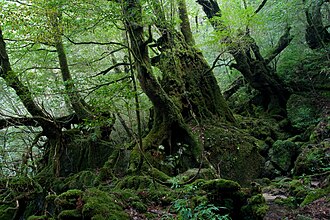
Inspired by the writings of Yoshie Hotta, Miyazaki also considered creating a film adaptation of the Hōjōki (1212), a Japanese literary classic on the ephemerality of life.16 It was written by the poet Kamo no Chōmei during a period of political turmoil and natural disasters, which the animation scholar Susan J. Napier felt resonated with the "increasing sense of vulnerability" in Japanese culture during the time of the film's production.17c However, Miyazaki felt the concept was "far removed from common sense" and had no possibility of commercial success;18 he never moved forward with this concept but continued to consider creating a historical piece.17 Upon the completion of his manga series Nausicaä of the Valley of the Wind (1982–1994), Miyazaki began work on the project proposal for the film in August 1994.19 However, encountering writer's block in December, he took a break from the production to direct the short film On Your Mark (1995) as a side project.20 Miyazaki returned to the film in April 1995 and began working on the storyboards in May.21 The film's broad scope and high level of detail extended the pre-production process.22 That month, Miyazaki took four of the art directors to visit the island of Yakushima,23 which had already inspired some environments in Nausicaä of the Valley of the Wind, to achieve the environmental depiction that he was seeking to portray.24 The island's relative lack of development informed their sketches of the film's forest of the gods.25 The fifth art director, Kazuo Oga, went to the Shirakami-Sanchi mountains to draw inspiration for the Emishi village.26
Production and animation
Princess Mononoke was the most expensive animated film ever produced in Japan at the time.27 It was originally allocated a budget of ¥2 billion, which was expanded to ¥2.35 billiond later in the production,29 more than double that of any previous Studio Ghibli film.27 Miyazaki stated, "I don't care if the studio goes bankrupt."30 The animation production commenced in July 1995.21 Miyazaki created the storyboards using the approach he took toward serialized manga, writing the film's plot as he drew the scenes.31 His declining sight initially caused him to use oversized paper, but he switched back to the normal size to increase the pace of the storyboarding.32 This process was done in parallel with the animation, and the final boards outlining the end of the film were not finished until January 1997.29
An unusually high level of detail was afforded illustrating backgrounds and animating background characters due to the large budget available.33 The decision to assign five art directors to the film was also unprecedented.34 Each tackled a different aspect; for example, one handled daylight shots while another covered the nighttime.35 The film used approximately 144,000 cels, 80,000 of them being key animation frames, more than any other Studio Ghibli film.36 Miyazaki is estimated to have drawn or retouched nearly 80,000 cels himself.37 The final shots were completed in June 1997, less than a month from the release date.21
Computer graphics
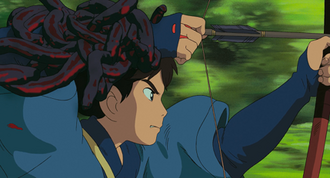
The film was created using a combination of hand-drawn animation and computer-generated imagery; approximately five minutes were animated entirely using digital processes. A further ten minutes use digital ink and paint, a technique used in all subsequent Studio Ghibli films.39 The company's hand-drawn methods were becoming outdated by the late 1990s,40 and by 1997, members of Studio Ghibli's computer graphics team felt that the adoption was made largely out of necessity.41 According to Mamoru Oshii – a contemporary of Miyazaki's – digital painting was adopted at the insistence of Michiyo Yasuda, a senior colorist at Studio Ghibli.42 While Studio Ghibli had already begun experimenting with digital techniques a few years prior on Pom Poko (1994), its computer graphics department was opened during the production of Princess Mononoke.43
Miyazaki's distaste for digital animation techniques was well known in Japan before the film's release, so his use of computer graphics came as a surprise, according to Denison.44 He made the decision to use the new techniques early in the production, starting with the demon god in the opening sequence.45 Certain sequences were created using 3D tools and then processed to resemble a traditionally animated sequence using a program called Toon Shader, developed by Microsoft at the studio's request.46 Some of this work was outsourced to the animation studio Toyo Links.47 Three broad categories of digital techniques were applied to the animation: the use of digital ink and paint to finish coloring hand-drawn frames; 3D rendering and digital compositing, which put the hand-drawn images in a three-dimensional environment to create more visual depth; and morphing and particle effects, which create additional detail and smoother transitions.48 Yoshinori Sugano, the head of the computer graphics department, recalled that the most involved uses of digital techniques were to mask the transitions between the digital and hand-drawn elements on screen. Some characters, particularly the gods, alternate between rendering approaches in different shots.38
Themes






Several scholars have explored the themes of Princess Mononoke in their work.
Conflicts of nature, technology, and humanity
Environmentalism is a central theme of Princess Mononoke.49 In the war between the forest gods and the people of Irontown, Ashitaka serves as the mediator.50 Unlike many Western works with similar themes, the film does not present these positions as complete opposites,51 nor does it outright reject modernity and technology.52 The scholars Tracey Daniels-Lerberg and Matthew Lerberg wrote that it instead "[embraces] the unpredictable outcomes that emerge in the uncertainty that remains."51 Both humanity and nature are given equal standing in the film's world, and Napier wrote that the film "offers a vision of life as a densely interwoven design, rather than a simple allegory of dichotomized opposites."53 Additionally, the film portrays internal strife within parties on both sides of the conflict: the different clans of spirits disagree on how to handle the conflict, and the humans war amongst themselves for various reasons.54 Ashitaka's relationships with both parties are volatile and "even dissatisfying at moments", according to Daniels-Lerberg and Lerberg. They attribute this sense of unease to the focus on emotion, rather than strict logic, that the film puts on the conflict.55 According to the film critic Roger Ebert, Princess Mononoke is not a "simplistic tale of good and evil, but the story of how humans, forest animals, and nature gods all fight for their share of the new emerging order."56
The film scholars Colin Odell and Michelle Le Blanc wrote that the film simultaneously mounts a criticism of humanity's mistreatment of the natural world and "grudgingly admits" that some disputes are inevitable to facilitate technological progress.57 While Irontown is shown to be a haven for downtrodden members of society, who have the opportunity to live honest lives and enjoy fair treatment from Eboshi,58 the conflict arises from the harm that the settlement causes to the surrounding environment. Greenberg identified this dynamic as a marked increase in complexity from Miyazaki's earlier works, which typically presented a utopian model as an answer to social issues.13 Miyazaki expressed that he "meant to state [his] objection to the way environmental issues are treated",59 referring to the general exclusion of humanity's role in environmental discourse in Japan.60 The ecological writings of the historian Sasuke Nakao, especially his "evergreen forest culture theory", were greatly influential on Miyazaki when creating the film's forest of the gods.61 Miyazaki stated that "[Nakao's book] taught me what I was the descendent of", and provided him an alternative to many traditional depictions of Japanese history that he disliked.62
Napier saw the film as an "elegy for a lost Japan", a version of the country that predates the modern patriarchal society and was controlled by nature.63 Setting the film in the Muromachi period allowed Miyazaki to depict the country before it had been deforested and altered by rice agriculture64 and positions the film within the moment of history when "humankind pushed nature into submission", according to the animation writers Jonathan Clements and Helen McCarthy.65 Miyazaki intended to portray the gods as "living animals, tortured by humans", feeling it to be an important aspect to depict in the relationship between nature and humanity.66 He was inspired for the film's concept by the Epic of Gilgamesh (c. 2100–1200 BCE), an ancient epic poem that depicts the death of the forest god and the ruin of humanity.67 The philosopher Takeshi Umehara, who wrote a stage play titled Gilgamesh (1988), had previously suggested that Miyazaki adapt his work into a film; Miyazaki had declined the offer at the time but later stated that he had unconsciously included elements similar to the play in Princess Mononoke.68 The film shares several themes with the Nausicaä of the Valley of the Wind manga, which Miyazaki had completed in 1994,69 namely the "environmental catastrophe, the role of technology and warfare, and human interactions with nonhuman species", according to Napier.70 Clements and McCarthy wrote that the film was conceived partly due to Miyazaki's discontent with the narrative of the manga's film adaptation (1984), in which the environmental theme was suddenly resolved via a deus ex machina.65
Miyazaki's filmmaking style changed considerably in the 1990s in response to various geopolitical conflicts, including the Gulf War and the Yugoslav Wars following the dissolution of the Soviet Union.71 He was especially critical of Japan's decision to provide military aid in the Gulf War, which he considered a violation of Article 9 of the Japanese Constitution.72 These events disheartened Miyazaki, who compared them to the preamble to World War I and felt he was watching history repeat itself.73 In 1995, two disasters occurred in Japan that had a marked negative impact on its culture: the Great Hanshin earthquake, which killed thousands and became the worst on record since 1923, and the Tokyo subway sarin attack perpetrated by the Aum Shinrikyo cult. Napier wrote that these had an effect "on both a psychological and an environmental level" and heightened the country's cultural "emptiness" following the Japanese asset price bubble bursting in 1992.17 After finishing Porco Rosso, Miyazaki resolved to create a "substantial film" that acknowledged academic discourse, eschewing the escapist philosophy of his earlier works.74 He instead set out to depict the philosophy that, "no matter how messy things get, we have no choice but to go on living."75
Heterogeneity of society
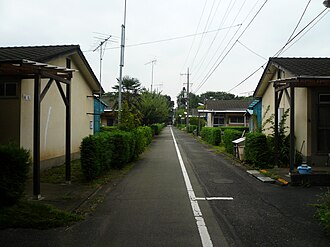
Napier wrote that "the sense of a broken heterogeneous world is stridently manifest" within Princess Mononoke.63 The film challenges popular cultural beliefs, such as the existence of a homogenous Japanese ethnicity (minzoku), by depicting social outcasts and peoples not of Yamato origin.77 The Emishi people are related to the modern Ainu people,78 and Miyazaki highlights this difference in the film: Ashitaka is immediately treated as a stranger at many of the villages he visits.79 The film scholar Eija Niskanen wrote that the film also critiques the Nihonjinron, a group of ethnonationalist theories about Japan that claim its culture is unique from others and depict the nation's people as uniform.79 The film scholar Shiro Yoshioka felt that the writing of Yoshihiko Amino, another historical scholar, influenced Miyazaki's writing in this regard.68 According to Denison, his explorations result in highly polarized characters and participants on both sides of the conflict becoming "monstrous".80 Miyazaki said that more recent historical studies had increasingly focused on the lifestyles of common people outside the nobility, many of which do not align with the theories of a minzoku.81 He was also inspired to portray people with leprosy after visiting the Tama Zenshoen Sanatorium near his home in Tokyo. He commented afterwards, "In the middle of no matter what kind of misery there is joy and laughter. In human life which tends toward ambiguity, I have never seen a place which shows this with such clarity."82
Napier felt that the film proposes a possible future Japanese identity that highlights non-uniformity and the role of women.63 Toshio Suzuki – the film's producer and a longtime friend of Miyazaki's – stated that Miyazaki was a feminist and brought ideals of gender equality to his professional life as well as his fictional works.83 However, McCarthy felt that his prior portrayals of women were predicated in a fundamentally patriarchal worldview; Miyazaki's female characters succeed only when given the opportunity to in a society ultimately governed by men.84 She argued that the protagonists Ashitaka and San were constructed incrementally through various predecessors in Miyazaki's works.85 His earlier films also portrayed young characters as able and driven to change the world, which is not continued here.13 San, according to Napier, is an "embodiment of Miyazaki's anger with what he increasingly perceived as a stupid and chaotic world."86 She also found San's early appearance in the film with a bloodstained face to create a vivid image of violence, wildness, and "aggressive sexuality that is confrontational rather than alluring."87 McCarthy wrote that San is Miyazaki's only female protagonist to be entirely unbound from patriarchy, refusing to accept a domestic life even despite her love for Ashitaka.88 In a divergence from Miyazaki's previous works that close with clearly optimistic outlooks, the film ends in an ambiguous manner; the Forest Spirit's death revives nature, but the wild forests remain felled,89 and Ashitaka and San do not stay together but agree to occasionally meet.90
Napier felt that the film's conflicting philosophies do not facilitate the inclusion of an antagonist of a similar kind to the Count from The Castle of Cagliostro or Muska from Castle in the Sky (1986).91 Eboshi's initial characterization sets her in the role of a villain: the belligerent of the environmental conflict and the cause of Nago's demonic corruption.92 However, this impression is repeatedly challenged by depictions of her leadership and caregiving qualities; the community of Irontown holds sincere respect for her, and her sheltering of former prostitutes and people affected by leprosy contravenes many traditional roles of femininity.93 Miyazaki's depictions of female characters working on iron and people with leprosy manufacturing weapons are considerable departures from historical views.76 Napier emphasized that the decision to place a female character in this leadership position prevents her stance from being viewed as a cliché of oppressive militarism or the interpretation of technology as inherently detrimental.94 She wrote that Eboshi can be viewed as a tragic character because she is not evil but is forced to become an aggressor to safeguard her progressive community.95 Although Eboshi and San represent diametrically opposed views, they share many leadership and nurturing characteristics,96 and the scholar Alice Vernon examined the relationship between the two as a symbiotic one, where Eboshi represents a possible future image of San.97
Style
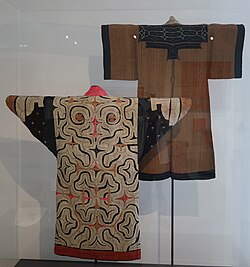
Princess Mononoke marked the first time Miyazaki explored a jidaigeki style – a period drama focusing on the lives of historic Japanese people.99 He particularly appreciated the works of Akira Kurosawa, who had directed several key films in the genre.17 The film subverts many traditional elements of the jidaigeki, such as the portrayals of the Emperor and the samurai as sacred and noble.86 Miyazaki chose not to align with typical depictions of the Muromachi period, such as the development of high culture or Zen aesthetics in the capital city of Kyoto.100 Napier wrote that the forest of the gods also subverts typical depictions of nature in the Muromachi period; as opposed to carefully tended Zen gardens, it is untamed, violent, and largely avoided by humans.101 The film exaggerates its historical perspective to facilitate the narrative; Irontown, for example, was inspired primarily by metalworking settlements in China102 as well as a tatara furnace in the Shimane Prefecture.1 Miyazaki lacked a historical reference for the Emishi people's garments, so the clothing worn by the girls in Ashitaka's village is influenced by styles from Bhutan and Thailand,103 and other characters' embroidered fabrics resemble traditional Ainu clothing.98 Instead of traditional arms, guns are the primary weapons in the film's conflict.104 Isao Takahata – a fellow director and longtime friend of Miyazaki's – said that the film was "dangerously liable to give the audiences misconceived impressions of history."105 Napier wrote that the film goes "beyond realism" to support its themes,53 and the critic Kazuhiko Komatsu felt that its world, while sometimes consistent with historical fact, is essentially Miyazaki's fantasy.106
According to Napier, the film presents a much "grimmer" tone than Miyazaki's previous works, inspired by the themes of the Hōjōki.107 She contrasted Miyazaki's previous depictions of historical settings to the film's rendering of the Muromachi period, which she wrote "refuses to sentimentalize the medieval history it highlights".108 The film is unusual in Miyazaki's filmography for its lack of flying sequences. Napier suggested that its focus on lateral motion over vertical can be tied to the "sense of entrapment and desperation" it presents.109 Studio Ghibli had begun hiring full-time animators by the early 1990s, in contrast to the industry standard of staff being employed on short-term contracts. Denison wrote that this helped the studio develop an animated "house style" over time.110 Miyazaki felt that an important aspect of this style was the studio's aptitude for illustrating the natural world;111 Denison observed from an interview with the art directors that their approach was to "simplify and caricature nature's essential meanings", prioritizing moments of contemplation and mindfulness of the surrounding landscape.34 The film uses a palette for the forest that contrasts with the pastel colors typically used in Miyazaki films, employing darker shades of green and brown.101 Napier emphasized that the medium of animation, compared to live action, is well suited for exploring the film's themes.112 The film depicts a number of animals and gods, but she noted that they are entirely distinct from the humans; most notably, the Forest Spirit presents a serene yet entirely foreign visage.113
Release
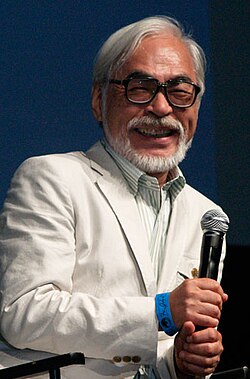
Marketing and Japanese release
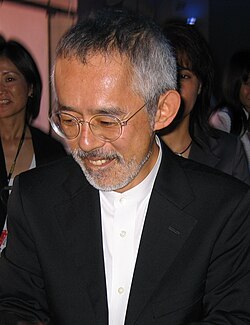
The promotional strategy was spearheaded by Suzuki, who by 1997 had already developed relationships within the media industry while promoting previous Studio Ghibli releases.114 Napier noted that the marketing put the film under the Studio Ghibli brand for the first time – as opposed to previous works that were labeled primarily as Miyazaki films – which she felt reflected Suzuki's rising position as the studio's main producer.115 According to Suzuki, three important elements of the campaign were the repeated use of a recognizable title logo, key imagery from the film, and a tagline.116 The tagline underwent several iterations before, with Suzuki's input, the final phrase was chosen: "Live."117 Suzuki also changed the title from the original intention of The Legend of Ashitaka e without Miyazaki's initial approval, as he found it less interesting.119 The budget allotted for the film's promotion was at least ¥2.6 billion,f even higher than the production budget, making it the largest film advertisement campaign in Japan at the time.120 Yoshioka argued that it was essential for Princess Mononoke to be a commercial success to make up for the large production budget, and the scale of its campaign was significantly expanded from previous films' as a result.114 Several types of merchandise, such as stuffed kodama and copies of San's mask, were sold.121 A number of preview screenings were organized before the release to advertise the film by word of mouth; 130 of them were originally scheduled, and 70 were ultimately held, a number that the film scholar Seiji Kanō still found "astonishing". Miyazaki's previous film, Porco Rosso, had had only 23 screenings by comparison.122
After Walt Disney Studios and Studio Ghibli's then–parent company, Tokuma Shoten, secured their distribution deal in 1997, the film would be the first among Miyazaki's works to receive a worldwide release. While the arrangement did extend the studio's reach to new regions, the announcement was made primarily to attract local audiences.123 Miyazaki also hinted at his retirement following the film's release, further piquing audience interest.124 The film was marketed as a split between an anime and an art house film, avoiding advertising in the mainstream ahead of its release.125 Denison felt that this choice was indicative of the studio's initial lack of confidence in the film's commercial viability126 and their perception of its financial riskiness.127 Yasuyoshi Tokuma, the president of Tokuma Shoten who frequently worked with Miyazaki, said in an interview before the release that it would be a "huge success" just to make back the investments that had been put into the film.128 Denison argued, however, that the marketing campaign's scale revealed the studio's ultimate aim to achieve a commercial success;126 she interpreted this approach as a "local equivalent of the 'calculated' blockbuster film."129
Princess Mononoke was presented by Tokuma Shoten, Nippon Television, and Dentsu, and released by Toho in Japan on July 12, 1997.130 It was the subject of immense public anticipation, and it was screened at 260 of the country's 1800 cinemas,131 many of which reported audiences queueing to purchase tickets in previously unseen numbers.124 Tokuma Shoten's specialist magazine Animage, which had been closely associated with Studio Ghibli since the 1980s, released special issues on the film, as did several other publications.132 Newspapers began to refer to the film's release as the "Mononoke phenomenon",124 as by the end of its first week, the film had brought in over a million viewers and earned ¥1.5 billiong at the box office.133 Advertising for the film labeled it a blockbuster (daihitto), and it increasingly competed with many high-profile films in the Japanese market, including Hollywood imports such as The Lost World: Jurassic Park (1997).134 By November, it had surpassed ¥9.65 billionh in distribution rental sales, breaking the national record previously held by E.T. the Extra-Terrestrial (1982).133 During that period, 12 million people, a tenth of Japan's population at the time, saw the film in theaters.135 A year after the film's release, it had attracted over 14.2 million viewers133 and earned ¥11.3 billioni in gross revenue,114 making it the all-time highest-grossing film in the country.26j
English dub and American release
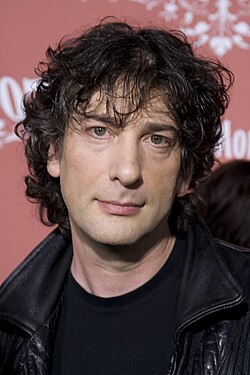
As part of the Disney–Tokuma deal, the film was handed over to Miramax Films, a Disney subsidiary at the time, to dub and distribute in the United States and other regions.136 The dub was directed by Jack Fletcher, who had previously worked on the dubs of other Studio Ghibli films such as Kiki's Delivery Service,137 and its script was written by the fantasy author Neil Gaiman, who was an unusual choice for anime localizations at the time, according to Denison.138 Gaiman claimed that Harvey Weinstein, who was the head of Miramax at the time, initially offered the role to the film director Quentin Tarantino, who had then recommended Gaiman instead. Gaiman had intended to decline the offer before being impressed by a scene in which a stone wets in the falling rain, saying, "I have never seen anything like this. This is real filmmaking."139 Steve Alpert, an executive at Studio Ghibli, assisted with the translation.140
Denison wrote that Miramax's approach to the dub "might be termed a project of indigenization" with an intent to form a new identity for the film outside of Japan.141 The language scholar Jennifer E. Nicholson wrote that the English dub's changes more closely approach an adaptation than a translation.142 Cultural differences between the United States and Japan, amplified by the film's discussion of specifically Japanese elements, resulted in a script that co-mingled the two languages and cultures.143 Gaiman inserted dialog for off-screen characters elucidating cultural concepts considered obscure for American audiences.138 Humor in particular demanded significant alterations; Gaiman approached the issue by searching for an "emotional equivalent" for the lines instead of considering the reason the originals were humorous.144 However, the title and dialog retained the Japanese word mononoke, which Nicholson argued could create the misconception that San's name is "Princess Mononoke", as well as downplaying the Japanese linguistic implications of the name San.145 Gaiman later recalled that although he oversaw the writing process, some script alterations were made without his knowledge. Several of the changes removed terms that identified the setting, such as substituting sake with wine and removing mentions of Japan and China.146 Nicholson found these decisions indicative of Miramax's intent to strip the film of its cultural context and divorce it from history entirely.147 Gaiman also recalled his drafts receiving contradictory corrections from both Miramax and Studio Ghibli, to which he responded by writing two sets of revisions and asking them to "go fight it out amongst [themselves]."148
The film featured a variety of celebrity voice actors who had developed followings in both traditional acting and voice acting roles.149 Denison wrote that various American and British accents were chosen to further remove elements of Japanese culture and color the film with "the 'American' voice that narrates it."150 The English-language release was marketed primarily as an art house film,138 and the media scholar Emma Pett felt that choosing the Miramax label rather than the family film–oriented Buena Vista label helped target the film towards a "middlebrow, culturally sophisticated audience" outside the mainstream.151 By this time, Weinstein had developed a reputation for importing and cutting international films to appeal to domestic audiences.139 However, among the terms of the distribution deal were that Studio Ghibli would approve and have ultimate control of the translation and that the film would not have any time cut.140 Weinstein attempted to convince Miyazaki and Suzuki otherwise but was unsuccessful.k Gaiman said that Miramax rolled back the planned marketing campaign and opened the film in a very limited number of screens.139 The English dub was first screened at the 48th Berlin International Film Festival on February 11, 1998,137 and premiered at the Avery Fisher Hall in New York City on September 26, 1999.156 It underperformed at the American box office, earning only US$2.3 million.139
Home media and other releases
The film was released on VHS in Japan by Buena Vista Home Entertainment in 1997 and on LaserDisc by Tokuma Shoten in 1998.157 Several related books have been published, including a manga series derived from the film's cels, art books with early sketches and storyboards, and reference works written by various academics.158 The English dub was released theatrically in Japan on April 29, 2000, with Japanese-language subtitles. A documentary titled Mononoke-hime in U.S.A. was released concurrently.159 These and other screenings internationally brought the English dub's total earnings to US$159 million at the time.160 The film has also been released on home media in various European and Asian regions.158
The DVD release in North America was not initially set to include the Japanese audio track. Online petitions were opened to retain it,161 and the planned August 2000 release was consequently delayed.162 Miramax released the DVD on December 19, 2000, featuring the original Japanese audio, the English dub audio, and extras including a trailer and a documentary.163 Nikkei Business reported that 4.4 million DVD units were sold in Japan as of 2007.164
Walt Disney Studios Home Entertainment released the film on Blu-ray in 2014, and it was included in a collection of Miyazaki's films in 2015.165 GKIDS re-issued it on DVD and Blu-ray in 2017.166 As of October 2020, the film has grossed US$9.2 million from Blu-ray sales in the United States.167 It has since received multiple worldwide theatrical re-releases, including at the annual Studio Ghibli Fest organized by GKIDS.168 GKIDS released the film in IMAX theaters in March 2025, featuring a remastered version in 4K resolution. Atsushi Okui, the vice president of Studio Ghibli, said that the original negatives had been preserved and rescanned in 4K over 10 years prior.169 The remaster grossed US$6.8 million at the North American box office,168 bringing the film's cumulative worldwide total to US$231.3 million as of February 2026.167
Music
| Princess Mononoke Soundtrack | ||||
|---|---|---|---|---|
| Soundtrack album by | ||||
| Released | July 2, 1997 | |||
| Length | 65:05 | |||
| Label | Tokuma Japan Communications | |||
| Producer | Joe Hisaishi | |||
| Joe Hisaishi chronology | ||||
| ||||

As with most of Miyazaki's previous films, Princess Mononoke's score was composed by Joe Hisaishi.170 According to McCarthy, the score's development involved a much closer collaboration between the two than on previous works.171 Hisaishi first composed an image album – a collection of demos and musical sketches that serve as a precursor to the finished score – which he shared with Miyazaki and Suzuki.171 The unused title The Legend of Ashitaka appears here as the title of the opening theme.172 With their input, the demos were then worked into the final score, performed by the Tokyo City Philharmonic Orchestra.173 Tokuma Shoten released the image album in July 1996 and the soundtrack album in July 1997.174 The vocal theme song performed by the countertenor singer Yoshikazu Mera was released as a single before the film's release and became popular with Japanese audiences.175 A third version of the soundtrack, arranged for symphony orchestra and performed by the Czech Philharmonic, was released in 1998. All three albums were issued on vinyl records in 2020.176
The vocal theme was re-recorded for the English dub by the American vocalist Sasha Lazard. Denison argued that this was a part of Miramax's efforts to remove the film's Japanese elements, but she also acknowledged that the score deviates substantially from a typical Hollywood-style compositional approach. For example, leitmotifs, which are commonly used to represent characters or settings, are instead used in transitional moments between more significant narrative events.175 McCarthy wrote that the film complements the scenes featuring music and dialog with a liberal use of silence and ambient sounds to augment the tension of certain moments, a significant departure from American scoring approaches.177 The musicology scholar Stacey Jocoy highlighted the emphatic use of brass instruments to accompany the film's epic story.178 Hisaishi employs Japanese pentatonic scales in conjunction with Western tonalities,171 and Jocoy analyzed the melody featuring this scale in San's theme as symbolic of her desire for "peace and beauty". The contrasting cluster chords – which she found similar to those of Igor Stravinsky's The Rite of Spring (1913) – are used to represent San's aggression.179
| Release date | English title | Japanese title | Estimated units |
|---|---|---|---|
| July 22, 1996 | Princess Mononoke Image Album | もののけ姫 イメージアルバム | 75,000 |
| June 25, 1997 | "Princess Mononoke"l | もののけ姫 | 605,000 |
| July 2, 1997 | Princess Mononoke Soundtrack | もののけ姫 サウンドトラック | 500,000 |
| July 8, 1998 | Princess Mononoke Symphonic Suite | 交響組曲 もののけ姫 | 80,000 |
Reception
Critical response
The film was generally well received by critics in Japan, and Kanō described a "flurry of praise" in the Japanese media following its box office success.182 The Asahi Shimbun's Noboru Akiyama felt that the work displayed a "strong artistic quality" and a number of reviews in animation magazines highlighted its visual fidelity.183 Several publications featured articles from critics and academics covering several aspects of the film's production as well as interviews with key staff.184 According to Yoshioka, a variety of academics were attracted to write about the film due to themes such as Japanese cultural history being relatively "easy topics" to cover, as well as in response to Miyazaki's growing status as a public intellectual (bunkajin) within Japanese society.185 Some scholars speculated on the contributing factors to the film's success; a number commented on the reactions of younger audience members, who found the themes relatable to their personal struggles and empathized with its motifs of hope.186 Napier also wrote that the themes of conflict and coexistence with nature and the spirit world resonated strongly with Japanese viewers.91 Very few reviews directed criticism at the film, and among them Kanō found many of the comments to be "highly questionable".187 Kenichiro Horii of the Shūkan Bunshun found the text difficult to parse, and others were disappointed by the fantasy that Miyazaki had constructed. A few critics also faulted the female characters' lack of sex appeal.188
Despite its poor performance in the American box office, the film received widespread praise from critics in the United States.189 On the review aggregator website Metacritic, the film was assigned a weighted average score of 76 out of 100 based on 29 critics, indicating "generally favorable" reviews.190 On Rotten Tomatoes, 93% of the 119 critics' reviews are positive, with an average rating of 8 out of 10. The website's consensus reads, "With its epic story and breathtaking visuals, Princess Mononoke is a landmark in the world of animation."191 In 2018, Pett conducted a meta-analysis of 1065 critical reviews published in the United States and the United Kingdom.192 Initial reviews often discussed the cultural differences that the film would exhibit and the alterations that Miramax had made to the presentation; Ty Burr of Entertainment Weekly was generally appreciative but felt "very curious to see if American audiences can handle it."193 While Janet Maslin of The New York Times felt that the film had been "effectively translated [...] without losing its Japanese essence",194 Michael Atkinson wrote in Mr. Showbiz that "an enormous amount of something or other got lost in the translation."195
Many critics compared the film with the family-oriented works, primarily produced by Disney, which defined audience expectations for animations in the United States.196 Variety's Leonard Klady wrote that the film "[flies] in the face of popular Western animation" by eschewing musical numbers or narratives written to appeal to children.197 Stephen Hunter commented in an article for The Washington Post that the animation is "completely vivid and exquisitely detailed", but lacks the fluidity of Disney's works.198 Critics also highlighted the violence and mature themes as aspects inappropriate for children.199 Burr and others favorably compared the film's fantasy elements with those of Star Wars: Episode I – The Phantom Menace (1999) – which had been released a few months prior – and novels such as The Lord of the Rings (1954–1955) and The Chronicles of Narnia (1950–1956).200 Roger Ebert of the Chicago Sun-Times considered the film Miyazaki's best and recommended it for an Academy Award nomination.201 In the United Kingdom, however, the film received a very limited number of reviews and was largely panned by critics. Pett and the journalist Andrew Osmond ascribed this to a general negative perception of anime in British society at the time, rooted in controversies caused by some violent and sexually explicit animations.202
Several publications have featured Princess Mononoke in their lists of best films. Animage ranked it 47th in their list of the 100 best anime in 2001.203 Empire ranked it 488th on their list of the 500 greatest films204 and placed it 3rd on their 2024 list of the 50 greatest animated films.205 It also ranked 13th on Paste's list of the 100 best anime films206 and 26th on Time Out and Total Film's lists of the greatest animated films.207
Accolades
Japan submitted Princess Mononoke for Best Foreign Language Film at the 70th Academy Awards,208 but it was not nominated.209
| Award / Publication | Year | Category | Recipient | Result | Ref. |
|---|---|---|---|---|---|
| Kinema Junpo | 1997 | Best Ten (Critics' Choice) | Princess Mononoke | Runner-up | 210 |
| Best Ten (Readers' Choice) | Won | ||||
| Best Director (Readers' Choice) | Hayao Miyazaki | Won | |||
| 52nd Mainichi Film Awards | Best Film | Princess Mononoke | Won | 211 | |
| Best Animation Film | Won | ||||
| Japanese Movie Fans' Choice | Won | ||||
| 10th Nikkan Sports Film Awards | Best Director | Hayao Miyazaki | Won | 212 | |
| Yūjirō Ishihara Award | Princess Mononoke | Won | |||
| 1st Japan Media Arts Festival | Grand Prize in Animation | Won | 210 | ||
| 7th Tokyo Sports Film Award | Best Director | Won | |||
| Osaka Film Festival | Special Award | Won | |||
| 21st Fumiko Yamaji Award | Cultural Award | Toshio Suzuki | Won | 213 | |
| 15th Golden Gross Award | Gold Award | Princess Mononoke | Won | 214 | |
| 39th Japan Record Awards | Best Composer | Joe Hisaishi | Won | 215 | |
| Best Album Production | Princess Mononoke Soundtrack | Wonm | |||
| 21st Japan Academy Film Prize | 1998 | Picture of the Year | Princess Mononoke | Wonn | 217 |
| Special Award | Yoshikazu Mera | Won | |||
| 40th Blue Ribbon Awards | Special Award | Princess Mononoke | Won | 210 | |
| 22nd Hochi Film Awards | Special Award | Won | 218 | ||
| 12th Takasaki Film Festival | Best Director | Hayao Miyazaki | Wono | 219 | |
| Elan d'or Awards | Special Prize | Princess Mononoke | Won | 210 | |
| 28th Annie Awards | 2000 | Outstanding Individual Achievement for Directing in an Animated Feature Production | Hayao Miyazaki | Nominatedp | 220 |
| 4th Golden Satellite Awards | Best Animated or Mixed Media Film | Princess Mononoke | Nominated | 221 | |
| 27th Saturn Awards | 2001 | Best Home Video Release | Won | 222 | |
| 36th Nebula Awards | Best Script | Nominated | 223 |
Legacy

According to Napier, the film is commonly considered to be Miyazaki's most significant feature film.70 She wrote that it marked a "new chapter" in his filmography on account of its nuanced and intermingled themes and the unprecedented scope of its production.69 The film was longer and more expensive to produce than any Studio Ghibli film up to that point, which Napier reported induced a high level of stress and demanded "almost superhuman efforts" from the entire staff, including Miyazaki. Some senior employees, worn out from the film's production, left Studio Ghibli in its aftermath, with Miyazaki himself increasingly withdrawing from public relations.22 Suzuki recounted that Miyazaki was overtaxed from supervising the storyboards, music, and vocal recordings and had "given his body and soul" to the production.225 In an interview before the film's release, Miyazaki said that, "Physically, I just can't go on."226 He resigned in 1998 but returned shortly after to direct Spirited Away (2001) following the death of Yoshifumi Kondō, who was intended to be Miyazaki's successor at Studio Ghibli.227
Princess Mononoke was the first film in which Miyazaki directly referenced scholarly writing, which strongly contributed to his status in Japanese society as a bunkajin and marked his works out for further academic inquiry.228 Alongside Neon Genesis Evangelion (1995–1996), the film laid the foundation for anime to become the subject of study by academics and critics.71 Yoshioka suggested that Miyazaki's growing reputation may have constrained his later creations – as he never wrote a feature film in the style of his earlier action-adventure works after Princess Mononoke – and motivated him to retire from the public eye.229 McCarthy, however, felt that the film provides a novel view of femininity that allows the female characters to express themselves without needing comparison to the men but writes that Miyazaki "opened the gates of this marvelous possibility" only to revert to traditional storytelling and character archetypes in later films.230
Yoshioka felt the film's widespread success turned Miyazaki into an "icon of contemporary Japanese cinema" on the international stage and primed many of his subsequent works to become commercial successes in turn.231 It has since become a cult film due to its sustained popularity among fans,232 and Pett wrote that the film is now an "established cultural touchstone", identifying multiple other works that it had influenced.233 James Cameron, for example, cited the film as an influence on his science fiction film Avatar (2009).224 Critics have also named a number of video games that take influence from the film, including Ori and the Blind Forest (2015)234 and The Legend of Zelda: Breath of the Wild (2017).235 Pett identified a shift in critical writings that reinterpreted San as a feminist figure.236 In April 2013, Studio Ghibli partnered with the English production company Whole Hog Theatre to create a stage adaptation of the film.237 It premiered at the New Diorama Theatre in London after selling out a year ahead of time238 and moved to Tokyo later that year.237 In 2025, a newly discovered species of deepwater tilefish was named Branchiostegus sanae after the character San.239
Notes
Notes
- Japanese: もののけ姫, Hepburn: Mononoke-hime
- Japanese: タタラ場, Hepburn: Tataraba; named after the Japanese tatara furnace.1
- See § Conflicts of nature, technology, and humanity for further information.
- Equivalent to ¥2.61 billion in 202428
- Japanese: アシタカせっ記, Hepburn: Ashitaka Sekki. Napier alternatively translated this title as The Tale of Ashitaka.118
- Equivalent to ¥2.89 billion in 202428
- Equivalent to ¥1.67 billion in 202428
- Equivalent to ¥2.94 billion in 202428
- Equivalent to ¥12.6 billion in 202428
- The film was overtaken as the highest-grossing film in Japan shortly afterward by Titanic (1997).26
- The potential editing of Princess Mononoke by Miramax Films has been the subject of rumor.152 The Guardian's Xan Brooks reported in 2005 that Miyazaki was rumored to have sent the then–head of Miramax, Harvey Weinstein, a samurai sword in the mail with the attached message, "No cuts." In response, Miyazaki stated, "Actually, my producer did that." He also claimed he "defeated" Weinstein's attempts to shorten the film's length.153 The claim has subsequently appeared in other media coverage.154 Emma Pett wrote in 2018 that Miyazaki was "complicit in the construction of his auteur image" and the perpetuation of the rumor by these responses.152 Steve Alpert recalled the events in his 2020 memoir, writing that Toshio Suzuki, after procuring a replica sword from a shop in Tokyo, presented it to Weinstein at a meeting in New York. He then "shouted in English and in a loud voice: 'Mononoke-hime, no cut!'"155
- Released as a single by Yoshikazu Mera featuring the vocal theme song181
- Shared with Sayuri Yoshinaga's Second Movement, Shimizu Yasuaki's Bach Box, and Neon Genesis Evangelion (all 1997)215
- Princess Mononoke was the first animated film to be nominated for, and receive, this award.216
- Shared with Jun Ichikawa219
- Awarded for the English-language version of the film220
References
References
Citations
- Sakakibara 2023.
- Nausicaa.net b.
- Searle 2023.
- Denison 2018, p. 3.
- McCarthy 2002, p. 182.
- Denison 2018, p. 3; McCarthy 2002, p. 182.
- Kanō 2006, p. 189; McCarthy 2002, p. 182.
- Greenberg 2018, p. 136.
- Green 2014.
- Kanō 2006, pp. 189–190.
- Greenberg 2018, pp. 137–138.
- Denison 2018, p. 3; Greenberg 2018, p. 136.
- Greenberg 2018, p. 137.
- Cited in McCarthy 2002, pp. 182–183.
- Napier 2018, p. 189; Yanagihara 2018.
- Napier 2018, p. 180.
- Napier 2018, p. 181.
- Cited in Kanō 2006, p. 190.
- Kanō 2006, pp. 191–192; McCarthy 2002, p. 185.
- Greenberg 2018, p. 140; McCarthy 2002, p. 185.
- McCarthy 2002, p. 185.
- Napier 2018, p. 178.
- Kanō 2006, p. 193.
- McCarthy 2002, p. 186; Yanagihara 2018.
- McCarthy 2002, pp. 186–187.
- McCarthy 2002, p. 186.
- Schilling 1999, p. 5.
- Rateinflation.com.
- Kanō 2006, p. 195.
- Cited in Kanō 2006, p. 193.
- Kanō 2006, p. 194.
- Kanō 2006, pp. 193–194.
- Denison 2018, p. 7.
- Denison 2018, p. 10.
- Denison 2018, pp. 10–11.
- Schilling 1999, p. 5; Toyama.
- Denison 2018, pp. 8–9.
- Denison 2023, p. 114.
- Denison 2018, p. 13; Napier 2018, p. 177.
- Denison 2023, pp. 106–107.
- Shimamura & Sugano 1997, cited in Denison 2023, p. 107.
- Oshii & Ueno 2004, p. 89, cited in Napier 2018, p. 275, note 3.
- Denison 2023, p. 108.
- Denison 2023, p. 107.
- Denison 2018, p. 12.
- Denison 2023, p. 113; Kanō 2006, p. 203.
- Clements 2013, p. 200, cited in Denison 2023, p. 108.
- Denison 2018, p. 12; Denison 2023, p. 113.
- Napier 2018, p. xiii; Odell & Le Blanc 2009, p. 109.
- Daniels-Lerberg & Lerberg 2018, p. 57.
- Daniels-Lerberg & Lerberg 2018, p. 58.
- Napier 2005, pp. 245–246.
- Napier 2018, p. 185.
- Odell & Le Blanc 2009, p. 110; Thevenin 2013, pp. 161–162.
- Chan 2015, p. 93, cited in Daniels-Lerberg & Lerberg 2018, p. 57.
- Ebert 1999b.
- Odell & Le Blanc 2009, p. 109.
- Greenberg 2018, p. 137; Thevenin 2013, p. 161.
- Miyazaki 2014, pp. 85–86, cited in Denison 2018, p. 3.
- Denison 2018, pp. 3–4.
- Napier 2005, p. 242; Miyazaki 2009, p. 358, cited in Yoshioka 2018, p. 29.
- Komatsu 1997, p. 49, cited in Napier 2005, p. 242; Yoshioka 2018, p. 29.
- Napier 2005, p. 232.
- Denison 2018, p. 4.
- Clements & McCarthy 2015, p. 653.
- Miyazaki 2014, p. 31, cited in Denison 2018, p. 2.
- Kanō 2006, p. 197.
- Yoshioka 2018, p. 30.
- Napier 2018, pp. 176–177.
- Napier 2018, p. 182.
- Yoshioka 2018, p. 26.
- Miyazaki 2009, p. 147, cited in Yoshioka 2018, pp. 26–27.
- Miyazaki 2002, p. 95, cited in Yoshioka 2018, p. 27.
- Yoshioka 2018, pp. 27–28.
- Miyazaki 2009, p. 386, cited in Yoshioka 2018, p. 27.
- Napier 2018, p. 184.
- Napier 2005, pp. 232–233.
- Napier 2005, pp. 234–235; Niskanen 2018, pp. 42–43.
- Niskanen 2018, p. 48.
- Denison 2018, p. 2.
- Cited in Yoshioka 2018, pp. 29–30.
- Kanō 2006, p. 201, cited in Napier 2018, p. 184.
- Cited in McCarthy 2018, p. 98.
- McCarthy 2018, pp. 98–99.
- McCarthy 2018, p. 98.
- Napier 2018, p. 183.
- Napier 2005, pp. 238–239.
- McCarthy 2018, p. 99.
- Napier 2018, p. 194.
- Napier 2005, p. 236.
- Napier 2018, p. 177.
- Vernon 2018, p. 117.
- Napier 2005, p. 240; Odell & Le Blanc 2009, p. 110; Vernon 2018, pp. 118–119.
- Napier 2005, pp. 240–241.
- Napier 2005, p. 241.
- Vernon 2018, p. 119.
- Vernon 2018, p. 127.
- Niskanen 2018, pp. 45–46.
- Napier 2018, p. 176.
- Napier 2005, p. 233.
- Napier 2005, p. 243.
- Miyazaki 2014, p. 64, cited in Denison 2018, p. 4.
- Miyazaki 2002, p. 166, cited in Yoshioka 2018, p. 30; Niskanen 2018, p. 47.
- Napier 2005, p. 235.
- Kanō 2006, p. 218, cited in Napier 2018, p. 185.
- Komatsu 1997, p. 51, cited in Napier 2005, p. 237.
- Napier 2018, pp. 180–181.
- Napier 2005, pp. 236–237.
- Napier 2005, pp. 324–325, note 7.
- Denison 2018, pp. 9–10.
- Miyazaki 2014, p. 90, cited in Denison 2018, p. 10.
- Napier 2018, p. 186.
- Napier 2018, pp. 186–187.
- Yoshioka 2018, p. 33.
- Napier 2018, p. 179.
- Suzuki 2005, p. 122, cited in Denison 2018, p. 6.
- Kanō 2006, pp. 209–210.
- Napier 2018, pp. 182–183.
- McCarthy 2002, p. 182; Suzuki 2016, p. 71, cited in Napier 2018, p. 276, note 12.
- Kanō 2006, p. 209.
- Denison 2018, pp. 16–17.
- Kanō 2006, p. 210, cited in Yoshioka 2018, p. 33.
- Napier 2018, p. 179; Denison 2023, p. 173.
- Yoshioka 2018, p. 34.
- Denison 2008, p. 106–107.
- Denison 2008, p. 107.
- Denison 2018, pp. 5–6.
- Cited in Denison 2018, p. 5.
- Denison 2018, p. 5.
- Galbraith 2008, pp. 399, 414; Miyazaki 1999, p. 217.
- Kanō 2006, p. 211, cited in Yoshioka 2018, p. 34.
- Denison 2018, p. 5; Yoshioka 2018, pp. 31–32.
- Kanō 2006, p. 212.
- McCarthy 2002, p. 185; Denison 2008, pp. 108–109.
- McCarthy 2002, pp. 185–186.
- Denison 2018, p. 14.
- Kanō 2006, p. 215.
- Denison 2018, p. 15.
- Kelly 2022.
- Nicholson 2018, p. 134.
- Denison 2005, p. 2.
- Nicholson 2018, p. 135.
- Denison 2005, p. 2; Nicholson 2018, p. 135.
- Biodrowski 2009, cited in Nicholson 2018, p. 135.
- Nicholson 2018, pp. 133–135.
- Biodrowski 2009, cited in Nicholson 2018, p. 136.
- Nicholson 2018, p. 136.
- Townsend 1999, cited in Nicholson 2018, p. 136.
- Carter 2018, p. 163.
- Denison 2005, p. 12, cited in Carter 2018, p. 168.
- Pett 2018, p. 175.
- Pett 2018, p. 185.
- Brooks 2005.
- Collin 2014, cited in Pett 2018, p. 185.
- Alpert 2020, p. 76.
- Kanō 2006, p. 216.
- Nausicaa.net d.
- Nausicaa.net a.
- Galbraith 2008, p. 414.
- Box Office Mojo 2025.
- Anime News Network 2000a.
- Anime News Network 2000b.
- Anime News Network 2000c.
- Nakamura 2007.
- Polo 2015.
- Giardina 2017.
- The Numbers.
- Box Office Mojo.
- Pulliam-Moore 2025.
- McCarthy 2002, p. 196.
- McCarthy 2002, p. 189.
- Matsumoto & Hamada 2013; Miyazaki 2009, pp. 272–274.
- McCarthy 2002, p. 189; Torres 2020.
- Hisaishi.
- Denison 2005, p. 4.
- Torres 2020.
- McCarthy 2002, pp. 189–190.
- Jocoy 2024, pp. 166–167.
- Jocoy 2024, p. 167.
- Hisaishi; Kanō 2006, p. 209; Mera 1997.
- Mera 1997.
- Kanō 2006, p. 217–218.
- Cited in Kanō 2006, pp. 217–218.
- Yoshioka 2018, pp. 31–32.
- Yoshioka 2018, p. 32.
- Yoshioka 2018, pp. 34–35.
- Kanō 2006, p. 218.
- Cited in Kanō 2006, p. 218.
- Kanō 2006, p. 216; Pett 2018, p. 176.
- Metacritic.
- Rotten Tomatoes.
- Pett 2018, p. 173.
- Burr 1999, cited in Pett 2018, pp. 175–176.
- Maslin 1999, cited in Pett 2018, p. 175.
- Atkinson, cited in Pett 2018, p. 176.
- Pett 2018, p. 178.
- Klady 1998, cited in Pett 2018, p. 178.
- Hunter 1999, cited in Pett 2018, p. 176.
- Pett 2018, p. 179.
- Pett 2018, pp. 181–182.
- Ebert 1999a, cited in Pett 2018, pp. 183–184.
- Osmond 2000, cited in Pett 2018, pp. 176–177.
- Anime News Network 2001.
- Empire.
- Travis 2024.
- Egan 2024.
- Jenkins; Kinnear & Winning 2014.
- Academy of Motion Picture Arts and Sciences 1997.
- Sharf 2019.
- Nausicaa.net c.
- Mainichi Shimbun.
- Nikkan Sports.
- Fumiko Yamaji Cultural Foundation.
- Japan Association of Theater Owners.
- Japan Composer's Association.
- Odell & Le Blanc 2009, p. 112.
- Japan Academy Film Prize.
- Sports Hochi.
- Takasaki Film Festival.
- Annie Awards.
- International Press Academy.
- Saturn Awards.
- Science Fiction and Fantasy Writers of America.
- Ito 2009.
- Suzuki 2016, pp. 100, 105, cited in Napier 2018, p. 178.
- Cited in McCarthy 2002, p. 189.
- Napier 2018, p. 195.
- Yoshioka 2018, pp. 25, 35–36.
- Yoshioka 2018, p. 36.
- McCarthy 2018, pp. 110–111.
- Yoshioka 2018, pp. 26, 36.
- Denison 2018, p. 17; Eiss 2010, p. 162.
- Pett 2018, pp. 185–186.
- Myers 2020.
- Rowe 2023.
- Pett 2018, p. 188.
- Tanaka 2013.
- Lussier 2012.
- Molloy 2025.
Book and journal sources
- Alpert, Steve (2020). Sharing a House with the Never-Ending Man: 15 Years at Studio Ghibli. Stone Bridge Press. ISBN 978-1-6117-2057-0.
- Chan, Melanie (2015). "Environmentalism and the animated landscape in Nausicaä of the Valley of the Wind and Princess Mononoke". In Pallant, Chris (ed.). Animated Landscapes: History, Form, and Function. Bloomsbury Academic. ISBN 978-1-6289-2349-0.
- Clements, Jonathan (2013). Anime: A History. British Film Institute. ISBN 978-1-84457-390-5.
- Clements, Jonathan; McCarthy, Helen (2015) [2006]. The Anime Encyclopedia: A Century of Japanese Animation (3rd ed.). Stone Bridge Press. ISBN 978-1-6117-2018-1.
- Denison, Rayna (November 2005). "Disembodied stars and the cultural meanings of Princess Mononoke's soundscape" (PDF). Scope (3). ISSN 1465-9166. Archived (PDF) from the original on March 8, 2024.
- Denison, Rayna (2008). "The language of the blockbuster: promotion, Princess Mononoke, and the daihitto in Japanese film culture". In Hunt, Leon; Wing-Fai, Leung (eds.). East Asian Cinemas: Exploring Transnational Connections on Film. I.B. Tauris. ISBN 978-1-84511-615-6.
- Denison, Rayna, ed. (2018). Princess Mononoke: Understanding Studio Ghibli's Monster Princess. Bloomsbury Academic. ISBN 978-1-5013-2976-0.
- Denison, Rayna. "Introducing Studio Ghibli's monster princess: from Mononokehime to Princess Mononoke". In Denison 2018, pp. 1–20.
- Yoshioka, Shiro. "Princess Mononoke: a game changer". In Denison 2018, pp. 25–40.
- Niskanen, Eija. "Deer gods, nativism, and history: mythical and archeological layers in Princess Mononoke". In Denison 2018, pp. 41–56.
- Daniels-Lerberg, Tracey; Lerberg, Matthew. "To 'see with eyes unclouded by hate': Princess Mononoke and the quest for environmental balance". In Denison 2018, pp. 57–73.
- McCarthy, Helen. "Teenage wildlife: Princess Mononoke and Hayao Miyazaki's theory of the feminine". In Denison 2018, pp. 97–114.
- Vernon, Alice. "Beyond girlhood in Ghibli: mapping heroine development against the adult woman anti-hero in Princess Mononoke". In Denison 2018, pp. 115–129.
- Nicholson, Jennifer E. "The translation and adaptation of Miyazaki's spirit princess in the West". In Denison 2018, pp. 133–150.
- Carter, Laz. "Marketing Mononoke: the daihitto becoming Disney". In Denison 2018, pp. 151–172.
- Pett, Emma. "Homer, Ovid, Disney, and Star Wars: the critical reception and transcultural popularity of Princess Mononoke". In Denison 2018, pp. 173–192.
- Denison, Rayna (2023). Studio Ghibli: An Industrial History. Palgrave Macmillan. ISBN 978-3-031-16843-7.
- Eiss, Jennifer (2010). 500 Essential Cult Movies: The Ultimate Guide. Ilex Press. ISBN 978-1-9058-1488-6.
- Galbraith, Stuart IV (2008). The Toho Studios Story: A History and Complete Filmography. Scarecrow Press. ISBN 978-1-4616-7374-3.
- Greenberg, Raz (2018). Hayao Miyazaki: Exploring the Early Work of Japan's Greatest Animator. Bloomsbury Academic. ISBN 978-1-5013-3594-5.
- Jocoy, Stacey (2024). "Scoring Japan's pasts and futures: legends, folklore, monsters, and historical drama". In Pellitteri, Marco (ed.). The Palgrave Handbook of Music and Sound in Japanese Animation. Palgrave Macmillan. pp. 147–172. ISBN 978-981-97-0428-6.
- Kanō, Seiji (2006). 宮崎駿全書 [The Complete Hayao Miyazaki] (in Japanese). Film Art. ISBN 978-4-8459-0687-1.
- McCarthy, Helen (2002) [1999]. Hayao Miyazaki: Master of Japanese Animation. Stone Bridge Press. ISBN 978-1-8806-5641-9.
- Miyazaki, Hayao (1999) [1997]. Princess Mononoke: The Art and Making of Japan's Most Popular Film of All Time. Translated by Schilling, Mark. Hyperion. ISBN 978-0-7868-6609-0.
- Schilling, Mark. Introduction. In Miyazaki 1999, pp. 3–8.
- Miyazaki, Hayao (2002). 風の帰る場所ナウシカから千尋までの軌跡 [Where the Wind Returns: The Path from Nausicaä to Chihiro] (in Japanese). Rockin' On. ISBN 978-4-8605-2007-6.
- Miyazaki, Hayao (2009) [1996]. Starting Point: 1979–1996. Translated by Cary, Beth; Schodt, Frederik L. Viz Media. ISBN 978-1-4215-6104-2.
- Miyazaki, Hayao (2014) [2008]. Turning Point: 1997–2008. Translated by Cary, Beth; Schodt, Frederik L. Viz Media. ISBN 978-1-9747-2450-5.
- Napier, Susan J. (2005) [2001]. Anime from Akira to Howl's Moving Castle: Experiencing Contemporary Japanese Animation. Palgrave Macmillan. ISBN 978-1-4039-7051-0.
- Napier, Susan J. (2018). Miyazakiworld: A Life in Art. Yale University Press. ISBN 978-0-3002-2685-0.
- Odell, Colin; Le Blanc, Michelle (2009). Studio Ghibli: The Films of Hayao Miyazaki and Isao Takahata. Kamera Books. ISBN 978-1-84243-279-2.
- Oshii, Mamoru; Ueno, Toshiya (2004). 宮崎駿の功罪 [The good and the bad of Hayao Miyazaki]. 宮崎駿の世界 [The World of Hayao Miyazaki]. Takeshobo. ISBN 978-4-8124-1943-4.
- Suzuki, Toshio (2005). 映画道楽 [My Film Hobby] (in Japanese). Pia Corporation. ISBN 978-4-8356-1540-0.
- Suzuki, Toshio (2016). ジブリの仲間たち [Friends of Ghibli] (in Japanese). Shinchosha. ISBN 978-4-1061-0674-3.
- Thevenin, Benjamin (October 2013). "Princess Mononoke and beyond: new nature narratives for children". Interactions: Studies in Communication & Culture. 4 (2): 147–170. doi:10.1386/iscc.4.2.147_1. ISSN 1757-2681.
Magazine and news sources
- Biodrowski, Steve (February 5, 2009). "Changing sake into wine – Neil Gaiman on adapting Princess Mononoke for America". Cinefantastique. Archived from the original on February 21, 2024. Retrieved October 25, 2024.
- Brooks, Xan (September 14, 2005). "A god among animators". The Guardian. Archived from the original on June 25, 2008. Retrieved May 22, 2010.
- Burr, Ty (November 3, 1999). "Here's the next Star Wars–like epic". Entertainment Weekly. Archived from the original on July 22, 2022. Retrieved December 18, 2024.
- Collin, Robbie (August 4, 2014). "Goodbye Studio Ghibli, your genius will endure". The Daily Telegraph. Archived from the original on April 9, 2018. Retrieved October 27, 2024.
- Ebert, Roger (October 24, 1999a). "Director Miyazaki draws American attention". Chicago Sun-Times. Archived from the original on January 31, 2018. Retrieved August 27, 2009 – via Industry Central.
- Ebert, Roger (October 29, 1999b). "Princess Mononoke". RogerEbert.com. Archived from the original on March 6, 2016. Retrieved January 29, 2016.
- Egan, Toussaint (February 15, 2024). "The 100 best anime movies of all time". Paste. Archived from the original on December 30, 2024. Retrieved January 9, 2025.
- "The 500 greatest movies of all time". Empire. Archived from the original on November 20, 2011. Retrieved June 14, 2010.
- Giardina, Carolyn (July 17, 2017). "GKIDS, Studio Ghibli ink home entertainment deal". The Hollywood Reporter. Archived from the original on August 3, 2017. Retrieved July 17, 2017.
- Green, Scott (March 14, 2014). "Viz to release Hayao Miyazaki's Princess Mononoke: The First Story". Crunchyroll. Archived from the original on December 30, 2023. Retrieved December 25, 2023.
- Hunter, Stephen (November 5, 1999). "The bland violence of Mononoke". The Washington Post. Retrieved January 12, 2025.
- Ito, Norihiro (December 25, 2009). 新作「アバター」宮崎アニメにオマージュ J・キャメロン監督 [New film Avatar pays homage to Miyazaki's animated film: J. Cameron]. Sankei Shimbun (in Japanese). Archived from the original on December 28, 2009. Retrieved March 10, 2010.
- Kelly, Stephen (July 13, 2022). "Princess Mononoke: the masterpiece that flummoxed the US". BBC. Archived from the original on August 22, 2023. Retrieved August 22, 2023.
- Klady, Leonard (January 29, 1998). "Princess Mononoke". Variety. Archived from the original on October 20, 2012. Retrieved September 14, 2012.
- Komatsu, Kazuhiko (August 1997). 森の神殺しとその呪い [The killing of the Forest Spirit and its curse]. Eureka. Vol. 29, no. 11. ISSN 1342-5641.
- Lussier, Germain (September 24, 2012). "Official stage adaptation of Princess Mononoke coming to London; sold out almost a year in advance". /Film. Archived from the original on March 30, 2013. Retrieved March 11, 2013.
- "52nd Mainichi Film Awards Winners". Mainichi Shimbun. Archived from the original on October 28, 2019. Retrieved January 28, 2024.
- Maslin, Janet (September 27, 1999). "Waging a mythic battle to preserve a pristine forest". The New York Times. p. E1.
- Molloy, Maddie (February 11, 2025). "Princess Mononoke's San inspires naming of deep-sea fish". BBC. Archived from the original on February 11, 2025. Retrieved February 11, 2025.
- Myers, Maddy (May 28, 2020). "Studio Ghibli's influence on game designers is extensive and expanding". Polygon. Archived from the original on November 16, 2024. Retrieved November 24, 2024.
- Osmond, Andrew (April 14, 2000). "Beauty and the beastly". The Guardian. Archived from the original on September 19, 2021. Retrieved December 19, 2024.
- Polo, Susana (July 30, 2015). "The complete Hayao Miyazaki collection is pretty enough to spirit you away". Polygon. Archived from the original on July 31, 2015. Retrieved April 30, 2015.
- Pulliam-Moore, Charles (March 26, 2025). "Studio Ghibli's new Princess Mononoke 4K restoration was a labor of love". The Verge. Archived from the original on March 26, 2025. Retrieved March 28, 2025.
- Rowe, Willa (May 16, 2023). "Tears of the Kingdom doubles down on Breath of the Wild's best inspiration". Inverse. Archived from the original on August 10, 2023. Retrieved August 9, 2023.
- Sakakibara, Orika (April 26, 2023). 「もののけ姫」たたら場のモデル 11年がかりで修復、操業時の姿に [Model of Princess Mononoke's Irontown restored over 11 years to its original appearance]. The Asahi Shimbun. Archived from the original on July 8, 2024. Retrieved July 14, 2025.
- Searle, Tyler B. (October 20, 2023). "The 10 best Princess Mononoke characters, ranked". Collider. Archived from the original on October 3, 2024. Retrieved January 8, 2025.
- Sharf, Zack (August 26, 2019). "Makoto Shinkai's Your Name follow-up is Japan's first anime Oscar entry in over 20 years". IndieWire. Archived from the original on June 22, 2023. Retrieved January 9, 2025.
- Shimamura, Tomio; Sugano, Yoshinori (September 1997). 本格的デジタル化に医とんだ「もののけ姫」のCG現場から [From the site of Princess Mononoke's CG standard digitization]. Kinema Junpo (in Japanese). No. 1233. pp. 74–82. ISSN 1342-5412.
- Tanaka, Nobuko (April 19, 2013). "U.K. stage group to rework Mononoke magic". The Japan Times. Archived from the original on April 19, 2013. Retrieved October 21, 2024.
- Torres, Eric (April 15, 2020). "Studio Ghibli's Princess Mononoke soundtracks coming to vinyl for the first time". Pitchfork. Archived from the original on January 21, 2024. Retrieved January 9, 2025.
- Travis, Ben (October 18, 2024). "The 50 best animated movies". Empire. Archived from the original on December 29, 2024. Retrieved January 9, 2025.
- Yanagihara, Hanya (May 17, 2018). "A real-life enchanted forest". T. The New York Times Company. Archived from the original on February 22, 2021. Retrieved November 19, 2023.
Online and other sources
- "44 countries hoping for Oscar nominations". Academy of Motion Picture Arts and Sciences (Press release). November 24, 1997. Archived from the original on February 13, 1998. Retrieved December 7, 2008.
- "New petition for Mononoke". Anime News Network. July 3, 2000a. Archived from the original on September 1, 2013. Retrieved September 15, 2012.
- "Disney blinks". Anime News Network. August 1, 2000b. Archived from the original on December 17, 2013. Retrieved September 15, 2012.
- "Princess Mononoke DVD confirmed". Anime News Network. October 11, 2000c. Archived from the original on December 17, 2013. Retrieved September 15, 2012.
- "Animage top 100 anime listing". Anime News Network. January 15, 2001. Archived from the original on April 15, 2019. Retrieved March 10, 2013.
- "28th Annual Annie Awards". Annie Awards. Archived from the original on June 30, 2015. Retrieved May 2, 2015.
- Atkinson, David. "Princess Mononoke". Mr. Showbiz. Archived from the original on August 17, 2000. Retrieved January 12, 2025.
- "Princess Mononoke". Box Office Mojo. IMDb. Archived from the original on April 10, 2026. Retrieved April 10, 2026.
- "Princess Mononoke". Box Office Mojo. IMDb. Archived from the original on September 2, 2025. Retrieved April 10, 2026.
- "映画賞 受賞者一覧" [List of film award winners]. Fumiko Yamaji Cultural Foundation (in Japanese). Archived from the original on February 2, 2018. Retrieved January 28, 2024.
- Hisaishi, Joe. "Discography". Joe Hisaishi Official Site (in Japanese). Archived from the original on June 4, 2010. Retrieved March 11, 2023.
- "International Press Academy: Satellite Awards". International Press Academy. Archived from the original on January 6, 2010. Retrieved January 28, 2024.
- "21st Japan Academy Film Prize winners". Japan Academy Film Prize. Archived from the original on September 3, 2017. Retrieved May 1, 2015.
- "第15回ゴールデングロス賞受賞作品" [15th Golden Gross Award Winners]. Japan Association of Theater Owners (in Japanese). Archived from the original on June 4, 2023. Retrieved January 28, 2024.
- "第39回日本レコード大賞" [39th Japan Record Awards]. Japan Composer's Association (in Japanese). Archived from the original on January 5, 2024. Retrieved January 28, 2024.
- Jenkins, David. "Time Out's 50 greatest animated films: part 3". Time Out. Archived from the original on October 8, 2009. Retrieved September 15, 2012.
- Kinnear, Simon; Winning, Josh (May 13, 2014). "75 greatest animated movies". Total Film. Archived from the original on May 23, 2014. Retrieved December 18, 2012.
- Matsumoto, Hitoshi; Hamada, Masatoshi (November 26, 2013). 鈴木 敏夫 [Toshio Suzuki]. 100秒博士アカデミー (in Japanese). RCC Broadcasting. TBS Television.
- Mera, Yoshikazu (June 25, 1997). もののけ姫 [Princess Mononoke] (CD) (in Japanese). Japan: Tokuma. TKDA-71167.
- "Princess Mononoke". Metacritic. Fandom, Inc. Archived from the original on April 26, 2022. Retrieved June 19, 2023.
- Nakamura, Hitoshi (May 23, 2007). "110万冊無料配布。"ゲドを読む。"の狙いを読む 宮崎吾朗監督作品「ゲド戦記」DVDのユニークなプロモーション". Nikkei Business (in Japanese). Archived from the original on August 16, 2018. Retrieved August 16, 2018.
- "Princess Mononoke – book list". Nausicaa.net. Archived from the original on December 2, 2024. Retrieved December 23, 2024.
- "Princess Mononoke – credits". Nausicaa.net. Archived from the original on June 12, 2010. Retrieved December 28, 2023.
- "Princess Mononoke – film information". Nausicaa.net. Archived from the original on January 8, 2023. Retrieved August 7, 2024.
- "Princess Mononoke – video list". Nausicaa.net. Archived from the original on June 7, 2009. Retrieved January 22, 2024.
- "日刊スポーツ映画大賞 – 歴代受賞者・作品" [Nikkan Sports Film Award – past winners and works]. Nikkan Sports. Archived from the original on September 3, 2017. Retrieved January 22, 2024.
- "Princess Mononoke". The Numbers. Nash Information Services. Archived from the original on February 19, 2026. Retrieved April 10, 2026.
- "Japanese consumer price index: 1970 to 2025". Rateinflation.com. Archived from the original on January 18, 2025. Retrieved March 2, 2025.
- "Princess Mononoke". Rotten Tomatoes. Fandango Media. Archived from the original on May 16, 2025. Retrieved May 28, 2025.
- "Past Saturn Awards". Saturn Awards. Archived from the original on September 27, 2011. Retrieved January 30, 2024.
- "2000 Nebula Awards". Science Fiction and Fantasy Writers of America. Archived from the original on January 29, 2022. Retrieved January 29, 2024.
- "報知映画賞 受賞作品・受賞者" [Hochi Film Award winning works]. Sports Hochi (in Japanese). Archived from the original on December 14, 2005. Retrieved January 27, 2024.
- 第12回高崎映画祭 受賞者・受賞作品 [12th Takasaki Film Festival winning works]. Takasaki Film Festival (in Japanese). Archived from the original on May 30, 2023. Retrieved January 28, 2024.
- Townsend, Emru (November 8, 1999). "Neil Gaiman: the Sandman scribe on anime and Miyazaki". The Critical Eye. Archived from the original on November 13, 2017. Retrieved November 13, 2024.
- Toyama, Ryoko. "Princess Mononoke – frequently asked questions". Nausicaa.net. Archived from the original on February 13, 2017. Retrieved July 30, 2021.
Further reading
Further reading
- Alekseyeva, Julia. "Spirit princess and Snow Queen: the Soviet roots of Princess Mononoke". In Denison 2018, pp. 77–96.
- Bartolomei, Cristiana; Ippolito, Alfonso; Mezzino, Davide (October 22, 2023). "Representation of landscape and ecological vision in Miyazaki's filmography". Sustainability. 15 (20) 15132. Bibcode:2023Sust...1515132B. doi:10.3390/su152015132. hdl:11585/945939. ISSN 2071-1050.
- Cheng, Catherine (June 2019). "Nature and the smiths in Hayao Miyazaki's Princess Mononoke" (PDF). Tamkang Review. 49 (2): 27–48. doi:10.6184/TKR.201906_49(2).0002. ISSN 0049-2949. Archived from the original on April 28, 2023. Retrieved April 28, 2023.
- Lamarre, Thomas (2009). The Anime Machine: A Media Theory of Animation. University of Minnesota Press. ISBN 978-0-8166-5155-9.
- Morgan, Gwendolyn (2015). "Creatures in crisis: apocalyptic environmental visions in Miyazaki's Nausicaä of the Valley of the Wind and Princess Mononoke". Resilience. 2 (3): 172–183. doi:10.5250/resilience.2.3.0172. ISSN 2996-4849.
- Napier, Susan J. (Fall 2001). "Confronting master narratives: history as vision in Miyazaki Hayao's cinema of de-assurance". Positions. 9 (2): 467–493. doi:10.1215/10679847-9-2-467. ISSN 1527-8271. Project MUSE 27987.
- Napier, Susan J. (January 25, 2011). "The garden and the sky: gender and space in the films of Miyazaki Hayao". Proceedings of the Association for Japanese Literary Studies. 11. doi:10.26812/pajls.v11i.1305. ISSN 1531-5533.
- Sierra, Wendi; Berwald, Alysah; Guck, Melissa; Maeder, Erica (Fall 2015). "Nature, technology, and ruined women: ecofeminism and Princess Mononoke". The Seneca Falls Dialogues Journal. 1 (1). S2CID 191180518. Archived from the original on January 4, 2025. Retrieved January 4, 2025.
- Rendell, James (April 2018). "Bridge builders, world makers: transcultural Studio Ghibli fan crafting". East Asian Journal of Popular Culture. 4 (1): 93–109. doi:10.1386/eapc.4.1.93_1. ISSN 2051-7084.
- Smith, Michelle J.; Parsons, Elizabeth (February 2012). "Animating child activism: environmentalism and class politics in Ghibli's Princess Mononoke and Fox's Fern Gully". Continuum. 26 (1): 25–37. doi:10.1080/10304312.2012.630138. ISSN 1030-4312.
- Yoshioka, Shiro (April 1, 2018). "Toshio's movie castle: a historical overview of Studio Ghibli's collaboration and promotional strategies". East Asian Journal of Popular Culture. 4 (1): 15–29. doi:10.1386/eapc.4.1.15_1. ISSN 2051-7084.
External links
External links
- Official website (in Japanese)
- Princess Mononoke (film) at Anime News Network's encyclopedia
- Princess Mononoke at IMDb