| Pouteria glomerata | |
|---|---|
| |
| Pouteria glomerata subsp. glomerata | |
Scientific classification 
| |
| Kingdom: | Plantae |
| Clade: | Embryophytes |
| Clade: | Tracheophytes |
| Clade: | Spermatophytes |
| Clade: | Angiosperms |
| Clade: | Eudicots |
| Clade: | Asterids |
| Order: | Ericales |
| Family: | Sapotaceae |
| Genus: | Pouteria |
| Species: | P. glomerata
|
| Binomial name | |
| Pouteria glomerata (Miq.) Radlk.
| |
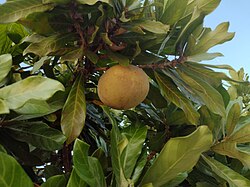
Pouteria glomerata is a species of plant in the family Sapotaceae. It is distributed from Mexico to North-East Argentina. Its greatest presence is in Brazil, where it is known as abiurana-do-igapó (wetland abiurana).1 Mature fruit has a smooth and yellow pericarp, with four ovary locules. The subspecies Pouteria glomerata subsp. stylosa is endemic to the Amazon Basin, where it is called abiurana-roxa (purple abiurana).2 The subspecies Pouteria glomerata subsp. glomerata, formerly known as Pouteria hypoglauca, is native to Central America, and an edible fruit (called cinnamon apple), grown in Florida.3
References
References
- Grandtner, MM; Chevrette, Julien (2013). Dictionary of Trees, Volume 2: South America: Nomenclature, Taxonomy and Ecology. Academic Press.
- Alves-Araújo, A. "Pouteria in Flora do Brasil 2020". Jardim Botânico do Rio de Janeiro.
- Boning, Charles R. (2021-06-01). Florida's Best Fruiting Plants: Native and Exotic Trees, Shrubs, and Vines. Rowman & Littlefield. p. 53. ISBN 978-1-68334-275-5.