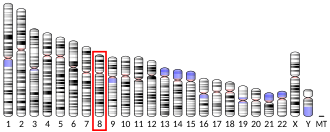
Paraneoplastic antigen Ma2 (PNMA2), also known as Ma2 or MM2, is a protein that in humans is encoded by the PNMA2 gene on chromosome 8 (8p21.2).56 The gene encodes an approximately 40 kDa onconeuronal protein predominantly expressed in neurons of the central nervous system7 and belongs to the paraneoplastic Ma antigen (PNMA) protein family.8
PNMA2 can self-assemble into virus-like particles which closely resemble the capsids of HIV-1.9 These capsids can act as an extracellular antigen and have been found to be capable of generating an autoimmune response.7 The conserved virus-like aspects of PNMA2 is shared with other retrotransposons-dertived mammalian proteins such as Arc and PEG10.
Evolution
The PNMA2 gene is located on the short arm of human chromosome 8 in a cytogenetic band.610 It comprises three exons, the third of which encodes the entire open reading frame.7 Phylogenomic analysis suggests PNMA2 was co-opted from an LTR retrotransposon of the Ty3/mdg4 family in the common ancestor of placental mammals approximately 100 mya. It appears across all major placental mammal lineages except marsupials.7 The promoter region lies 150 base pairs from the neighboring DPYSL2 gene, with which it likely shares a bidirectional promoter, this may have facilitated the gene's co-option.7
Clinical significance
Normally sequestered within the immune-privileged CNS, PNMA2 can be ectopically expressed by certain peripheral tumors, leading to release of virus-like capsids into systemic circulation, and this can trigger an autoimmune response. The resulting autoantibodies preferentially target the epitopes of the capsid and cross-react with normal PNMA2 in the brain, causing what is known as "anti-Ma2 paraneoplastic neurological syndrome" (Ma2-PNS).511
See also
See also
References
References
- GRCh38: Ensembl release 89: ENSG00000240694 – Ensembl, May 2017
- GRCm38: Ensembl release 89: ENSMUSG00000046204 – Ensembl, May 2017
- "Human PubMed Reference:". National Center for Biotechnology Information, U.S. National Library of Medicine.
- "Mouse PubMed Reference:". National Center for Biotechnology Information, U.S. National Library of Medicine.
- Voltz R, Gultekin SH, Rosenfeld MR, Gerstner E, Eichen J, Posner JB, Dalmau J (Jun 1999). "A serologic marker of paraneoplastic limbic and brain-stem encephalitis in patients with testicular cancer". N Engl J Med. 340 (23): 1788–95. doi:10.1056/NEJM199906103402303. PMID 10362822.
- "Entrez Gene: PNMA2 paraneoplastic antigen MA2".
- Xu J, Erlendsson S, Singh M, Holling GA, Regier M, Ibiricu I, Einstein J, Hantak MP, Day GS, Piquet AL, Smith TL, Clardy SL, Whiteley A, Feschotte C (Feb 2024). "PNMA2 forms immunogenic non-enveloped virus-like capsids associated with paraneoplastic neurological syndrome". Cell. 187 (4): 831–845.e19. doi:10.1016/j.cell.2024.01.009. PMC 10922747. PMID 38301645.
- Rosenfeld MR, Eichen JG, Wade DF, Posner JB, Dalmau J (Sep 2001). "Molecular and clinical diversity in paraneoplastic immunity to Ma proteins". Ann Neurol. 50 (3): 339–48. doi:10.1002/ana.1288. PMID 11558790. S2CID 24518861.
- Madigan V, Zhang Y, Raghavan R, Wilkinson ME, Faure G, Puccio E, Segel M, Lash B, Macrae RK, Zhang F (Mar 2024). "Human paraneoplastic antigen Ma2 (PNMA2) forms icosahedral capsids that can be engineered for mRNA delivery". Proc Natl Acad Sci U S A. 121 (11). doi:10.1073/pnas.2307812120. PMC 10945824. PMID 38437549.
- "OMIM Entry 603970 — Paraneoplastic Ma Antigen 2; PNMA2".
- Dalmau J, Graus F, Villarejo A, Posner JB, Blumenthal D, Thiessen B, Saiz A, Meneses P, Rosenfeld MR (Aug 2004). "Clinical analysis of anti-Ma2-associated encephalitis". Brain. 127 (Pt 8): 1831–44. doi:10.1093/brain/awh203. PMID 15215214.
Further reading
Further reading
- Hillier LD, Lennon G, Becker M, et al. (1997). "Generation and analysis of 280,000 human expressed sequence tags". Genome Res. 6 (9): 807–28. doi:10.1101/gr.6.9.807. PMID 8889549.
- Nagase T, Ishikawa K, Suyama M, et al. (1999). "Prediction of the coding sequences of unidentified human genes. XII. The complete sequences of 100 new cDNA clones from brain which code for large proteins in vitro". DNA Res. 5 (6): 355–64. doi:10.1093/dnares/5.6.355. PMID 10048485.
- Dalmau J, Gultekin SH, Voltz R, et al. (1999). "Ma1, a novel neuron- and testis-specific protein, is recognized by the serum of patients with paraneoplastic neurological disorders". Brain. 122 (1): 27–39. doi:10.1093/brain/122.1.27. PMID 10050892.
- Rosenfeld MR, Eichen JG, Wade DF, et al. (2001). "Molecular and clinical diversity in paraneoplastic immunity to Ma proteins". Ann. Neurol. 50 (3): 339–48. doi:10.1002/ana.1288. PMID 11558790. S2CID 24518861.
- Strausberg RL, Feingold EA, Grouse LH, et al. (2003). "Generation and initial analysis of more than 15,000 full-length human and mouse cDNA sequences". Proc. Natl. Acad. Sci. U.S.A. 99 (26): 16899–903. Bibcode:2002PNAS...9916899M. doi:10.1073/pnas.242603899. PMC 139241. PMID 12477932.
- Ota T, Suzuki Y, Nishikawa T, et al. (2004). "Complete sequencing and characterization of 21,243 full-length human cDNAs". Nat. Genet. 36 (1): 40–5. doi:10.1038/ng1285. PMID 14702039.
- Gerhard DS, Wagner L, Feingold EA, et al. (2004). "The status, quality, and expansion of the NIH full-length cDNA project: the Mammalian Gene Collection (MGC)". Genome Res. 14 (10B): 2121–7. doi:10.1101/gr.2596504. PMC 528928. PMID 15489334.
- Kimura K, Wakamatsu A, Suzuki Y, et al. (2006). "Diversification of transcriptional modulation: large-scale identification and characterization of putative alternative promoters of human genes". Genome Res. 16 (1): 55–65. doi:10.1101/gr.4039406. PMC 1356129. PMID 16344560.
- Ewing RM, Chu P, Elisma F, et al. (2007). "Large-scale mapping of human protein-protein interactions by mass spectrometry". Mol. Syst. Biol. 3 (1): 89. doi:10.1038/msb4100134. PMC 1847948. PMID 17353931.