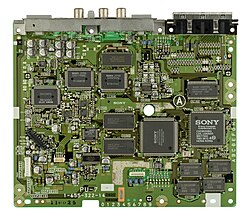


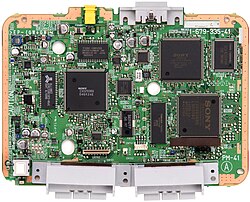
The PlayStation technical specifications describe the various components of the original PlayStation video game console.
Central processing unit (CPU)
LSI CoreWare CW33000-based core1
- MIPS R3000A-compatible 32-bit RISC CPU MIPS R3051 with 5 KB L1 cache, running at 33.8688 MHz.2
- The microprocessor was manufactured by LSI Logic Corp. with technology licensed from SGI.
- Features:
- CPU cache RAM:
- 4 KB instruction cache2
- 1 KB data cache configured as a scratchpad7
Geometry Transformation Engine (GTE)
- Coprocessor that resides inside the main CPU processor, giving it additional vector math instructions used for 3D graphics, lighting, geometry, polygon and coordinate transformations – GTE performs high-speed matrix multiplications.
- Operating performance: 66 MIPS6
- Uses fixed point arithmetic, different operations used different representations8
- Polygons per second (rendered in hardware):
- 90,000 with texture mapping, lighting and Gouraud shading
- 180,000 with texture mapping9
- 360,00010 with flat shading
Motion Decoder (MDEC)
- Also residing within the main CPU, enables full screen, high quality FMV playback and is responsible for decompressing images and video into VRAM.5
- Operating performance: 80 MIPS11
- Documented device mode is to read three RLE-encoded 16×16 macroblocks, run IDCT and assemble a single 16×16 RGB macroblock.
- Output data may be transferred directly to GPU via DMA.
- It is possible to overwrite IDCT matrix and some additional parameters, however MDEC internal instruction set was never documented.
- It is directly connected to a CPU bus.
System Control Coprocessor (Cop0)
- This unit is part of the CPU. Has 16 32-bit control registers.
- Modified from the original R3000A cop0 architecture, with the addition of a few registers and functions.
- Controls memory management through virtual memory technique, system interrupts, exception handling, and breakpoints.
Memory
- 2 MiB main EDO DRAM5
- Additional RAM is integrated with the GPU (including a 1 MB framebuffer) and SPU (512 KB), see below for details.
- Cache RAM for CPU core and CD-ROM. See the relevant sections for details.
- Flash RAM support through the use of memory cards, see below.
- BIOS stored on 512 KB ROM
Graphics processing unit (GPU)
32-bit Sony GPU (designed by Toshiba)12
- Handles display of graphics, control of framebuffer, and drawing of polygons and textures
- Handles 2D graphics processing, in a similar manner to the 3D engine
- RAM:
- 1 MB VRAM5 (later models contained SGRAM) for framebuffer
- 2 KB texture cache (132 MB/s memory bus bandwidth, 32-bit wide)
- 64 bytes FIFO buffer
- Features:
- Adjustable framebuffer (1024×512)
- Emulation of simultaneous backgrounds (to simulate parallax scrolling)
- Mask bit
- Texture window
- Dithering
- Clipping
- Alpha blending (4 per-texel alpha blending modes)
- Fog
- Framebuffer effects
- Transparency effects
- Render to texture
- Offscreen rendering
- Multipass rendering
- Flat or Gouraud shading and texture mapping2
- No line restriction
- Colored light sourcing
- Resolutions:
- Progressive: 256×224 to 640×240 pixels2
- Interlaced: 256×448 to 640×512 pixels
- Acceptable video modes: 15kHz, 24kHz, 31kHz
- Colors:
- Maximum color depth of 16,777,216 colors (24-bit true color)
- 57,344 (256×224) to 153,600 (640×240) colors on screen
- Unlimited color lookup tables (CLUTs)
- 32 levels of transparency
- All calculations are performed to 24 bit accuracy
- Texture mapping color mode:11
- Mode 4: 4-bit CLUT (16 colors)
- Mode 8: 8-bit CLUT (256 colors)
- Mode 15: 15-bit direct (32,768 colors)
- Mode 24: 24-bit (16,777,216 colors)
- Sprite engine
- 1024×512 framebuffer, 8×8 and 16×16 sprite sizes, bitmap objects
- Up to 4,000 sprites on screen (at 8×8 sprite size), scaling and rotation213
- 256×256 maximum sprite size11
- Special sprite effects:11
- Rotation
- Scaling up/down
- Warping
- Transparency
- Fading
- Priority
- Vertical and horizontal line scroll
- Pixel fillrate (theoretical maximum):14
- 66 MPixel/s flat shaded polygons
- 33 MPixel/s Gouraud shaded polygons
- 33 MPixel/s for textured polygons with optional Gourard shading
- Actual fill rate is lower due to polygon overhead or texture cache misses
Sound processing unit (SPU)
- Supports ADPCM sources with up to 24 channels5
- Sampling rate of up to 44.1 kHz5
- 512 KB RAM5
- PCM audio source11
- Supports MIDI sequencing11
- Digital effects include:
I/O system and connectivity
- 660 MB maximum storage capacity, double speed (CLV) CD-ROM drive
- 2×, with a maximum data throughput of 300 KB/s (double speed), 150 KB/s (normal)11
- 32 KB data buffer15
- XA Mode 2 compliant
- Audio CD play11
- CD-DA (CD-Digital Audio)
- Rated for 70,000 seek operations16
Two control pads via connectors11
- Expandable with multitap connector11
Backup flash RAM support
- Two removable cards11
- Each card has 128 KB flash memory
- OS support for File Save, Retrieve and Remove11
- Some games (like "Music 2000") can use Memory Cards as main RAM, to store data for real time processing, bypassing the 2MB RAM limit.
Video and audio connectivity
- AV Multi Out (Composite video, S-Video, RGBS)
- RCA Composite video and Stereo out (SCPH-100x to 5000 only)
- RFU (SCPH-112X) DC out (SCPH-100x to 5000 only)
- S-Video out (SCPH-1000 only)
Serial and parallel ports
- Serial I/O (used for PlayStation Link Cable SCPH-100x to 900x only)
- Parallel I/O (N/A) SCPH-100x to 750x only)
Power input
- 100 V AC (NTSC-J); 120 V AC (NTSC-U/C); or 220–240 V AC (PAL)
- 7.5 V DC 2 A (PSone only)
See also
See also
References
References
- "FastForward Sony Taps LSI Logic for PlayStation Video Game CPU Chip". Archived from the original on 2019-07-23. Retrieved 2016-10-05.
- "Sony's PlayStation Debuts in Japan!". Electronic Gaming Monthly. No. 65. Sendai Publishing. December 1994. p. 70.
- "FastForward Sony Taps LSI Logic for PlayStation Video Game CPU Chip". FastForward. Archived from the original on 23 July 2019. Retrieved 29 January 2014.
- "LSI Builds Custom CPU for Sony PlayStation" (PDF). Microprocessor Report. Vol. 8, no. 9. MicroDesign Resources. July 11, 1994. Archived (PDF) from the original on September 17, 2024. Retrieved September 17, 2024.
- "Inside the PlayStation". Next Generation. No. 6. Imagine Media. June 1995. p. 51.
- "Tech Specs: Sony PlayStation". Next Generation. No. 12. Imagine Media. December 1995. p. 40.
- Net Yaroze User Guide. Sony Computer Entertainment Inc. February 1997. p. 14.
- PlayStation Developer Seminar / Fall ‘96 / GTE & Advanced Graphics
- Karl Hodge. "Hall of Fame: Sony PlayStation, the games console that changed everything".
- "Sony PlayStation". GamePro. No. 72. IDG. September 1994. p. 20.
- "Sony PlayStation". Next Generation. No. 24. Imagine Media. December 1996. p. 50.
- "Is it Time to Rename the GPU? | IEEE Computer Society". Archived from the original on 2023-10-12. Retrieved 2019-07-18.
- "NEXT Generation Issue #1 January 1995". January 1995.
- "GPU Rendering Timings - PlayStation Development Network". www.psxdev.net. Retrieved 2025-01-10.
- "Nocash PSXSPX Playstation Specifications - CDROM - Response/Data Queueing". Archived from the original on 2015-10-22. Retrieved 2023-05-21.
- "Making Crash Bandicoot – part 5". 6 February 2011. Archived from the original on 13 March 2011. Retrieved 29 May 2019.