| PlayCanvas | |
|---|---|
 | |
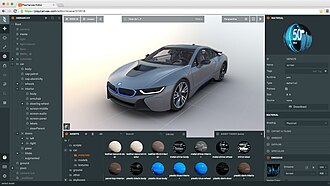 The PlayCanvas web-based Editor and example of a 3d application in-development | |
| Developers | Will Eastcott, Dave Evans, Vaios Kalpias Ilias, Kevin Rooney, Maksims Mihejevs |
| Written in | JavaScript |
| Operating system | OS independent |
| Platform | Cross-platform |
| Type | HTML5 3D engine |
| License | MIT License |
| Website | playcanvas |
| Repository | github |
| As of | July 2014 |
PlayCanvas is an open-source1 3D game engine/interactive 3D application engine alongside a proprietary cloud-hosted creation platform that allows for simultaneous editing from multiple computers via a browser-based interface.2 It runs in modern browsers that support WebGL, including Mozilla Firefox and Google Chrome. The engine is capable of rigid-body physics simulation, handling three-dimensional audio and 3D animations.
PlayCanvas has gained the support of ARM, Activision and Mozilla.3
The PlayCanvas engine was open-sourced on June 4, 2014.45
In April 2019, BusinessInsider.com reported that the company was acquired by Snap Inc. in 2017.6
Features
The PlayCanvas platform has collaborative real-time Editor that allows editing a project by multiple developers simultaneously.7 The engine supports the WebGL 1.0 and 2.0 standard to produce GPU accelerated 3D graphics and allows for scripting via the JavaScript programming language.8 Projects can be distributed via a URL web link or packaged in native wrappers, p.g. for Android, using CocoonJS91011 or for Steam using Electron, and many other options and platforms.
Notable PlayCanvas applications
Various companies12 use PlayCanvas in projects of different disciplines of interactive 3D content in the web.
Disney created an educational game13 for Hour of Code based on its Moana film.
King published Shuffle Cats Mini,14 as a launch title for Facebook Instant Games.
TANX15 – massively multiplayer online game of cartoon styled tanks.
Miniclip published number of games1617 on their platform with increase of HTML5 games popularity on the web.
Mozilla collaborated18 with PlayCanvas team creating After the Flood19 demo for presenting cutting-edge features of WebGL 2.0.
References
References
- "PlayCanvas goes open source". hacks.mozilla.org. June 4, 2014. Retrieved August 30, 2014.
- "GDC 2014: Mozilla and partners prove Web is the platform for gaming". blog.mozilla.org. March 18, 2014. Retrieved August 30, 2014.
- "Techstars London: Top Picks". techcrunch.com. September 27, 2013. Retrieved August 30, 2014.
- "PlayCanvas 3D WebGL Game Engine Now Open Source". gamingonlinux.com. June 4, 2014. Retrieved September 17, 2014.
- "PlayCanvas takes its WebGL video game engine open source". thenextweb.com. June 4, 2014. Retrieved September 17, 2014.
- Ghosh, Shona. "This tech CEO secretly sold his startup to Snap and spent 2 years building a product that could transform the firm's fortunes". Business Insider. Retrieved 2019-05-01.
- "PlayCanvas Video Game Making".
- "PlayCanvas Browser-Based Game Engine". phoronix.com. June 4, 2014. Retrieved August 30, 2014.
- "Ludei CocoonJS". Archived from the original on 2014-09-03. Retrieved 2014-07-14.
- "Ludei CocconJS Tech Partners - Engines". ludei.com. Archived from the original on July 2, 2014. Retrieved September 17, 2014.
- "PlayCanvas App On Mobile Using CocoonJS". magicsheepgames.co.uk. October 9, 2013. Archived from the original on September 17, 2014. Retrieved September 17, 2014.
- "Github PlayCanvas Users List". GitHub.
- "Disney - Hour of Code - Moana (educational game)". Archived from the original on 2017-04-05. Retrieved 2017-04-04.
- "Facebook - Shuffle Cats Mini (game)". Facebook.
- "TANX (game)".
- "Miniclip - Virtual Voodoo (game)".
- "Miniclip - Flappy Bird (game)".
- "Mozilla launching WebGL 2.0 support in Firefox".
- "After the Flood (webgl 2.0 demo)".