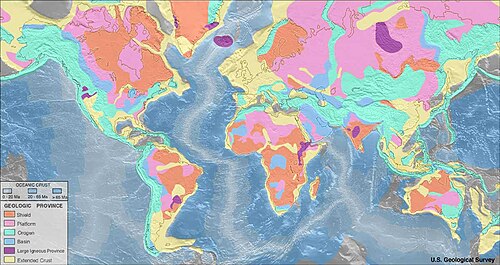
| Oceanic crust: 0–20 Ma 20–65 Ma >65 Ma |
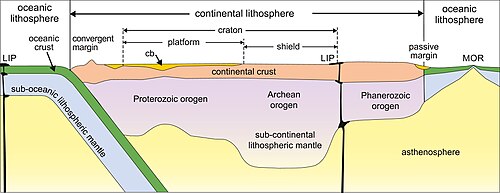
In geology, platform is a craton covered with sediments. It can be classified into the following groups: a "protoplatform" of metamorphosed sediments at the bottom, a "quasiplatform" of slightly deformed sediments, a "cataplatform", and an "orthoplatform" at the top. The Mesoproterozoic Jotnian sediments of the Baltic area are examples of a "quasiplatform".1 The post-Ordovician rocks of the South American Platform are examples of an orthoplatform.2
References
References
- Nagornji, M.A.; Nikolaev, V.G. (2005). "The quasiplatform sediments of the East European Platform". Russian Journal of Earth Sciences. 7 (5): 1–12. Bibcode:2005RuJES...700171N. doi:10.2205/2005ES000171.
- de Almeida, F. F. M.; et al. (1976). "The Upper Precambrian of South America". Boletim IG-USP. 7. Archived from the original on 2015-10-01. Retrieved 2015-09-29.