| Platanus dissecta Temporal range:
| |
|---|---|
| |
Scientific classification 
| |
| Kingdom: | Plantae |
| Clade: | Embryophytes |
| Clade: | Tracheophytes |
| Clade: | Spermatophytes |
| Clade: | Angiosperms |
| Clade: | Eudicots |
| Order: | Proteales |
| Family: | Platanaceae |
| Genus: | Platanus |
| Species: | †P. dissecta
|
| Binomial name | |
| †Platanus dissecta | |
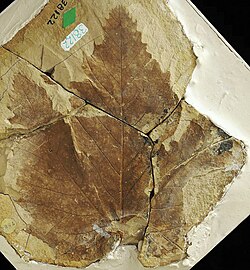
Platanus dissecta is an extinct species of plane tree in the family Platanaceae.1 It is known from fossil leaves dating to the Miocene of western North America.1 The species was first described by Leo Lesquereux and was reexamined in 2019 to clarify its morphology and systematic affinities.1
Background
Platanus dissecta lived during the Miocene epoch, approximately 23 to 5 million years ago.1 It belongs to the plane tree genus Platanus, which today includes the American sycamore and the Oriental plane.1
Morphology
The fossil leaves of P. dissecta are deeply dissected into lobes, with venation patterns that distinguish the species from other fossil and living Platanus taxa.1 These features suggest adaptation to the temperate environments of the Miocene.1
Systematic affinities
Platanus dissecta is placed in the family Platanaceae and shows close affinities with North American species of Platanus.1 The 2019 reanalysis suggested that it may share ancestry with the lineage leading to modern Platanus occidentalis.1
References
References
- Manchester, Steven R.; Dilcher, David L. (2019). "Morphology and Systematic Affinities of Platanus dissecta Lesquereux (Platanaceae) from the Miocene of Western North America". International Journal of Plant Sciences. 180 (9): 901–914. doi:10.1086/706453.