| Placentonema gigantissima | |
|---|---|
| |
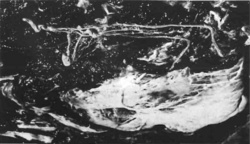
| Placentonema gigantissima in the placenta of a sperm whale (Physeter macrocephalus) | |
Scientific classification 
| |
| Kingdom: | Animalia |
| Phylum: | Nematoda |
| Class: | Chromadorea |
| Order: | Rhabditida |
| Family: | Tetrameridae |
| Genus: | Placentonema |
| Species: | P. gigantissima
|
| Binomial name | |
| Placentonema gigantissima (Gubanov, 1951)
| |
Placentonema gigantissima is a giant nematode that parasitizes the placenta and other tissues of the sperm whale. With a length of 8.4 metres (28 ft) and a diameter of 2.5 centimetres (0.98 in), it is potentially the largest nematode worm ever described, inhabiting one of the largest mammals in the world.1 It was discovered in the 1950s around the Kuril Islands.2
Taxonomy
Placentonema gigantissima was described in 1951 by Russian parasitologist and helminthologist Nikolai Mikhailovich Gubanov.2
Originally described from the family Crassicaudidae,2 it is now classified in the subfamily Crassicaudinae of the roundworm family Tetrameridae.
It is a monotypic genus that differs from the only other genus in the subfamily, Crassicauda, by its "caudal alae, stub-like papillae and multiple uterus branching into 32 uteri".2
Description
The body is very long, cylindrical, tapering at the ends, with a transparent cuticle.2 The oral orifice is oval shaped with two simple lateral lips, while the esophagus is divided into two parts, one muscular and glandular.2
Males are up to 3.75 m long and 9 mm wide; females up to 8.4 m long and 2.5 cm wide, with up to 32 ovaries.21 Mature eggs are oval, 0.05 mm long by 0.03 mm wide, and the young inside the eggs are completely formed.2
Life cycle
Placentonema gigantissima utilizes nutrients found in the endometrium of female sperm whales. It forms spiriud (small, embryonated) eggs.3
It can parasitize not only the placenta, but also the uterus, reproductive tract, mammary glands, and subdermis of the sperm whale.4 It is commonly found in pregnant sperm whales.5
Much of the life cycle of P. gigantissima is unknown.5
Distribution
This species is found inside female sperm whales that inhabit lower latitudes of the southern hemisphere.6
External links
External links
Placentonema gigantissima was discussed on RNZ Critter of the Week, 24 November 2023
References
References
- Jairajpuri, Shamim (2005-01-01). "Parasite diversity with specific reference to nematodes". Journal of Parasitic Diseases. 29 (2): 81–84.
- Gubanov, Nikolai Mikhailovich (21 April 1951). "Гигантская нематода из плаценты китообразных Placentonema gigantissima nov. gen., nov. sp" [Giant nematoda from the placenta of Cetacea; Placentonema gigantissima nov. gen., nov. sp] (PDF). Doklady Akademii Nauk SSSR (in Russian). 77 (6): 1123–1125. PMID 14822893. Archived from the original (PDF) on 15 December 2013.
- Juan-Sallés, Carles; Garner, Michael M. (2019). "67 - Avian Spirurids". Fowler's Zoo and Wild Animal Medicine Current Therapy. 9: 471. doi:10.1016/B978-0-323-55228-8.00067-9. ISBN 9780323552288. S2CID 239100923.
- Hermosilla, Carlos; Hirzmann, J.; Silva, L. M. R.; Brotons, J. M.; Cerdà, M.; Prenger-Berninghoff, E.; Ewers, C.; Taubert, A. (2018). "Occurrence of anthropozoonotic parasitic infections and faecal microbes in free-ranging sperm whales (Physeter macrocephalus) from the Mediterranean Sea". Parasitology Research. 117 (8): 2531–2541. doi:10.1007/s00436-018-5942-3. ISSN 0932-0113. PMID 29858939.
- Dailey, Murray D. (1985-01-01), "Diseases of Mammalia: Cetacea", Diseases of Marine Animals. Vol. 4 part 2, ed. Otto Kinne, pp. 805–848, retrieved 2024-01-09
- Dailey, Murray D.; Vogelbein, Wolfgang K. (1991-01-01). "Parasite fauna of 3 species of Antarctic whales with reference to their use as potential stock indicators". Fishery Bulletin. 89 (3): 355–365.