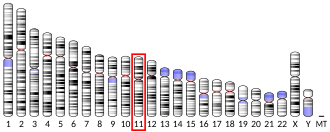
Membrane-associated phosphatidylinositol transfer protein 1 is a protein that in humans is encoded by the PITPNM1 gene.45
Function
PITPNM1 belongs to a family of proteins that share homology with the Drosophila retinal degeneration B (rdgB) protein.[supplied by OMIM]5
Interactions
PITPNM1 has been shown to interact with PTK2B.6
References
References
- GRCh38: Ensembl release 89: ENSG00000110697 – Ensembl, May 2017
- "Human PubMed Reference:". National Center for Biotechnology Information, U.S. National Library of Medicine.
- "Mouse PubMed Reference:". National Center for Biotechnology Information, U.S. National Library of Medicine.
- Rubboli F, Bulfone A, Bogni S, Marchitiello A, Zollo M, Borsani G, Ballabio A, Banfi S (1997). "A mammalian homologue of the Drosophila retinal degeneration B gene: implications for the evolution of phototransduction mechanisms". Genes Funct. 1 (3): 205–13. doi:10.1046/j.1365-4624.1997.00015.x. PMID 9680295.
- "Entrez Gene: PITPNM1 phosphatidylinositol transfer protein, membrane-associated 1".
- Lev S, Hernandez J, Martinez R, Chen A, Plowman G, Schlessinger J (Mar 1999). "Identification of a novel family of targets of PYK2 related to Drosophila retinal degeneration B (rdgB) protein". Mol. Cell. Biol. 19 (3) (published March 1999): 2278–88. doi:10.1128/mcb.19.3.2278. ISSN 0270-7306. PMC 84020. PMID 10022914. Wikidata Q22008764.
Further reading
Further reading
- Vihtelic TS, Hyde DR, O'Tousa JE (1991). "Isolation and characterization of the Drosophila retinal degeneration B (rdgB) gene". Genetics. 127 (4): 761–8. doi:10.1093/genetics/127.4.761. PMC 1204403. PMID 1903119.
- Aikawa Y, Hara H, Watanabe T (1997). "Molecular cloning and characterization of mammalian homologues of the Drosophila retinal degeneration B gene". Biochem. Biophys. Res. Commun. 236 (3): 559–64. doi:10.1006/bbrc.1997.7009. PMID 9245688.
- Tian D, Litvak V, Toledo-Rodriguez M, Carmon S, Lev S (2002). "Nir2, a novel regulator of cell morphogenesis". Mol. Cell. Biol. 22 (8): 2650–62. doi:10.1128/MCB.22.8.2650-2662.2002. PMC 133726. PMID 11909959.
- Litvak V, Tian D, Carmon S, Lev S (2002). "Nir2, a human homolog of Drosophila melanogaster retinal degeneration B protein, is essential for cytokinesis". Mol. Cell. Biol. 22 (14): 5064–75. doi:10.1128/MCB.22.14.5064-5075.2002. PMC 139767. PMID 12077336.
- Litvak V, Shaul YD, Shulewitz M, Amarilio R, Carmon S, Lev S (2002). "Targeting of Nir2 to lipid droplets is regulated by a specific threonine residue within its PI-transfer domain". Curr. Biol. 12 (17): 1513–8. Bibcode:2002CBio...12.1513L. doi:10.1016/S0960-9822(02)01107-7. PMID 12225667. S2CID 5639384.
- Litvak V, Argov R, Dahan N, Ramachandran S, Amarilio R, Shainskaya A, Lev S (2004). "Mitotic phosphorylation of the peripheral Golgi protein Nir2 by Cdk1 provides a docking mechanism for Plk1 and affects cytokinesis completion". Mol. Cell. 14 (3): 319–30. doi:10.1016/S1097-2765(04)00214-X. PMID 15125835.
- Beausoleil SA, Jedrychowski M, Schwartz D, Elias JE, Villén J, Li J, Cohn MA, Cantley LC, Gygi SP (2004). "Large-scale characterization of HeLa cell nuclear phosphoproteins". Proc. Natl. Acad. Sci. U.S.A. 101 (33): 12130–5. Bibcode:2004PNAS..10112130B. doi:10.1073/pnas.0404720101. PMC 514446. PMID 15302935.
- Amarilio R, Ramachandran S, Sabanay H, Lev S (2005). "Differential regulation of endoplasmic reticulum structure through VAP-Nir protein interaction". J. Biol. Chem. 280 (7): 5934–44. doi:10.1074/jbc.M409566200. PMID 15545272.
- Ocaka L, Spalluto C, Wilson DI, Hunt DM, Halford S (2005). "Chromosomal localization, genomic organization and evolution of the genes encoding human phosphatidylinositol transfer protein membrane-associated (PITPNM) 1, 2 and 3". Cytogenet. Genome Res. 108 (4): 293–302. doi:10.1159/000081519. PMID 15627748. S2CID 20792950.
- Litvak V, Dahan N, Ramachandran S, Sabanay H, Lev S (2005). "Maintenance of the diacylglycerol level in the Golgi apparatus by the Nir2 protein is critical for Golgi secretory function". Nat. Cell Biol. 7 (3): 225–34. doi:10.1038/ncb1221. PMID 15723057. S2CID 5881790.
- Rual JF, Venkatesan K, Hao T, Hirozane-Kishikawa T, Dricot A, Li N, Berriz GF, Gibbons FD, Dreze M, Ayivi-Guedehoussou N, Klitgord N, Simon C, Boxem M, Milstein S, Rosenberg J, Goldberg DS, Zhang LV, Wong SL, Franklin G, Li S, Albala JS, Lim J, Fraughton C, Llamosas E, Cevik S, Bex C, Lamesch P, Sikorski RS, Vandenhaute J, Zoghbi HY, Smolyar A, Bosak S, Sequerra R, Doucette-Stamm L, Cusick ME, Hill DE, Roth FP, Vidal M (2005). "Towards a proteome-scale map of the human protein-protein interaction network". Nature. 437 (7062): 1173–8. Bibcode:2005Natur.437.1173R. doi:10.1038/nature04209. PMID 16189514. S2CID 4427026.
- Olsen JV, Blagoev B, Gnad F, Macek B, Kumar C, Mortensen P, Mann M (2006). "Global, in vivo, and site-specific phosphorylation dynamics in signaling networks". Cell. 127 (3): 635–48. doi:10.1016/j.cell.2006.09.026. PMID 17081983. S2CID 7827573.
- Burgis NE, Cunningham RP (2007). "Substrate specificity of RdgB protein, a deoxyribonucleoside triphosphate pyrophosphohydrolase". J. Biol. Chem. 282 (6): 3531–8. doi:10.1074/jbc.M608708200. PMID 17090528.