| Pisces Dwarf | |
|---|---|
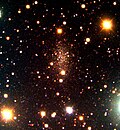
 Hubble Space Telescope image of the Pisces Dwarf | |
| Observation data (J2000 epoch) | |
| Constellation | Pisces |
| Right ascension | 01h 03m 55.0s1 |
| Declination | +21° 53′ 06″1 |
| Redshift | -287 ± 0 km/s1 |
| Distance | 2.51 ± 0.08 Mly (769 ± 25 kpc)2 |
| Apparent magnitude (V) | 14.21 |
| Characteristics | |
| Type | dIrr/dSph1 |
| Apparent size (V) | 2′ × 2′1 |
| Other designations | |
| Pisces I, Psc I, LGS 3,1 PGC 3792,1 LEDA 3792 | |
The Pisces Dwarf, also known as Pisces I (Psc I) or LGS3,1 is an irregular dwarf galaxy and suspected satellite galaxy of the Triangulum Galaxy (M33), located within the Pisces constellation.23 Discovered by astronomer Valentina Karachentseva in 1976,3 it is approaching the Milky Way at 287 km/s, evident by its blueshift, and may be a galaxy currently transitioning between a dwarf spheroidal and dwarf irregular galaxy;4 alternatively, it may be a rare unique version of one of the two types.2
Structure
The Pisces Dwarf has a very irregular shape, and is composed primarily of moderately aged and young stars, as given by its metallicity of [Fe/H]=−2.10 ± 0.22.2 Its star formation has declined, with its peak starburst period suspected to be an estimated 8 billion years ago,5 and a significant lack of new star formation within the past 100 million years.26 It is suspected to be a potential transition galaxy, currently transitioning from a dwarf irregular to a dwarf spheroidal galaxy.367
Gallery
-
-
 Cropped Hubble image of part of Pisces I
References
References
- "NASA/IPAC Extragalactic Database". Results for Pisces Dwarf. Retrieved 2007-03-15.
- McConnachie, A. W.; Irwin, M. J.; Ferguson, A. M. N.; Ibata, R. A.; Lewis, G. F.; Tanvir, N. (2005). "Distances and metallicities for 17 Local Group galaxies". Monthly Notices of the Royal Astronomical Society. 356 (4): 979–997. arXiv:astro-ph/0410489. Bibcode:2005MNRAS.356..979M. doi:10.1111/j.1365-2966.2004.08514.x.
- "Dwarf Galaxies in Pisces - NASA Science". 2016-08-11. Retrieved 2026-04-21.
- Garofalo, Alessia; Tantalo, Maria; Cusano, Felice; Clementini, Gisella; Calura, Francesco; Muraveva, Tatiana; Paris, Diego; Speziali, Roberto (2021-07-01). "Born in a Pair (?): Pisces II and Pegasus III*". The Astrophysical Journal. 916 (1): 10. arXiv:2105.11488. Bibcode:2021ApJ...916...10G. doi:10.3847/1538-4357/ac0253. ISSN 0004-637X.
- Karachentseva, V. E. (1976). "Some characteristics of isolated pairs composed of a normal galaxy and DDO-dwarf". Soobshch. Spets. Astrofiz. Obs. 18 (18): 42–51. Bibcode:1976SoSAO..18...42K.
- Miller, B. W., Dolphin, A. E., Lee, M. G., Kim, S. C., Hodge, P. (2001). "The Star Formation History of LGS3". The Astrophysical Journal. 562 (2): 713–726. arXiv:astro-ph/0108408. Bibcode:2001ApJ...562..713M. doi:10.1086/323853. S2CID 119089499.
{{cite journal}}: CS1 maint: multiple names: authors list (link) - Hidalgo, Sebastian L.; Aparicio, Antonio; Skillman, Evan; Monelli, Matteo; Gallart, Carme; Cole, Andrew; Dolphin, Andrew; Weisz, Daniel; Bernard, Edouard J.; Cassisi, Santi; Mayer, Lucio; Stetson, Peter; Tolstoy, Eline; Ferguson, Henry (2011). "The Acs Lcid Project. V. The Star Formation History of the Dwarf Galaxy Lgs-3: Clues to Cosmic Reionization and Feedback". The Astrophysical Journal. 730 (1): 14. arXiv:1101.5762. Bibcode:2011ApJ...730...14H. doi:10.1088/0004-637X/730/1/14. S2CID 118411768.