 | |
 | |
| Names | |
|---|---|
| Preferred IUPAC name
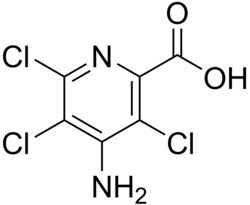
4-Amino-3,5,6-trichloropyridine-2-carboxylic acid | |
| Other names
Picloram
Tordon Grazon | |
| Identifiers | |
3D model (JSmol)
|
|
| Abbreviations | ATCP |
| ChEBI | |
| ChEMBL | |
| ChemSpider |
|
| ECHA InfoCard | 100.016.034 |
| KEGG |
|
PubChem CID
|
|
| UNII | |
CompTox Dashboard (EPA)
|
|
| |
| |
| Properties | |
| C6H3Cl3N2O2 | |
| Molar mass | 241.45 g·mol−1 |
| Appearance | colorless to white crystalline solid1 |
| Odor | chlorine-like1 |
| Melting point | 218.5 °C (425.3 °F; 491.6 K) decomposes |
| 0.04% (20°C)1 430 mg/L at 25 deg C2 | |
| Vapor pressure | 0.0000006 mmHg (35°C)1 |
| Hazards | |
| NIOSH (US health exposure limits): | |
PEL (Permissible)
|
TWA 15 mg/m3 (total) TWA 5 mg/m3 (resp)1 |
REL (Recommended)
|
none established1 |
IDLH (Immediate danger)
|
N.D.1 |
Except where otherwise noted, data are given for materials in their standard state (at 25 °C [77 °F], 100 kPa).
| |


Picloram is a systemic herbicide used for general woody plant control. It also controls a wide range of broad-leaved weeds, but most grasses are resistant.3 A chlorinated derivative of picolinic acid, picloram is in the pyridine family of herbicides.
Picloram can be sprayed on foliage, injected into plants, applied to cut surfaces, or placed at the base of the plant where it will leach to the roots. Once absorbed by the foliage, stem, or roots, picloram is transported throughout the plant.
Herbicides containing picloram are sold under a variety of brand names. Dow Chemicals and now Dow AgroSciences sell herbicides containing it under the brand name Tordon.4
During the Vietnam War, picloram and other herbicides were combined to make Agent White (commercially available as Tordon 101) and enhanced Agent Orange, which was previously used by the British military during the Malayan Emergency. Large quantities of these herbicides were sprayed by U.S. forces in areas where they considered its long-term persistence desirable, such as inland forests.5 In 1974, 413,000 pounds (187 t) of picloram were used in the U.S., mainly by government and industry.6
Safety
Picloram is of moderate toxicity to the eyes and only mildly toxic on the skin.3 No history of human intoxication by picloram has been documented, so symptoms of acute exposure are difficult to characterize.
Picloram is the most persistent of its family of herbicides.7 It does not adhere to soil, so it may leach into groundwater, and has in fact been detected there. It is degraded in soil and water mainly by microbes. Picloram has very little tendency to accumulate in aquatic life.
Gardeners who use dung as fertilizer should check to make certain that the animal source has not grazed on picloram-treated hay, as the dung still has broadleaf-killing potency.8
In regards to occupational exposures, the U.S. Occupational Safety and Health Administration has established a permissible exposure limit of 15 mg/m3 total exposure and 5 mg/m3 for respiratory exposure, over an eight-hour workshift.9
Carcinogenicity
A 2026 study in Nature Medicine reported an association between picloram exposure signatures and the alarming rise in early-onset colorectal cancer. The researchers used DNA methylation scores as indirect markers of previous exposure to lifestyle and environmental factors, including pesticides. A higher picloram-related methylation score was associated with colorectal cancer diagnosed before age 50, compared with colorectal cancer diagnosed at age 70 or older. This association was replicated in a meta-analysis of nine colorectal cancer cohorts.10
The same study also compared estimated pesticide use with cancer incidence in 94 United States counties over 21 years. Picloram use remained associated with early-onset colorectal cancer incidence after adjustment for socioeconomic factors and other pesticide use. The authors noted that picloram was first registered as a herbicide in the United States in 1964, so people who could have been exposed to it from childhood would often still be younger than 70 in 2026. They suggested that this could partly explain why the association was mainly seen for early-onset disease. The study found an association, but did not perform research to (dis)prove that picloram causes colorectal cancer. Therefore, the authors stated that further longitudinal and experimental research is needed to test causality, dose dependence and latency.10
References
References
- NIOSH Pocket Guide to Chemical Hazards. "#0514". National Institute for Occupational Safety and Health (NIOSH).
- "Picloram".
- Picloram Pesticide Information Profile, Pesticide Management Education Program, Cornell University.
- Stanley A. Greene (2005). Sittig's Handbook of Pesticides and Agricultural Chemicals. William Andrew. p. 717. ISBN 978-0-8155-1903-4.
- Committee to Review the Health Effects in Vietnam Veterans of Exposure to Herbicides; Institute of Medicine (1994). Veterans and Agent Orange: Health Effects of Herbicides Used in Vietnam. National Academies Press. pp. 89–90. ISBN 978-0-309-55619-4.
- "Pesticide Usage Survey of Agricultural, Governmental, and Industrial Sectors in the United States, 1974". epa.gov. EPA. 1977.
- Consumer Factsheet on: PICLORAM, U.S. Environmental Protection Agency
- Use Caution When Harvesting and Feeding Ditch Hay Archived 2010-06-14 at the Wayback Machine, U. Minnesota Extension
- NIOSH Pocket Guide to Chemical Hazards, Centers for Disease Control and Prevention
- Maas, Silvana C. E.; Baraibar, Iosune; Lemler, Lea; Butjosa-Espín, Maria; Blanco Irazuegui, Odei; Tabernero, Josep; Elez, Elena; Seoane, Jose A. (2026). "Epigenetic fingerprints link early-onset colon and rectal cancer to pesticide exposure". Nature Medicine. doi:10.1038/s41591-026-04342-5.