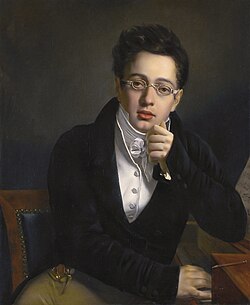
The Piano Sonata in E minor D 566 by Franz Schubert is a sonata for solo piano written in June 1817. The original manuscript appeared to lack a finale.1 Ludwig Scheibler (1848–1921) was the first to suggest in 1905 that the Rondo in E, D.506 might be that movement.2 The British composer and musicologist Kathleen Dale produced the first edition using this suggestion in 1948.3 The 1976 Henle edition by Paul Badura-Skoda followed the same practice.4
The work takes approximately 20 minutes to perform or 25–30 minutes with the rondo finale.
Movements
I. Moderato
- E minor
II. Allegretto
- E major
III. Scherzo: Allegro vivace – Trio
- A♭ major
(IV. Rondo: Allegretto, D 506)
- E major
- D 506 has been associated with the last piece of Fünf Klavierstücke (D 459A/3) and the Adagio D 349 too as a set of movements that might form a sonata.5
References
References
- Tirimo, Martino. Schubert: The Complete Piano Sonatas. Vienna: Wiener Urtext Edition, 1997.
- Maurice J. E. Brown. 'Recent Schubert Discoveries', in Music & Letters. Vol. 32, No. 4 (October 1951), pp. 349-361
- Schubert, Sonata in E Minor, British & Continental Music Agencies Edition No. 60 (1948)
- 'Klaviersonaten, Bd. III by Franz Schubert', reviewed by Howard Ferguson in Music & Letters Vol. 58, No. 4 (October 1977), p. 495
- F. Bisogni, quoted in Walburga Litschauer's Preface to Schubert: Piano Sonatas I. Bärenreiter 2000
External links
External links
- Piano Sonata D.566: Scores at the International Music Score Library Project
- Rondo in E major: Scores at the International Music Score Library Project