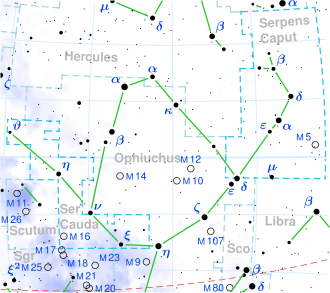
  | |
| Observation data Epoch J2000.0 Equinox J2000.0 (ICRS) | |
|---|---|
| Constellation | Serpens1 |
| Right ascension | 16h 02m 17.69166s2 |
| Declination | +22° 48′ 16.0302″2 |
| Apparent magnitude (V) | 4.823 |
| Characteristics | |
| Evolutionary stage | main sequence4 |
| Spectral type | A3 V5 |
| U−B color index | +0.103 |
| B−V color index | +0.063 |
| Astrometry | |
| Radial velocity (Rv) | −28.2±4.26 km/s |
| Proper motion (μ) | RA: +4.032 mas/yr Dec.: +23.602 mas/yr |
| Parallax (π) | 18.22±0.26 mas2 |
| Distance | 179 ± 3 ly (54.9 ± 0.8 pc) |
| Absolute magnitude (MV) | +1.121 |
| Details | |
| Mass | 2.507 M☉ |
| Radius | 2.278 R☉ |
| Luminosity | 279 L☉ |
| Surface gravity (log g) | 4.04010 cgs |
| Temperature | 7,566±1211 K |
| Metallicity [Fe/H] | 0.38010 dex |
| Rotational velocity (v sin i) | 12812 km/s |
| Age | 3207 Myr |
| Other designations | |
| π Ser, 44 Serpentis, BD+23°2886, FK5 3268, HD 143894, HIP 78554, HR 5972, SAO 8415513 | |
| Database references | |
| SIMBAD | data |
Pi Serpentis, Latinized from π Serpentis, is a solitary14 white-hued star in the constellation Serpens, located in its head, Serpens Caput. Based upon an annual parallax shift of 18.22 mas as seen from Earth, it is located around 179 light years from the Sun. It is visible to the naked eye with an apparent visual magnitude of 4.82.3
This is an A-type main sequence star with a stellar classification of A3 V.5 It is about 3207 million years old with a high rate of spin, measured at a 12812 km/s projected rotational velocity. The star has an estimated 2.507 times the mass of the Sun and 2.278 times the Sun's radius. It is radiating 279 times the solar luminosity from its photosphere at an effective temperature of 7,566 K.11
In 1992, an infrared excess was detected from this system at a wavelength of 60μm.15 The data suggests a dusty debris disk with a temperature of 45 K is orbiting 211 AU from the host star.8
References
References
- Anderson, E.; Francis, Ch. (2012). "XHIP: An extended hipparcos compilation". Astronomy Letters. 38 (5): 331. arXiv:1108.4971. Bibcode:2012AstL...38..331A. doi:10.1134/S1063773712050015. XHIP record for this object at VizieR.
- van Leeuwen, F. (2007), "Validation of the new Hipparcos reduction", Astronomy and Astrophysics, 474 (2): 653–664, arXiv:0708.1752, Bibcode:2007A&A...474..653V, doi:10.1051/0004-6361:20078357, S2CID 18759600.
- Mermilliod, J.-C. (1986), "Compilation of Eggen's UBV data, transformed to UBV (unpublished)", Catalogue of Eggen's UBV Data, SIMBAD, Bibcode:1986EgUBV........0M.
- Zorec, J.; Royer, F. (2012). "Rotational velocities of A-type stars. IV. Evolution of rotational velocities". Astronomy and Astrophysics. 537: A120. arXiv:1201.2052. Bibcode:2012A&A...537A.120Z. doi:10.1051/0004-6361/201117691.
- Cowley, A.; et al. (April 1969), "A study of the bright A stars. I. A catalogue of spectral classifications", Astronomical Journal, 74: 375–406, Bibcode:1969AJ.....74..375C, doi:10.1086/110819.
- de Bruijne, J. H. J.; Eilers, A.-C. (October 2012), "Radial velocities for the HIPPARCOS-Gaia Hundred-Thousand-Proper-Motion project", Astronomy & Astrophysics, 546: 14, arXiv:1208.3048, Bibcode:2012A&A...546A..61D, doi:10.1051/0004-6361/201219219, S2CID 59451347, A61.
- De Rosa, R. J.; et al. (January 2014), "The VAST Survey - III. The multiplicity of A-type stars within 75 pc", Monthly Notices of the Royal Astronomical Society, 437 (2): 1216–1240, arXiv:1311.7141, Bibcode:2014MNRAS.437.1216D, doi:10.1093/mnras/stt1932, S2CID 88503488.
- Rhee, Joseph H.; et al. (May 2007), "Characterization of Dusty Debris Disks: The IRAS and Hipparcos Catalogs", The Astrophysical Journal, 660 (2): 1556–1571, arXiv:astro-ph/0609555, Bibcode:2007ApJ...660.1556R, doi:10.1086/509912, S2CID 11879505.
- McDonald, I.; et al. (2012), "Fundamental Parameters and Infrared Excesses of Hipparcos Stars", Monthly Notices of the Royal Astronomical Society, 427 (1): 343–57, arXiv:1208.2037, Bibcode:2012MNRAS.427..343M, doi:10.1111/j.1365-2966.2012.21873.x, S2CID 118665352.
- Soubiran, C.; et al. (June 2010), "The PASTEL catalogue of stellar parameters", Astronomy and Astrophysics, 515: A111, arXiv:1004.1069, Bibcode:2010A&A...515A.111S, doi:10.1051/0004-6361/201014247, S2CID 118362423.
- Muñoz Bermejo, J.; et al. (May 2013), "A PCA approach to stellar effective temperatures", Astronomy and Astrophysics, 453: A95, arXiv:1303.7218, Bibcode:2013A&A...553A..95M, doi:10.1051/0004-6361/201220961, S2CID 67752733.
- Royer, F.; et al. (February 2007), "Rotational velocities of A-type stars. III. Velocity distributions", Astronomy and Astrophysics, 463 (2): 671–682, arXiv:astro-ph/0610785, Bibcode:2007A&A...463..671R, doi:10.1051/0004-6361:20065224, S2CID 18475298.
- "* pi. Ser". SIMBAD. Centre de données astronomiques de Strasbourg. Retrieved 2017-03-23.
{{cite web}}: CS1 maint: postscript (link) - Rodriguez, David R.; Zuckerman, B. (February 2012), "Binaries among Debris Disk Stars", The Astrophysical Journal, 745 (2): 147, arXiv:1111.5618, Bibcode:2012ApJ...745..147R, doi:10.1088/0004-637X/745/2/147, S2CID 73681879.
- Cheng, K.-P.; et al. (September 1992), "Newly identified main-sequence A stars with circumstellar dust", Astrophysical Journal, Part 2, 396 (2): L83–L86, Bibcode:1992ApJ...396L..83C, doi:10.1086/186522.