  | |
| Observation data Epoch J2000 Equinox ICRS | |
|---|---|
| Constellation | Hydra |
| Right ascension | 14h 06m 22.29749s1 |
| Declination | −26° 40′ 56.5024″1 |
| Apparent magnitude (V) | 3.252 |
| Characteristics | |
| Evolutionary stage | horizontal branch3 |
| Spectral type | K1 III–IV4 or K2-III Fe-0.55 |
| U−B color index | +1.0406 |
| B−V color index | +1.1206 |
| Astrometry | |
| Radial velocity (Rv) | +26.72 km/s |
| Proper motion (μ) | RA: +43.701 mas/yr Dec.: −141.181 mas/yr |
| Parallax (π) | 32.30±0.16 mas1 |
| Distance | 101.0 ± 0.5 ly (31.0 ± 0.2 pc) |
| Absolute magnitude (MV) | 0.797 |
| Details8 | |
| Mass | 1.40±0.21 M☉ |
| Radius | 12.49±0.49 R☉ |
| Luminosity | 60.8±2.6 L☉ |
| Surface gravity (log g) | 2.40±0.11 cgs |
| Temperature | 4,565±75 K |
| Metallicity [Fe/H] | −0.16±0.10 dex |
| Rotational velocity (v sin i) | 2.259 km/s |
| Age | 6.29±3.05 Gyr |
| Other designations | |
| π Hya, Pi Hya, 49 Hydrae, CPD−26°5170, FK5 519, HD 123123, HIP 68895, HR 5287, SAO 18224410 | |
| Database references | |
| SIMBAD | data |
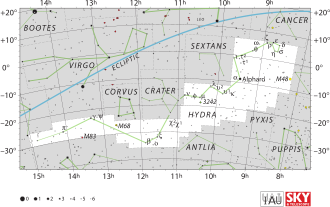
Pi Hydrae, Latinized from π Hydrae, is a star in the constellation Hydra with an apparent visual magnitude of 3.3,2 making it visible to the naked eye. Parallax measurements put this star at a distance of about 101 light-years (31 parsecs) from the Earth.
The spectrum of this star shows it to have a stellar classification of K1 III-IV,4 with the luminosity class of 'III-IV' suggesting it is in an evolutionary transition stage somewhere between a subgiant and a giant star. It has a low projected rotational velocity of 2.25 km s−1.9 Pi Hydrae is radiating 61 times the Sun's luminosity from its outer envelope with an effective temperature of 4,565 K,8 giving it the orange hue of a K-type star.11
Pi Hydrae is a type of giant known as a cyanogen-weak star, which means that its spectrum displays weak absorption lines of CN− relative to the metallicity. (The last is a term astronomers use when describing the abundance of elements other than hydrogen and helium.) Otherwise, it appears to be a normal star of its evolutionary class, having undergone first dredge-up of nuclear fusion by-products onto its surface layers.12
In Chinese astronomy, π Hydrae forms with γ Hydrae the asterism Ping (平), representing a judge.13 The Chinese name for π Hydrae itself is Ping èr (平二), the second star of Ping.14 R. H. Allen's 1899 book Star Names instead claimed the Chinese name Ping Sing, translated as "a Tranquil Star", for ι Hydrae (Ukdah).15
References
References
- van Leeuwen, F. (November 2007), "Validation of the new Hipparcos reduction", Astronomy and Astrophysics, 474 (2): 653–664, arXiv:0708.1752, Bibcode:2007A&A...474..653V, doi:10.1051/0004-6361:20078357, S2CID 18759600
- Wielen, R.; et al. (1999), "Sixth Catalogue of Fundamental Stars (FK6). Part I. Basic fundamental stars with direct solutions", Veröff. Astron. Rechen-Inst. Heidelb, 35 (35), Astronomisches Rechen-Institut Heidelberg: 1, Bibcode:1999VeARI..35....1W
- Stock, Stephan; Reffert, Sabine; Quirrenbach, Andreas (2018). "Precise radial velocities of giant stars. X. Bayesian stellar parameters and evolutionary stages for 372 giant stars from the Lick planet search". Astronomy and Astrophysics. 616: A33. arXiv:1805.04094. Bibcode:2018A&A...616A..33S. doi:10.1051/0004-6361/201833111.
- Gray, R. O.; et al. (July 2006), "Contributions to the Nearby Stars (NStars) Project: Spectroscopy of Stars Earlier than M0 within 40 pc-The Southern Sample", The Astronomical Journal, 132 (1): 161–170, arXiv:astro-ph/0603770, Bibcode:2006AJ....132..161G, doi:10.1086/504637, S2CID 119476992
- Keenan, Philip C.; McNeil, Raymond C. (1989), "The Perkins catalog of revised MK types for the cooler stars", Astrophysical Journal Supplement Series, 71: 245, Bibcode:1989ApJS...71..245K, doi:10.1086/191373.
- Jennens, P. A.; Helfer, H. L. (September 1975), "A new photometric metal abundance and luminosity calibration for field G and K giants", Monthly Notices of the Royal Astronomical Society, 172 (3): 667–679, Bibcode:1975MNRAS.172..667J, doi:10.1093/mnras/172.3.667
- Hekker, S.; et al. (August 2006), "Precise radial velocities of giant stars. I. Stable stars", Astronomy and Astrophysics, 454 (3): 943–949, arXiv:astro-ph/0604502, Bibcode:2006A&A...454..943H, doi:10.1051/0004-6361:20064946, S2CID 119529768
- Reffert, Sabine; Bergmann, Christoph; Quirrenbach, Andreas; Trifonov, Trifon; Künstler, Andreas (2015-02-01). "Precise radial velocities of giant stars. VII. Occurrence rate of giant extrasolar planets as a function of mass and metallicity". Astronomy and Astrophysics. 574: A116. arXiv:1412.4634. Bibcode:2015A&A...574A.116R. doi:10.1051/0004-6361/201322360. ISSN 0004-6361.
- Hekker, S.; Meléndez, J. (December 2007), "Precise radial velocities of giant stars. III. Spectroscopic stellar parameters", Astronomy and Astrophysics, 475 (3): 1003–1009, arXiv:0709.1145, Bibcode:2007A&A...475.1003H, doi:10.1051/0004-6361:20078233, S2CID 10436552
- "49 Hya -- Star", SIMBAD, Centre de Données astronomiques de Strasbourg, retrieved 2012-01-16
- "The Colour of Stars", Australia Telescope, Outreach and Education, Commonwealth Scientific and Industrial Research Organisation, December 21, 2004, archived from the original on March 18, 2012, retrieved 2012-01-16
- Luck, R. Earle (February 1991), "Chemical abundances for cyanogen-weak giants", Astrophysical Journal Supplement Series, 75: 579–610, Bibcode:1991ApJS...75..579L, doi:10.1086/191542
- Ridpath, Ian. "Star Tales – Hydra". Retrieved 22 February 2026.
- "AEEA 天文教育資訊網" [Activities of Exhibition and Education in Astronomy] (in Chinese). Archived from the original on 21 May 2011.
- Allen, R. H. (1899), Star Names: Their Lore and Meaning, p. 249
External links
External links
- Kaler, James B., "PI HYA (Pi Hydrae)", Stars, University of Illinois, retrieved 2012-01-16