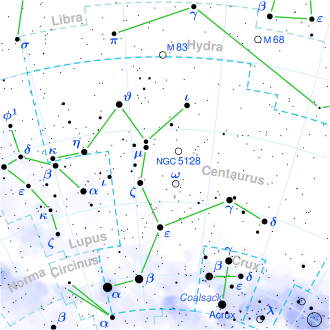
  | |
| Observation data Epoch J2000.0 Equinox ICRS | |
|---|---|
| Constellation | Centaurus1 |
| Right ascension | 11h 21m 00.41s2 |
| Declination | −54° 29′ 27.7″2 |
| Apparent magnitude (V) | +3.901 (4.08 + 5.65)3 |
| Characteristics | |
| Evolutionary stage | main sequence |
| Spectral type | B5Vn4 + B6V5 |
| B−V color index | −0.157±0.0151 |
| Astrometry | |
| Radial velocity (Rv) | +9.4±3.71 km/s |
| Proper motion (μ) | RA: −35.85±0.34< mas/yr2 Dec.: −1.72±0.27 mas/yr2 |
| Parallax (π) | 9.12±0.34 mas2 |
| Distance | 360 ± 10 ly (110 ± 4 pc) |
| Absolute magnitude (MV) | −1.301 |
| Orbit6 | |
| Period (P) | 39.0±0.19 yr |
| Semi-major axis (a) | 0.2263±0.0011″ |
| Eccentricity (e) | 0.8530±0.0040 |
| Inclination (i) | 19.4±4.9° |
| Longitude of the node (Ω) | 327.8±3.9° |
| Periastron epoch (T) | 2010.410±0.037 |
| Argument of periastron (ω) (secondary) | 340.3±4.0° |
| Details | |
| A | |
| Mass | 6.436 M☉ |
| Temperature | 16,7607 K |
| Rotational velocity (v sin i) | 3408 km/s |
| Age | 13.99 Myr |
| B | |
| Mass | 3.686 M☉ |
| Other designations | |
| π Cen, CPD−53°4498, FK5 428, GC 15601, HD 98718, HIP 55425, HR 4390, SAO 238986, CCDM J11210-542910 | |
| Database references | |
| SIMBAD | data |
Pi Centauri is a binary star system in the southern constellation of Centaurus. Its name is a Bayer designation that is Latinized from π Centauri, and abbreviated Pi Cen or π Cen. This pair has a blue-white hue and is visible to the naked eye with a combined apparent visual magnitude of +3.90.1 The system is located at a distance of approximately 360 light years from the Sun based on parallax,2 and is drifting further away with a radial velocity of around +9 km/s.1 It is a member of the Lower Centaurus–Crux subgroup of the Scorpius–Centaurus association.11
The magnitude +4.083 primary, designated component A, is a B-type main-sequence star with a stellar classification of B5Vn,4 where the 'n' suffix indicates broad, diffuse (nebulous) lines due to rapid rotation. This star is spinning with a projected rotational velocity of 340 km/s, giving it an equatorial bulge that is 22% larger than the polar radius.8 It has 6.46 times the mass of the Sun and is radiating 7831 times the Sun's luminosity from its photosphere at an effective temperature of 16,760 K.7
The secondary companion, component B, is magnitude +5.653 with a class of B6V5 and 3.76 times the Sun's mass. The pair orbit around their common barycentre once every 39 years with an eccentricity of 0.8530. The semi-major axis of the companion is 0.23 arcseconds at an inclination of 19.4°.6
References
References
- Anderson, E.; Francis, Ch. (2012), "XHIP: An extended hipparcos compilation", Astronomy Letters, 38 (5): 331, arXiv:1108.4971, Bibcode:2012AstL...38..331A, doi:10.1134/S1063773712050015. XHIP record for this object at VizieR.
- van Leeuwen, F. (2007), "Validation of the new Hipparcos reduction", Astronomy and Astrophysics, 474 (2): 653–664, arXiv:0708.1752, Bibcode:2007A&A...474..653V, doi:10.1051/0004-6361:20078357, S2CID 18759600.Vizier catalog entry
- Mason, Brian D.; et al. (2001), "The 2001 US Naval Observatory Double Star CD-ROM. I. The Washington Double Star Catalog", The Astronomical Journal, 122 (6): 3466, Bibcode:2001AJ....122.3466M, doi:10.1086/323920.
- Hiltner, W. A.; et al. (July 1969), "MK Spectral Types for Bright Southern OB Stars", Astrophysical Journal, 157: 313–326, Bibcode:1969ApJ...157..313H, doi:10.1086/150069.
- Edwards, T. W. (1976), "MK classification for visual binary components", The Astronomical Journal, 81: 245–249, Bibcode:1976AJ.....81..245E, doi:10.1086/111879.
- Tokovinin, Andrei (2012), "Speckle Interferometry and Orbits of "Fast" Visual Binaries", The Astronomical Journal, 144 (2), 56, arXiv:1206.1882, Bibcode:2012AJ....144...56T, doi:10.1088/0004-6256/144/2/56, S2CID 118586009.
- Zorec, J.; et al. (July 2009), "Fundamental parameters of B supergiants from the BCD system. I. Calibration of the (λ_1, D) parameters into Teff", Astronomy and Astrophysics, 501 (1): 297–320, arXiv:0903.5134, Bibcode:2009A&A...501..297Z, doi:10.1051/0004-6361/200811147, S2CID 14969137.
- van Belle, Gerard T. (March 2012), "Interferometric observations of rapidly rotating stars", The Astronomy and Astrophysics Review, 20 (1) 51, arXiv:1204.2572, Bibcode:2012A&ARv..20...51V, doi:10.1007/s00159-012-0051-2, S2CID 119273474.
- Gratton, R.; et al. (October 2023), "Multiples among B stars in the Scorpius-Centaurus association", Astronomy & Astrophysics, 678, id. A93, arXiv:2308.09962, Bibcode:2023A&A...678A..93G, doi:10.1051/0004-6361/202346806.
- "pi Cen". SIMBAD. Centre de données astronomiques de Strasbourg. Retrieved 2019-10-10.
- Bobylev, V. V.; Bajkova, A. T. (September 2007), "Kinematics of the Scorpius–Centaurus OB association", Astronomy Letters, 33 (9): 571–583, arXiv:0708.0943, Bibcode:2007AstL...33..571B, doi:10.1134/S1063773707090010, S2CID 15785349.