  | |
| Observation data Epoch J2000.0 Equinox J2000.0 (ICRS) | |
|---|---|
| Constellation | Cassiopeia1 |
| Right ascension | 00h 43m 28.070s2 |
| Declination | +47° 01′ 28.36″2 |
| Apparent magnitude (V) | +4.9493 |
| Characteristics | |
| Evolutionary stage | Main sequence |
| Spectral type | A5V4 + A5V5 |
| B−V color index | +0.1713 |
| Variable type | Ellipsoidal6 |
| Astrometry | |
| Radial velocity (Rv) | +12.9±0.87 km/s |
| Proper motion (μ) | RA: −24.570 mas/yr2 Dec.: −36.886 mas/yr2 |
| Parallax (π) | 18.6293±0.1142 mas2 |
| Distance | 175 ± 1 ly (53.7 ± 0.3 pc) |
| Absolute magnitude (MV) | +1.301 |
| Orbit8 | |
| Period (P) | 1.9642 d |
| Eccentricity (e) | 0.00 |
| Periastron epoch (T) | 2427535.74 JD |
| Argument of periastron (ω) (secondary) | 0.00° |
| Semi-amplitude (K1) (primary) | 120.5 km/s |
| Semi-amplitude (K2) (secondary) | 122.1 km/s |
| Details | |
| A | |
| Mass | 1.822 M☉ |
| Radius | 1.95 R☉ |
| Luminosity | 229 L☉ |
| Surface gravity (log g) | 4.4110 cgs |
| Temperature | 8,392±28510 K |
| Rotational velocity (v sin i) | 605 km/s |
| Age | 25110 Myr |
| B | |
| Mass | 1.872 M☉ |
| Radius | 1.95 R☉ |
| Rotational velocity (v sin i) | 655 km/s |
| Other designations | |
| π Cas, 20 Cas, BD+46°146, HD 4058, HIP 3414, HR 184, SAO 3660211 | |
| Database references | |
| SIMBAD | data |
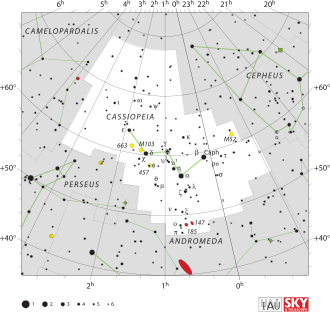
Pi Cassiopeiae is a close binary star8 system in the constellation Cassiopeia, near the southern border with Andromeda. Its name is a Bayer designation that is Latinized from π Cassiopeiae, and abbreviated Pi Cas or π Cas. This system is visible to the naked eye as a point of light with a combined apparent visual magnitude of +4.949.3 Based upon an annual parallax shift of 18.63 mas as seen from Earth,2 this system is located about 175 light-years (54 pc) 175 light years from the Sun. It is drifting further away with a radial velocity of +13 km/s.7
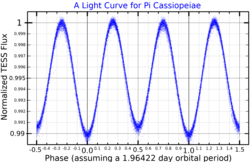
This is a double-lined spectroscopic binary system with an orbital period of nearly two days in a circular orbit.8 It is classified as a rotating ellipsoidal variable star and its brightness varies by 0.02 magnitudes with a period of 23.57 hours,6 which equals half of its orbital period. The spectrum matches that of an A-type main-sequence star with a stellar classification of A5 V.4 The two stars have similar masses and spectra.5 A star at a projected separation of 1,700 AU has been identified as a possible white dwarf. It is at the same distance as Pi Cassiopeiae and shares a common proper motion. The age of the white dwarf is calculated to be about 500 million years.13
Pi Cassiopeiae has been given the spectral class of kA3hF1mA5, indicating an Am star,14 but this is now considered doubtful.15
References
References
- Anderson, E.; Francis, Ch. (2012), "XHIP: An extended hipparcos compilation", Astronomy Letters, 38 (5): 331, arXiv:1108.4971, Bibcode:2012AstL...38..331A, doi:10.1134/S1063773712050015. XHIP record for this object at VizieR.
- Vallenari, A.; et al. (Gaia collaboration) (2023), "Gaia Data Release 3. Summary of the content and survey properties", Astronomy and Astrophysics, 674: A1, arXiv:2208.00211, Bibcode:2023A&A...674A...1G, doi:10.1051/0004-6361/202243940, S2CID 244398875. Gaia DR3 record for this source at VizieR.
- Høg, E.; et al. (2000), "The Tycho-2 catalogue of the 2.5 million brightest stars", Astronomy and Astrophysics, 355: L27, Bibcode:2000A&A...355L..27H, doi:10.1888/0333750888/2862.
- Cowley, A.; et al. (April 1969), "A study of the bright A stars. I. A catalogue of spectral classifications", Astronomical Journal, 74: 375–406, Bibcode:1969AJ.....74..375C, doi:10.1086/110819.
- Howe, K. S.; Clarke, C. J. (2009), "An analysis of v sin (I) correlations in early-type binaries", Monthly Notices of the Royal Astronomical Society, 392 (1): 448, Bibcode:2009MNRAS.392..448H, doi:10.1111/j.1365-2966.2008.14073.x, S2CID 120183969.
- Samus, N. N.; et al. (2017), "General Catalogue of Variable Stars", Astronomy Reports, GCVS 5.1, 61 (1): 80–88, Bibcode:2017ARep...61...80S, doi:10.1134/S1063772917010085, S2CID 125853869.
- de Bruijne, J. H. J.; Eilers, A.-C. (October 2012), "Radial velocities for the HIPPARCOS-Gaia Hundred-Thousand-Proper-Motion project", Astronomy & Astrophysics, 546: 14, arXiv:1208.3048, Bibcode:2012A&A...546A..61D, doi:10.1051/0004-6361/201219219, S2CID 59451347, A61.
- Pourbaix, D.; et al. (2004), "SB9: The Ninth Catalogue of Spectroscopic Binary Orbits", Astronomy & Astrophysics, 424: 727–732, arXiv:astro-ph/0406573, Bibcode:2004A&A...424..727P, doi:10.1051/0004-6361:20041213, S2CID 119387088.
- McDonald, I.; et al. (2012), "Fundamental Parameters and Infrared Excesses of Hipparcos Stars", Monthly Notices of the Royal Astronomical Society, 427 (1): 343–57, arXiv:1208.2037, Bibcode:2012MNRAS.427..343M, doi:10.1111/j.1365-2966.2012.21873.x, S2CID 118665352.
- David, Trevor J.; Hillenbrand, Lynne A. (2015), "The Ages of Early-Type Stars: Strömgren Photometric Methods Calibrated, Validated, Tested, and Applied to Hosts and Prospective Hosts of Directly Imaged Exoplanets", The Astrophysical Journal, 804 (2): 146, arXiv:1501.03154, Bibcode:2015ApJ...804..146D, doi:10.1088/0004-637X/804/2/146, S2CID 33401607.
- "pi. Cas", SIMBAD, Centre de données astronomiques de Strasbourg, retrieved 2017-08-30.
- MAST: Barbara A. Mikulski Archive for Space Telescopes, Space Telescope Science Institute, retrieved 8 December 2021.
- Qiu, Dan; et al. (2021), "Precise Ages of Field Stars from White Dwarf Companions in Gaia DR2", The Astrophysical Journal Supplement Series, 253 (2): 58, arXiv:2012.04890, Bibcode:2021ApJS..253...58Q, doi:10.3847/1538-4365/abe468, S2CID 234867350.
- Abt, Helmut A.; Morrell, Nidia I. (1995), "The Relation between Rotational Velocities and Spectral Peculiarities among A-Type Stars", Astrophysical Journal Supplement Series, 99: 135, Bibcode:1995ApJS...99..135A, doi:10.1086/192182.
- Renson, P.; Manfroid, J. (2009), "Catalogue of Ap, HGMN and Am stars", Astronomy and Astrophysics, 498 (3): 961, Bibcode:2009A&A...498..961R, doi:10.1051/0004-6361/200810788.