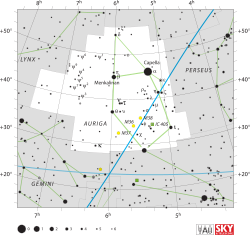
  | |
| Observation data Epoch J2000 Equinox ICRS | |
|---|---|
| Constellation | Auriga1 |
| Right ascension | 05h 59m 56.09792s2 |
| Declination | +45° 56′ 12.2457″2 |
| Apparent magnitude (V) | 4.253 |
| Characteristics | |
| Evolutionary stage | asymptotic giant branch4 |
| Spectral type | M3 IIb5 |
| U−B color index | +1.833 |
| B−V color index | +1.723 |
| Variable type | LC6 |
| Astrometry | |
| Radial velocity (Rv) | 0.71±0.767 km/s |
| Proper motion (μ) | RA: −3.755 mas/yr2 Dec.: −7.785 mas/yr2 |
| Parallax (π) | 4.515±0.241 mas2 |
| Distance | 720 ± 40 ly (220 ± 10 pc) |
| Absolute magnitude (MV) | −2.461 |
| Details | |
| Mass | 2.988 M☉ |
| Radius | 218.69 R☉ |
| Luminosity | 6,630±1,0549 L☉ |
| Surface gravity (log g) | 0.55±0.1010 cgs |
| Temperature | 3,525±1259 K |
| Metallicity [Fe/H] | 0.03±0.0410 dex |
| Other designations | |
| π Aur, 35 Aurigae, BD+45 1217, HD 40239, HIP 28404, HR 2091, SAO 4075611 | |
| Database references | |
| SIMBAD | data |
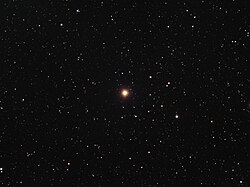
Pi Aurigae is a single,12 red-hued star in the northern constellation of Auriga. Its name is a Bayer designation that is Latinized from π Aurigae, and abbreviated Pi Aur or π Aur. Located about one degree north of the 2nd magnitude star Beta Aurigae,13 Pi Aurigae is visible to the naked eye with an apparent visual magnitude of 4.253 Based upon parallax measurements, it is approximately 720 light-years (220 parsecs) away from Earth.2 At that distance, the brightness of the star is diminished by 0.54 in magnitude from extinction caused by interstellar gas and dust.7
Pi Aurigae is an evolved bright giant star with a stellar classification of M3 IIb.5 After exhausting the supply of hydrogen at its core the star has expanded to approximately 219 times the size of the Sun.9 It is classified as a slow irregular variable of type LC and its brightness varies from magnitude +4.24 to +4.34.6 On average, the star is radiating 6,630 times the Sun's luminosity from its enlarged photosphere at an effective temperature of 3,525 K.9
References
References
- Anderson, E.; Francis, Ch. (2012), "XHIP: An extended hipparcos compilation", Astronomy Letters, 38 (5): 331, arXiv:1108.4971, Bibcode:2012AstL...38..331A, doi:10.1134/S1063773712050015. XHIP record for this object at VizieR.
- Vallenari, A.; et al. (Gaia collaboration) (2023), "Gaia Data Release 3. Summary of the content and survey properties", Astronomy and Astrophysics, 674: A1, arXiv:2208.00211, Bibcode:2023A&A...674A...1G, doi:10.1051/0004-6361/202243940, S2CID 244398875. Gaia DR3 record for this source at VizieR.
- Johnson, H. L.; et al. (1966), "UBVRIJKL photometry of the bright stars", Communications of the Lunar and Planetary Laboratory, 4 (99): 99, Bibcode:1966CoLPL...4...99J.
- Eggen, Olin J. (July 1992), "Asymptotic giant branch stars near the sun", Astronomical Journal, 104 (1): 275–313, Bibcode:1992AJ....104..275E, doi:10.1086/116239.
- Keenan, Philip C.; McNeil, Raymond C. (1989), "The Perkins catalog of revised MK types for the cooler stars", Astrophysical Journal Supplement Series, 71: 245, Bibcode:1989ApJS...71..245K, doi:10.1086/191373.
- Ruban, E. V.; et al. (September 2006), "Spectrophotometric observations of variable stars", Astronomy Letters, 32 (9): 604–607, Bibcode:2006AstL...32..604R, doi:10.1134/S1063773706090052, S2CID 121747360.
- Famaey, B.; et al. (January 2005), "Local kinematics of K and M giants from CORAVEL/Hipparcos/Tycho-2 data. Revisiting the concept of superclusters", Astronomy and Astrophysics, 430 (1): 165–186, arXiv:astro-ph/0409579, Bibcode:2005A&A...430..165F, doi:10.1051/0004-6361:20041272, S2CID 17804304.
- Khalatyan, A.; Anders, F.; Chiappini, C.; Queiroz, A. B. A.; Nepal, S.; Dal Ponte, M.; Jordi, C.; Guiglion, G.; Valentini, M.; Torralba Elipe, G.; Steinmetz, M.; Pantaleoni-González, M.; Malhotra, S.; Jiménez-Arranz, Ó.; Enke, H.; Casamiquela, L.; Ardèvol, J. (2024). "Transferring spectroscopic stellar labels to 217 million Gaia DR3 XP stars with SHBoost". Astronomy and Astrophysics. 691: A98. arXiv:2407.06963. Bibcode:2024A&A...691A..98K. doi:10.1051/0004-6361/202451427.
- McDonald, I.; et al. (October 2017), "Fundamental parameters and infrared excesses of Tycho-Gaia stars", Monthly Notices of the Royal Astronomical Society, 471 (1): 770–791, arXiv:1706.02208, Bibcode:2017MNRAS.471..770M, doi:10.1093/mnras/stx1433, ISSN 0035-8711 Pi Aurigae's database entry at VizieR.
- Wu, Yue; et al. (January 2011), "Coudé-feed stellar spectral library - atmospheric parameters", Astronomy and Astrophysics, 525: A71, arXiv:1009.1491, Bibcode:2011A&A...525A..71W, doi:10.1051/0004-6361/201015014, S2CID 53480665.
- "pi. Aur", SIMBAD, Centre de données astronomiques de Strasbourg, retrieved 2012-08-20.
- Eggleton, P. P.; Tokovinin, A. A. (September 2008), "A catalogue of multiplicity among bright stellar systems", Monthly Notices of the Royal Astronomical Society, 389 (2): 869–879, arXiv:0806.2878, Bibcode:2008MNRAS.389..869E, doi:10.1111/j.1365-2966.2008.13596.x, S2CID 14878976.
- O'Meara, Stephen James (2007), Steve O'Meara's Herschel 400 Observing Guide, Cambridge University Press, p. 23, ISBN 978-0521858939.