| Phlebolepis Temporal range: late Silurian
| |
|---|---|
| |
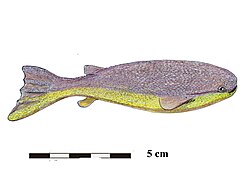
| Phlebolepis elegans, thelodont from Late Silurian of Baltic states, Russia and England | |
Scientific classification 
| |
| Kingdom: | Animalia |
| Phylum: | Chordata |
| Infraphylum: | Agnatha |
| Class: | †Thelodonti |
| Order: | †Phlebolepidiformes |
| Family: | †Phlebolepididae |
| Genus: | †Phlebolepis Pander, 1856 |
| Species | |
| |
Phlebolepis is an extinct thelodont agnathan genus belonging to the family Phlebolepididae. Whole fossils are found in Late Silurian (Ludlow epoch) aged strata from Saaremaa, Estonia. Phlebolepis elegans was average-sized for a thelodont, 7 cm long.1
The scales of Phlebolepis are robust and abrasion-resistant, similar to modern sharks which live among rough substrates such as rocky caves or reefs.23
References
References
- Wilson, Mark V. H.; Märss, Tiiu (2012). "Anatomy of the Silurian thelodont Phlebolepis elegans Pander". Estonian Journal of Earth Sciences. 61 (4): 261–276. doi:10.3176/earth.2012.4.06.
- Ferrón, Humberto G.; Botella, Héctor (2017). "Squamation and ecology of thelodonts". PLOS ONE. 12 (2) e0172781. Bibcode:2017PLoSO..1272781F. doi:10.1371/journal.pone.0172781. PMC 5328365. PMID 28241029.
- Ferrón, Humberto G; Martínez-Pérez, Carlos; Turner, Susan; Manzanares, Esther; Botella, Héctor (2018). "Patterns of ecological diversification in thelodonts" (PDF). Palaeontology. 61 (2): 303–315. doi:10.1111/pala.12347. hdl:10550/85568.