| Philotheca hispidula | |
|---|---|
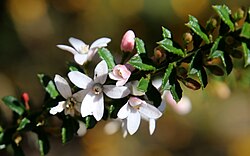
| |
| In Ku-ring-gai Chase National Park | |
Scientific classification 
| |
| Kingdom: | Plantae |
| Clade: | Embryophytes |
| Clade: | Tracheophytes |
| Clade: | Spermatophytes |
| Clade: | Angiosperms |
| Clade: | Eudicots |
| Clade: | Rosids |
| Order: | Sapindales |
| Family: | Rutaceae |
| Genus: | Philotheca |
| Species: | P. hispidula
|
| Binomial name | |
| Philotheca hispidula | |
| Synonyms1 | |
| |
Philotheca hispidula is a flowering plant in the citrus family and is endemic to New South Wales. It is a small shrub with narrow egg-shaped to wedge-shaped leaves that are glandular-wavy on the edges, and white or pale pink flowers arranged singly in leaf axils.
Description
Philotheca hispidula is a shrub that typically grows to a height of about 1 m (3 ft 3 in) with slightly glandular-warty, finely bristly branchlets. The leaves are narrow egg-shaped to narrow wedge-shaped with the narrower end towards the base, 10–20 mm (0.39–0.79 in) long and 3–4 mm (0.12–0.16 in) wide. The flowers are usually arranged singly in leaf axils on a finely bristly peduncle 1–15 mm (0.039–0.591 in) long and a pedicel 3–5 mm (0.12–0.20 in) long. There are five semi-circular, fleshy-centred sepals about 1 mm (0.039 in) long and five broadly elliptical white or pale pink petals about 6.5 mm (0.26 in) long with a glandular keel. The ten stamens are slightly hairy. Flowering occurs in spring and the fruit is about 7 mm (0.28 in) long with a beak about 3 mm (0.12 in) long.234
Taxonomy
This species was first formally described in 1827 by Sprengel from an unpublished description by Franz Sieber and the description was published in Systema Vegetabilium.5 In 2005 Paul G. Wilson changed the name to Philotheca hispidula in the journal Nuytsia.67
Distribution and habitat
Philotheca hispidula grows in forest on sandstone in the Blue Mountains and in the Sydney region.23
References
References
- "Philotheca hispidula". Australian Plant Census. Retrieved 5 August 2020.
- Wilson, Paul G. (2013). Wilson, Annette J.G. (ed.). Flora of Australia (Volume 26). Canberra: Australian Biological Resources Study. p. 398. Retrieved 6 August 2020.
- "Philotheca hispidula". PlantNET – NSW Flora Online. Retrieved 17 August 2018.
- Les Robinson (2003). Field Guide to the Native Plants of Sydney. Kangaroo Press. p. 120. ISBN 978-0-7318-1211-0.
- "Eriostemon hispidula". APNI. Retrieved 6 August 2020.
- "Philotheca hispidula". APNI. Retrieved 6 August 2020.
- Wilson, Paul G. (1998). "A Taxonomic Review of the genera Eriostemon and Philotheca". Nuytsia. 12 (2): 259. Retrieved 6 August 2020.