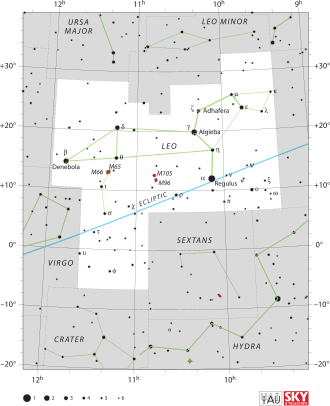
  | |
| Observation data Epoch J2000 Equinox ICRS | |
|---|---|
| Constellation | Leo |
| Right ascension | 11h 16m 39.69960s1 |
| Declination | −03° 39′ 05.7770″1 |
| Apparent magnitude (V) | 4.462 |
| Characteristics | |
| Evolutionary stage | main sequence3 |
| Spectral type | A7 IVn4 |
| U−B color index | +0.102 |
| B−V color index | +0.222 |
| Astrometry | |
| Radial velocity (Rv) | −3.05 km/s |
| Proper motion (μ) | RA: −110.371 mas/yr Dec.: −37.161 mas/yr |
| Parallax (π) | 17.71±0.25 mas1 |
| Distance | 184 ± 3 ly (56.5 ± 0.8 pc) |
| Absolute magnitude (MV) | 0.566 |
| Details | |
| Mass | 1.597 M☉ |
| Radius | 3.98 R☉ |
| Luminosity | 428 L☉ |
| Surface gravity (log g) | 3.567 cgs |
| Temperature | 7,680±2617 K |
| Rotational velocity (v sin i) | 2544 km/s |
| Age | 4327 Myr |
| Other designations | |
| φ Leo, 74 Leo, BD−02°3315, FK5 1292, HD 98058, HIP 55084, HR 4368, SAO 1381029 | |
| Database references | |
| SIMBAD | data |
Phi Leonis (φ Leo) is a single10 star in the equatorial-northern constellation Leo, located in the southern celestial hemisphere. It is bright enough to be seen with the naked eye, having an apparent visual magnitude of 4.46.2 Based upon parallax measurements,1 the distance to Phi Leo is around 184 light years.
The spectrum of this star fits a stellar classification of A7IVn,4 which suggests it is an A-type subgiant star that has left the main sequence and is evolving into a giant star. It is being viewed with the plane of the star's equator lying close the line of sight from the Earth,11 and shows a high rotation rate with a projected rotational velocity of 254 km/s.4 This rapid spin is giving the star an oblate shape with an equatorial bulge that is 29% larger than the polar radius.12
Phi Leonis has been mentioned as a shell star—indicating that there is a circumstellar disk of gas around the star's equator—and may display a slight variability.6 Sporadic variation of the spectra on the time scale of minutes up to months in duration suggests that solid, cometary bodies are in orbit around the star, with objects approaching close enough for refractory materials to sublimate.11 Most exocomet hosts do have a circumstellar disk, which can act as an exocomet reservoir. Cold dust around Phi Leonis was not detected, and the star is not associated with a warm debris disk.13
References
References
- van Leeuwen, F. (2007), "Validation of the new Hipparcos reduction", Astronomy and Astrophysics, 474 (2): 653–664, arXiv:0708.1752, Bibcode:2007A&A...474..653V, doi:10.1051/0004-6361:20078357, S2CID 18759600.
- Mermilliod, J.-C. (1986), "Compilation of Eggen's UBV data, transformed to UBV (unpublished)", Catalogue of Eggen's UBV Data, SIMBAD, Bibcode:1986EgUBV........0M.
- Zorec, J.; Royer, F. (2012). "Rotational velocities of A-type stars. IV. Evolution of rotational velocities". Astronomy and Astrophysics. 537: A120. arXiv:1201.2052. Bibcode:2012A&A...537A.120Z. doi:10.1051/0004-6361/201117691.
- Royer, F.; et al. (February 2007), "Rotational velocities of A-type stars. III. Velocity distributions", Astronomy and Astrophysics, 463 (2): 671–682, arXiv:astro-ph/0610785, Bibcode:2007A&A...463..671R, doi:10.1051/0004-6361:20065224, S2CID 18475298.
- Wielen, R.; et al. (1999), "Sixth Catalogue of Fundamental Stars (FK6). Part I. Basic Fundamental Stars with Direct Solutions", Veroeffentlichungen des Astronomischen Rechen-Instituts Heidelberg, 35 (35), Astronomisches Rechen-Institut Heidelberg: 1, Bibcode:1999VeARI..35....1W.
- Hauck, B.; Jaschek, C. (February 2000), "A-shell stars in the Geneva system", Astronomy and Astrophysics, 354: 157–162, Bibcode:2000A&A...354..157H.
- David, Trevor J.; Hillenbrand, Lynne A. (2015), "The Ages of Early-Type Stars: Strömgren Photometric Methods Calibrated, Validated, Tested, and Applied to Hosts and Prospective Hosts of Directly Imaged Exoplanets", The Astrophysical Journal, 804 (2): 146, arXiv:1501.03154, Bibcode:2015ApJ...804..146D, doi:10.1088/0004-637X/804/2/146, S2CID 33401607.
- Stassun, Keivan G.; et al. (2019). "The Revised TESS Input Catalog and Candidate Target List". The Astronomical Journal. 158 (4): 138. arXiv:1905.10694. Bibcode:2019AJ....158..138S. doi:10.3847/1538-3881/ab3467.
- "ups Leo". SIMBAD. Centre de données astronomiques de Strasbourg. Retrieved 2016-09-29.
{{cite web}}: CS1 maint: postscript (link) - Hutter, D. J.; Tycner, C.; Zavala, R. T.; Benson, J. A.; Hummel, C. A.; Zirm, H. (2021). "Surveying the Bright Stars by Optical Interferometry. III. A Magnitude-limited Multiplicity Survey of Classical Be Stars". The Astrophysical Journal Supplement Series. 257 (2): 69. arXiv:2109.06839. Bibcode:2021ApJS..257...69H. doi:10.3847/1538-4365/ac23cb. S2CID 237503492.
- Eiroa, C.; Rebollido, I.; Montesinos, B.; Villaver, E.; et al. (September 14, 2016), "Exocomet signatures around the A-shell star Φ Leo?" (PDF), Astronomy & Astrophysics, L1: 594, arXiv:1609.04263, Bibcode:2016A&A...594L...1E, doi:10.1051/0004-6361/201629514, S2CID 41231308.
- van Belle, Gerard T., Gerard T. (March 2012), "Interferometric observations of rapidly rotating stars", The Astronomy and Astrophysics Review, 20 (1): 51, arXiv:1204.2572, Bibcode:2012A&ARv..20...51V, doi:10.1007/s00159-012-0051-2, S2CID 119273474.
- Cataldi, Gianni; Moór, Attila; Ohashi, Nagayoshi; Eiroa, Carlos; Grady, Carol; Rebollido, Isabel (2019-02-22). "No Detection of Cold Dust around the Potential Exocomet Host ϕ Leo". Research Notes of the AAS. 3 (2): 39. Bibcode:2019RNAAS...3...39C. doi:10.3847/2515-5172/ab082b. ISSN 2515-5172. S2CID 127680980.