  | |
| Observation data Epoch J2000.0 Equinox J2000.0 (ICRS) | |
|---|---|
| Constellation | Hydra1 |
| Right ascension | 10h 38m 34.95281s2 |
| Declination | −16° 52′ 35.6665″2 |
| Apparent magnitude (V) | 4.903 |
| Characteristics | |
| Evolutionary stage | red clump4 |
| Spectral type | G8 III5 |
| B−V color index | 0.9126 |
| Astrometry | |
| Radial velocity (Rv) | +17.45±0.707 km/s |
| Proper motion (μ) | RA: −98.922 mas/yr Dec.: +25.842 mas/yr |
| Parallax (π) | 15.49±0.57 mas2 |
| Distance | 211 ± 8 ly (65 ± 2 pc) |
| Absolute magnitude (MV) | +0.898 |
| Orbit3 | |
| Period (P) | 1200 d |
| Eccentricity (e) | 0.1 |
| Periastron epoch (T) | 2420760 JD |
| Argument of periastron (ω) (secondary) | 270° |
| Semi-amplitude (K1) (primary) | 4.0 km/s |
| Details | |
| φ3 Hya | |
| Mass | 2.045 M☉ |
| Radius | 96 R☉ |
| Luminosity | 485 L☉ |
| Surface gravity (log g) | 2.958 cgs |
| Temperature | 4,952±175 K |
| Metallicity [Fe/H] | −0.22±0.128 dex |
| Rotational velocity (v sin i) | 3.66 km/s |
| Age | 1.175 Gyr |
| Other designations | |
| φ3 Hya, BD−16°3100, FK5 2850, HD 92214, HIP 52085, HR 4171, SAO 1561229 | |
| Database references | |
| SIMBAD | data |
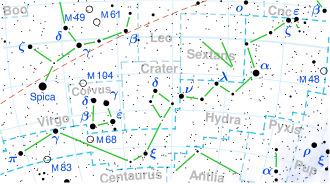
Phi3 Hydrae (φ3 Hya) is a binary star3 in the equatorial constellation of Hydra. It originally received the Flamsteed designation of 2 Crateris before being placed in the Hydra constellation.10 Based upon an annual parallax shift of 15.49 mas as seen from Earth, it is located around 211 light years from the Sun. It is visible to the naked eye with an apparent visual magnitude of 4.90.3 It forms a triangle with the fainter φ1 Hydrae and φ2 Hydrae, between μ Hydrae and ν Hydrae.
This is a single-lined spectroscopic binary star system with an orbital period of about 1,200 days and an eccentricity of 0.1.3 The primary, component A, is an evolved G-type giant star with a stellar classification of G8 III.5 It is a red clump star,4 which means it is generating energy through the fusion of helium at its core. The star has twice5 the mass of the Sun and has expanded to 96 times the Sun's radius. It is 1.175 billion years old and is radiating 485 times the solar luminosity from its photosphere at an effective temperature of 4,952 K.5
References
References
- Roman, Nancy G. (1987), "Identification of a constellation from a position", Publications of the Astronomical Society of the Pacific, 99 (617): 695, Bibcode:1987PASP...99..695R, doi:10.1086/132034. Constellation record for this object at VizieR.
- van Leeuwen, F. (2007), "Validation of the new Hipparcos reduction", Astronomy and Astrophysics, 474 (2): 653–664, arXiv:0708.1752, Bibcode:2007A&A...474..653V, doi:10.1051/0004-6361:20078357, S2CID 18759600.
- Pourbaix, D.; et al. (September 2004), "SB9: The ninth catalogue of spectroscopic binary orbits", Astronomy and Astrophysics, 424: 727–732, arXiv:astro-ph/0406573, Bibcode:2004A&A...424..727P, doi:10.1051/0004-6361:20041213, S2CID 119387088.
- Laney, C. D.; et al. (January 2012), "A new Large Magellanic Cloud K-band distance from precision measurements of nearby red clump stars", Monthly Notices of the Royal Astronomical Society, 419 (2): 1637–1641, arXiv:1109.4800, Bibcode:2012MNRAS.419.1637L, doi:10.1111/j.1365-2966.2011.19826.x, S2CID 117788450.
- Luck, R. Earle (September 2015), "Abundances in the Local Region. I. G and K Giants", The Astronomical Journal, 150 (3): 23, arXiv:1507.01466, Bibcode:2015AJ....150...88L, doi:10.1088/0004-6256/150/3/88, S2CID 118505114, 88.
- Massarotti, Alessandro; et al. (January 2008), "Rotational and radial velocities for a sample of 761 HIPPARCOS giants and the role of binarity", The Astronomical Journal, 135 (1): 209–231, Bibcode:2008AJ....135..209M, doi:10.1088/0004-6256/135/1/209, S2CID 121883397.
- de Bruijne, J. H. J.; Eilers, A.-C. (October 2012), "Radial velocities for the HIPPARCOS-Gaia Hundred-Thousand-Proper-Motion project", Astronomy & Astrophysics, 546: 14, arXiv:1208.3048, Bibcode:2012A&A...546A..61D, doi:10.1051/0004-6361/201219219, S2CID 59451347, A61.
- McWilliam, Andrew (1990), "High-resolution spectroscopic survey of 671 GK giants. I - Stellar atmosphere parameters and abundances", The Astrophysical Journal Supplement Series, 74: 1075, Bibcode:1990ApJS...74.1075M, doi:10.1086/191527.
- "phi Hya". SIMBAD. Centre de données astronomiques de Strasbourg. Retrieved 2017-03-17.
- Wagman, M. (August 1987), "Flamsteed's Missing Stars", Journal for the History of Astronomy, 18 (3): 216, Bibcode:1987JHA....18..209W, doi:10.1177/002182868701800305, S2CID 118445625.