| |||
| Names | |||
|---|---|---|---|
| Preferred IUPAC name
1,1,3,3,3-Pentafluoro-2-(trifluoromethyl)prop-1-ene | |||
| Other names
Perfluoroisobutene, Perfluoroisobutylene, Octafluoroisobutylene, Octafluoro-sec-butene, PFIB
| |||
| Identifiers | |||
| |||
3D model (JSmol)
|
|||
| ChEMBL | |||
| ChemSpider |
| ||
| ECHA InfoCard | 100.108.743 | ||
| EC Number |
| ||
PubChem CID
|
|||
| RTECS number |
| ||
| UNII | |||
CompTox Dashboard (EPA)
|
|||
| |||
| |||
| Properties | |||
| C4F8 | |||
| Molar mass | 200.030 g/mol | ||
| Appearance | colorless gas | ||
| Density | 8.2 g/l | ||
| Melting point | −130 °C (−202 °F; 143 K) | ||
| Boiling point | 7.0 °C (44.6 °F; 280.1 K) | ||
| Hazards | |||
| GHS labelling: | |||
 
| |||
| Danger | |||
| H330, H370 | |||
| P260, P264, P270, P271, P284, P304+P340, P307+P311, P310, P320, P321, P403+P233, P405, P501 | |||
Except where otherwise noted, data are given for materials in their standard state (at 25 °C [77 °F], 100 kPa).
| |||
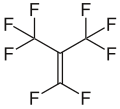


Perfluoroisobutene (PFIB) is the perfluorocarbon with the formula (CF3)2C=CF2. Classified as a perfluoroalkene, it is the fluorinated counterpart of the hydrocarbon isobutene. This colorless gas is notable for its high toxicity.1
Production and reactions
PFIB is one product of pyrolysis of polytetrafluoroethylene (PTFE).2 Tetrafluoroethylene thermally dimerizes to octafluorocyclobutane, which above 600 °C degrades to hexafluoropropylene and PFIB.1
Perfluoroisobutene is highly reactive toward nucleophiles, e.g. methanol.1 It also forms addition compounds with thiols, and it is this reactivity that may be related to its toxicity.3 It hydrolyzes readily to give the relatively innocuous (CF3)2CHCO2H, which readily decarboxylates to give hexafluoropropane.
Oxidation of HFIB with potassium permanganate gives hexafluoroacetone.4
Safety
Perfluoroisobutene is highly toxic with an LCt = 880 mg⋅min⋅m−3 (mice).3 It is a Schedule 2 substance of the Chemical Weapons Convention. Its toxicity is comparable to that of phosgene.1
References
References
- Siegemund, Günter; Schwertfeger, Werner; Feiring, Andrew; Smart, Bruce; Behr, Fred; Vogel, Herward; McKusick, Blaine (2000). "Fluorine Compounds, Organic". Ullmann's Encyclopedia of Industrial Chemistry. doi:10.1002/14356007.a11_349. ISBN 978-3-527-30385-4.
- Stewart, Charles E. (2006). Weapons of mass casualties and terrorism response handbook. American Academy of Orthopaedic Surgeons. Sudbury, Mass: Jones and Bartlett. ISBN 978-0-7637-2425-2.
- Timperley, Christopher M. (2000). "Highly-toxic fluorine compounds". Fluorine Chemistry at the Millennium. pp. 499–538. doi:10.1016/B978-008043405-6/50040-2. ISBN 9780080434056.
- Michael Van Der Puy, Louis G. Anello (1985). "Hexafluoroacetone". Organic Syntheses. 63: 154. doi:10.15227/orgsyn.063.0154.