| Perchoerus | |
|---|---|
| |
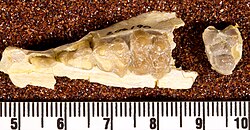
| Left maxilla fragments of P. minor (specimen USNM 206190) | |
Scientific classification 
| |
| Kingdom: | Animalia |
| Phylum: | Chordata |
| Class: | Mammalia |
| Infraclass: | Placentalia |
| Order: | Artiodactyla |
| Family: | Tayassuidae |
| Genus: | †Perchoerus Leidy, 1869 |
| Type species | |
| Palaeochoerus probus Leidy, 1856
| |
| Species | |
| |
| Synonyms1 | |
| |
Perchoerus is an extinct genus of suine (pig-like mammal) from the Eocene and Oligocene of North America. Three species are known.213 While often considered one of the earliest peccaries (Tayassuidae), other studies have recovered it to be a basal suine outside of either peccaries or Suidae (Old World pigs).4 Perchoerus is a rare component of the White River fauna, and the largest species, P. probus, also occurs in the John Day Formation of Oregon.1
Description
Perchoerus had a steeply-sloped skull with a short snout. It was similar in some respects to Thinohyus, another peccary-like suine from the Oligocene of the John Day Formation. Both are rare, and historically Perchoerus and Thinohyus have often been confused for each other.2 There are still some clear differences: Perchoerus has a shorter snout, stronger sagittal crests, and more lightly-built zygomatic and occipital areas. In addition, its M3 (upper third molar) is simpler and shorter from front-to-back, and there is less of a gap (diastema) between its canines and premolars.31
As reported by Scott (1913), the molars of Perchoerus are generally quadrituberculate (four-cusped) and lack any of the accessory cuspules (minor cusps) present in modern peccaries. The feet bore 4 functional digits and had free metacarpals. The bones in the forearm were separate rather than fused.5
Species
- P. minor is the oldest and smallest known species of Perchoerus, only the size of a house cat.6 It is known from skull and tooth material from the Chadronian (latest Eocene, 36-34 Ma) of Nebraska, South Dakota, and Wyoming.1 Apart from its minuscule size, the jaw more slender and the molars more simple than other Perchoerus species.1
- P. nanus was slightly younger and larger, from the Orellan (earliest Oligocene, 34-32 Ma) of Nebraska, South Dakota, and Colorado. It was intermediate between the other two species in anatomy.16
- P. probus was the latest and largest species, from the Whitneyan to early Arikareean (Oligocene, 32-30 Ma) of Nebraska, South Dakota, and Oregon. The type species of Perchoerus, P. probus was about as large as living peccaries (~35 kg (77 lb)),7 and is known from more remains than the other species. Apart from its larger size, it also had larger cheek teeth and a more complex structure of its third molars (m3 and M3).136
Palaeoecology
Low δ13C values from the teeth of P. probus suggest that it was an inhabitant of dense riparian habitats.7 The rarity of its fossils also support a preference for forests (where fossil preservation is difficult),2 and its tooth structure implies that it was a browser of tough vegetation.7
References
References
- Prothero, Donald R. (2009). "THE EARLY EVOLUTION OF THE NORTH AMERICAN PECCARIES" (PDF). Museum of Northern Arizona Bulletin. 65: 509–542. Archived from the original (PDF) on 20 November 2023.
- Scott, William Berryman; Jepsen, Glenn Lowell (1940). "The Mammalian Fauna of the White River Oligocene: Part IV. Artiodactyla". Transactions of the American Philosophical Society. 28 (4): 363–746. doi:10.2307/1005504. ISSN 0065-9746. JSTOR 1005504.
- Prothero, Donald R. (2021). "The systematics of North American peccaries (Mammalia: Artiodactyla: Tayassuidae)". New Mexico Museum of Natural History and Science Bulletin. 85: 6–8.
- Parisi Dutra, Rodrigo; Casali, Daniel de Melo; Missagia, Rafaela Velloso; Gasparini, Germán Mariano; Perini, Fernando Araujo; Cozzuol, Mario Alberto (2016-09-13). "Phylogenetic Systematics of Peccaries (Tayassuidae: Artiodactyla) and a Classification of South American Tayassuids". Journal of Mammalian Evolution. 24 (3): 345–358. doi:10.1007/s10914-016-9347-8. hdl:11336/54840. ISSN 1064-7554.
- Scott, William Berryman (1913). A history of land mammals in the Western Hemisphere; illustrated with 32 plates and more than 100 drawings. New York: Macmillan. p. 365.
- Prothero, Donald R.; Williams, Mary Persis (2016). The Princeton Field Guide to Prehistoric Mammals. Princeton University Press. pp. 157–158. ISBN 9781400884452.
- Boardman, Grant S.; Secord, Ross (1 April 2013). "Stable isotope paleoecology of White River ungulates during the Eocene–Oligocene climate transition in northwestern Nebraska". Palaeogeography, Palaeoclimatology, Palaeoecology. 375: 38–49. Bibcode:2013PPP...375...38B. doi:10.1016/j.palaeo.2013.02.010. Retrieved 17 November 2024 – via Elsevier Science Direct.