| Pentagonal cupola | |
|---|---|
 | |
| Type | Johnson J4 – J5 – J6 |
| Faces | 5 triangles 5 squares 1 pentagon 1 decagon |
| Edges | 25 |
| Vertices | 15 |
| Vertex configuration | |
| Symmetry group | |
| Properties | convex, elementary |
| Net | |
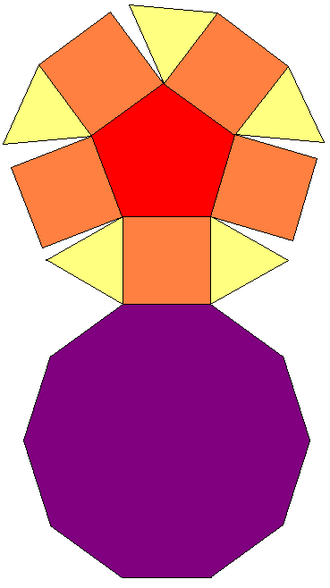 | |
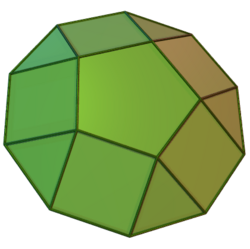
In geometry, the pentagonal cupola is one of the Johnson solids (J5). It can be obtained as a slice of the rhombicosidodecahedron. The pentagonal cupola consists of 5 equilateral triangles, 5 squares, 1 pentagon, and 1 decagon.
Properties
The pentagonal cupola's faces are five equilateral triangles, five squares, one regular pentagon, and one regular decagon.1 It has the property of convexity and regular polygonal faces, from which it is classified as the fifth Johnson solid.2 This cupola cannot be sliced by a plane without cutting within a face, so it is an elementary polyhedron.3
The following formulae for circumradius , and height , surface area , and volume may be applied if all faces are regular with edge length :4
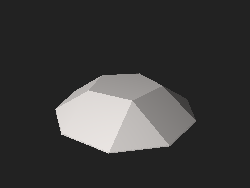
It has an axis of symmetry passing through the center of both top and base, which is symmetrical by rotating around it at one-, two-, three-, and four-fifth of a full-turn angle. It is also mirror-symmetric relative to any perpendicular plane passing through a bisector of the hexagonal base. Therefore, it has pyramidal symmetry, the cyclic group of order ten.3
Related polyhedron
The pentagonal cupola can be applied to construct a polyhedron. A construction that involves the attachment of its base to another polyhedron is known as augmentation; attaching it to prisms or antiprisms is known as elongation or gyroelongation.56 Some of the Johnson solids with such constructions are:
- elongated pentagonal cupola
- gyroelongated pentagonal cupola
- pentagonal orthobicupola
- pentagonal gyrobicupola
- pentagonal orthocupolarotunda
- pentagonal gyrocupolarotunda
- elongated pentagonal orthobicupola
- elongated pentagonal gyrobicupola
- elongated pentagonal orthocupolarotunda
- gyroelongated pentagonal bicupola
- gyroelongated pentagonal cupolarotunda
- augmented truncated dodecahedron
- parabiaugmented truncated dodecahedron
- metabiaugmented truncated dodecahedron
- triaugmented truncated dodecahedron
- gyrate rhombicosidodecahedron
- parabigyrate rhombicosidodecahedron
- metabigyrate rhombicosidodecahedron
- trigyrate rhombicosidodecahedron
Relatedly, a construction from polyhedra by removing one or more pentagonal cupolas is known as diminishment1:
- diminished rhombicosidodecahedron
- paragyrate diminished rhombicosidodecahedron
- metagyrate diminished rhombicosidodecahedron
- bigyrate diminished rhombicosidodecahedron
- parabidiminished rhombicosidodecahedron
- metabidiminished rhombicosidodecahedron
- gyrate bidiminished rhombicosidodecahedron
- tridiminished rhombicosidodecahedron
References
References
- Berman, Martin (1971). "Regular-faced convex polyhedra". Journal of the Franklin Institute. 291 (5): 329–352. doi:10.1016/0016-0032(71)90071-8. MR 0290245.
- Uehara, Ryuhei (2020). Introduction to Computational Origami: The World of New Computational Geometry. Springer. p. 62. doi:10.1007/978-981-15-4470-5. ISBN 978-981-15-4470-5. S2CID 220150682.
- Johnson, Norman W. (1966). "Convex polyhedra with regular faces". Canadian Journal of Mathematics. 18: 169–200. doi:10.4153/cjm-1966-021-8. MR 0185507. S2CID 122006114. Zbl 0132.14603.
- Braileanu1, Patricia I.; Cananaul, Sorin; Pasci, Nicoleta E. (2022). "Geometric pattern infill influence on pentagonal cupola mechanical behavior subject to static external loads". Journal of Research and Innovation for Sustainable Society. 4 (2). Thoth Publishing House: 5–15. doi:10.33727/JRISS.2022.2.1:5-15 (inactive 1 July 2025). ISSN 2668-0416.
{{cite journal}}: CS1 maint: DOI inactive as of July 2025 (link) CS1 maint: numeric names: authors list (link) - Demey, Lorenz; Smessaert, Hans (2017). "Logical and Geometrical Distance in Polyhedral Aristotelian Diagrams in Knowledge Representation". Symmetry. 9 (10): 204. Bibcode:2017Symm....9..204D. doi:10.3390/sym9100204.
- Slobodan, Mišić; Obradović, Marija; Ðukanović, Gordana (2015). "Composite Concave Cupolae as Geometric and Architectural Forms" (PDF). Journal for Geometry and Graphics. 19 (1): 79–91.