| Pegasus Dwarf Spheroidal Galaxy | |
|---|---|
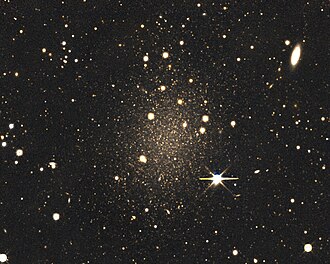 Pegasus Dwarf Spheroidal Galaxy with the legacy surveys | |
| Observation data (J2000 epoch) | |
| Constellation | Pegasus |
| Right ascension | 23h 51m 46.3s1 |
| Declination | +24° 34′ 57″1 |
| Heliocentric radial velocity | −341.6 ± 1.7 km/s2 |
| Distance | 2.713 ± 0.075 Mly (831.8 ± 23 kpc)2 |
| Apparent magnitude (V) | 24.62 |
| Absolute magnitude (V) | −11.62 |
| Characteristics | |
| Type | dSph3 |
| Apparent size (V) | 4.0′ × 2.0′1 |
| Other designations | |
| Pegasus II,1 Andromeda VI,1 Peg dSph,1 KKH 99,1 PGC 2807158 | |
The Pegasus Dwarf Spheroidal (also known as Andromeda VI or Peg dSph for short) is a dwarf spheroidal galaxy about 2.7 million light-years away in the constellation Pegasus. The Pegasus Dwarf is a member of the Local Group and a satellite galaxy of the Andromeda Galaxy (M31).
General information
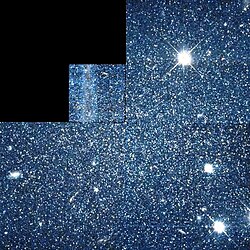
The Pegasus Dwarf Spheroidal is a galaxy with mainly metal-poor stellar populations.4 Its metallicity is [Fe/H] ≃ −1.3.5 It is located at the right ascension 23h51m46.30s and declination +24d34m57.0s in the equatorial coordinate system (epoch J2000.0), and in a distance of about 830 kpc from Earth and a distance of 281.6 kpc from the Andromeda Galaxy.2
The galaxy was discovered in 19996 by various authors on the Second Palomar Observatory Sky Survey (POSS II) films.7
See also
See also
- List of Andromeda's satellite galaxies
- Pegasus Dwarf Irregular Galaxy (Peg DIG)
- Pegasus galaxy, the Stargate Atlantis fictional location (probably the Pegasus Dwarf Irregular Galaxy).
References
References
- "Results for object Andromeda VI (Pegasus Dwarf Spheroidal)". NASA/IPAC Extragalactic Database. Retrieved March 18, 2025.
{{cite web}}: CS1 maint: deprecated archival service (link) - Pickett, Connor S.; Collins, Michelle L M.; Rich, R Michael; Read, Justin I.; Charles, Emily J E.; Martin, Nicolas; Chapman, Scott; McConnachie, Alan; Savino, Alessandro; Weisz, Daniel R. (2025). "Mass modelling the Andromeda Dwarf Galaxies: Andromeda VI and Andromeda XXIII". Monthly Notices of the Royal Astronomical Society. 540 (2): 1701–1718. arXiv:2505.04475. Bibcode:2025MNRAS.540.1701P. doi:10.1093/mnras/staf796.
- Karachentsev, I. D.; Kashibadze, O. G. (2006). "Masses of the local group and of the M81 group estimated from distortions in the local velocity field". Astrophysics. 49 (1): 3–18. Bibcode:2006Ap.....49....3K. doi:10.1007/s10511-006-0002-6. S2CID 120973010.
- Van den Bergh, Sidney (May 15, 2000). The Galaxies of the Local Group. Cambridge Astrophysics. p. 240. ISBN 978-1-139-42965-8.
- McConnachie, A. W.; Irwin, M. J.; Ferguson, A. M. N.; Ibata, R. A.; Lewis, G. F.; Tanvir, N. (2005). "Distances and metallicities for 17 Local Group galaxies". Monthly Notices of the Royal Astronomical Society. 356 (4): 979–997. arXiv:astro-ph/0410489. Bibcode:2005MNRAS.356..979M. doi:10.1111/j.1365-2966.2004.08514.x.
- Pritzl, Barton J.; Armandroff, Taft E.; Jacoby, George H.; Da Costa, G. S. (May 2005). "The Dwarf Spheroidal Companions to M31: Variable Stars in Andromeda I and Andromeda III". The Astronomical Journal. 129 (5): 2232–2256. arXiv:astro-ph/0501083. Bibcode:2005AJ....129.2232P. doi:10.1086/428372. S2CID 9749493.
- Wallace Sargent. "The Second Palomar Observatory Sky Survey (POSS II)". Caltech. Archived from the original on 2009-05-16.