| Pediculus | |
|---|---|
| |
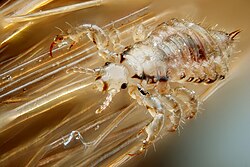
| Head louse, Pediculus humanus capitis | |
Scientific classification 
| |
| Kingdom: | Animalia |
| Phylum: | Arthropoda |
| Clade: | Pancrustacea |
| Class: | Insecta |
| Order: | Psocodea |
| Suborder: | Troctomorpha |
| Infraorder: | Phthiraptera |
| Parvorder: | Anoplura |
| Family: | Pediculidae Leach, 1817 |
| Genus: | Pediculus Linnaeus, 1758 |
| Species | |
|
See text | |
Pediculus is a genus of sucking lice, the sole genus in the family Pediculidae. Pediculus species are ectoparasites of primates.
Species include:1
- Pediculus clavicornis Nitzsch, 1864
- Pediculus humanus Linnaeus, 1758
- Pediculus humanus humanus Linnaeus, 1758 – the body louse
- Pediculus humanus capitis De Geer, 1767 – the head louse
- Pediculus mjobergi Ferris, 1916
- Pediculus schaeffi Fahrenholz, 1910
Humans are the hosts of Pediculus humanus. Chimpanzees and bonobos host Pediculus shaeffi. Various New World monkeys in the families Cebidae and Atelidae host Pediculus mjobergi.2
The three-gene cladogram (largely reproduced in a later phylogenomic analysis, which included fewer taxa of this genus) is:34
| |||||||||||||||||||||||||||||||||||||||||||||||||
| 47.6 |
Labels below nodes are estimated divergence times (Mya).
References
References
- "Pediculus". Integrated Taxonomic Information System. Retrieved 15 August 2017.
- "Pediculus". Phthiraptera.info. Archived from the original on 16 August 2017. Retrieved 15 August 2017.
- Light, JE; Smith, VS; Allen, JM; Durden, LA; Reed, DL (22 September 2010). "Evolutionary history of mammalian sucking lice (Phthiraptera: Anoplura)". BMC Evolutionary Biology. 10 (1): 292. Bibcode:2010BMCEE..10..292L. doi:10.1186/1471-2148-10-292. PMC 2949877. PMID 20860811.
- de Moya, Robert S; Yoshizawa, Kazunori; Walden, Kimberly K O; Sweet, Andrew D; Dietrich, Christopher H; Kevin P, Johnson (2021-06-16). Buckley, Thomas (ed.). "Phylogenomics of Parasitic and Nonparasitic Lice (Insecta: Psocodea): Combining Sequence Data and Exploring Compositional Bias Solutions in Next Generation Data Sets". Systematic Biology. 70 (4): 719–738. doi:10.1093/sysbio/syaa075. ISSN 1063-5157. PMID 32979270.