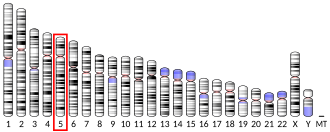
Protocadherin beta-13 is a protein that in humans is encoded by the PCDHB13 gene.34
Function
This gene is a member of the protocadherin beta gene cluster, one of three related gene clusters tandemly linked on chromosome five. The gene clusters demonstrate an unusual genomic organization similar to that of B-cell and T-cell receptor gene clusters. The beta cluster contains 16 genes and 3 pseudogenes, each encoding 6 extracellular cadherin domains and a cytoplasmic tail that deviates from others in the cadherin superfamily. The extracellular domains interact in a homophilic manner to specify differential cell-cell connections. Unlike the alpha and gamma clusters, the transcripts from these genes are made up of only one large exon, not sharing common 3' exons as expected. These neural cadherin-like cell adhesion proteins are integral plasma membrane proteins. Their specific functions are unknown but they most likely play a critical role in the establishment and function of specific cell-cell neural connections.4
References
References
Further reading
Further reading
- Yagi T, Takeichi M (2000). "Cadherin superfamily genes: functions, genomic organization, and neurologic diversity". Genes Dev. 14 (10): 1169–80. doi:10.1101/gad.14.10.1169. PMID 10817752. S2CID 44844497.
- Nollet F, Kools P, van Roy F (2000). "Phylogenetic analysis of the cadherin superfamily allows identification of six major subfamilies besides several solitary members". J. Mol. Biol. 299 (3): 551–72. doi:10.1006/jmbi.2000.3777. PMID 10835267.
- Frank M, Kemler R (2003). "Protocadherins". Curr. Opin. Cell Biol. 14 (5): 557–62. doi:10.1016/S0955-0674(02)00365-4. PMID 12231349.
- Wu Q, Maniatis T (2000). "Large exons encoding multiple ectodomains are a characteristic feature of protocadherin genes". Proc. Natl. Acad. Sci. U.S.A. 97 (7): 3124–9. doi:10.1073/pnas.060027397. PMC 16203. PMID 10716726.
- Wu Q, Zhang T, Cheng JF, et al. (2001). "Comparative DNA Sequence Analysis of Mouse and Human Protocadherin Gene Clusters". Genome Res. 11 (3): 389–404. doi:10.1101/gr.167301. PMC 311048. PMID 11230163.
- Vanhalst K, Kools P, Vanden Eynde E, van Roy F (2001). "The human and murine protocadherin-beta one-exon gene families show high evolutionary conservation, despite the difference in gene number". FEBS Lett. 495 (1–2): 120–5. doi:10.1016/S0014-5793(01)02372-9. PMID 11322959. S2CID 36671435.
- Strausberg RL, Feingold EA, Grouse LH, et al. (2003). "Generation and initial analysis of more than 15,000 full-length human and mouse cDNA sequences". Proc. Natl. Acad. Sci. U.S.A. 99 (26): 16899–903. Bibcode:2002PNAS...9916899M. doi:10.1073/pnas.242603899. PMC 139241. PMID 12477932.
- Clark HF, Gurney AL, Abaya E, et al. (2003). "The Secreted Protein Discovery Initiative (SPDI), a Large-Scale Effort to Identify Novel Human Secreted and Transmembrane Proteins: A Bioinformatics Assessment". Genome Res. 13 (10): 2265–70. doi:10.1101/gr.1293003. PMC 403697. PMID 12975309.
- Ota T, Suzuki Y, Nishikawa T, et al. (2004). "Complete sequencing and characterization of 21,243 full-length human cDNAs". Nat. Genet. 36 (1): 40–5. doi:10.1038/ng1285. PMID 14702039. S2CID 21903526.
- Gerhard DS, Wagner L, Feingold EA, et al. (2004). "The Status, Quality, and Expansion of the NIH Full-Length cDNA Project: The Mammalian Gene Collection (MGC)". Genome Res. 14 (10B): 2121–7. doi:10.1101/gr.2596504. PMC 528928. PMID 15489334.