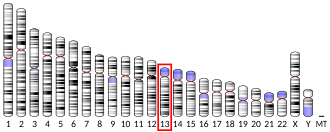
Protocadherin-17 is a protein that in humans is encoded by the PCDH17 gene.56
This gene belongs to the protocadherin gene family, a subfamily of the cadherin superfamily. The encoded protein contains six extracellular cadherin domains, a transmembrane domain, and a cytoplasmic tail differing from those of the classical cadherins. The encoded protein may play a role in the establishment and function of specific cell-cell connections in the brain.6 PCDH17 promoter methylation is found to be closely associated with bladder cancer malignancy 7
References
References
Further reading
Further reading
- Yagi T, Takeichi M (2000). "Cadherin superfamily genes: functions, genomic organization, and neurologic diversity". Genes Dev. 14 (10): 1169–80. doi:10.1101/gad.14.10.1169. PMID 10817752. S2CID 44844497.
- Suzuki ST (2000). "Recent progress in protocadherin research". Exp. Cell Res. 261 (1): 13–8. doi:10.1006/excr.2000.5039. PMID 11082270.
- Wu Q, Maniatis T (2000). "Large exons encoding multiple ectodomains are a characteristic feature of protocadherin genes". Proc. Natl. Acad. Sci. U.S.A. 97 (7): 3124–9. Bibcode:2000PNAS...97.3124W. doi:10.1073/pnas.060027397. PMC 16203. PMID 10716726.
- Strausberg RL, Feingold EA, Grouse LH, et al. (2003). "Generation and initial analysis of more than 15,000 full-length human and mouse cDNA sequences". Proc. Natl. Acad. Sci. U.S.A. 99 (26): 16899–903. Bibcode:2002PNAS...9916899M. doi:10.1073/pnas.242603899. PMC 139241. PMID 12477932.
- Ota T, Suzuki Y, Nishikawa T, et al. (2004). "Complete sequencing and characterization of 21,243 full-length human cDNAs". Nat. Genet. 36 (1): 40–5. doi:10.1038/ng1285. PMID 14702039. S2CID 21903526.
- Dunham A, Matthews LH, Burton J, et al. (2004). "The DNA sequence and analysis of human chromosome 13". Nature. 428 (6982): 522–8. Bibcode:2004Natur.428..522D. doi:10.1038/nature02379. PMC 2665288. PMID 15057823.
- Suzuki Y, Yamashita R, Shirota M, et al. (2004). "Sequence Comparison of Human and Mouse Genes Reveals a Homologous Block Structure in the Promoter Regions". Genome Res. 14 (9): 1711–8. doi:10.1101/gr.2435604. PMC 515316. PMID 15342556.
- Gerhard DS, Wagner L, Feingold EA, et al. (2004). "The Status, Quality, and Expansion of the NIH Full-Length cDNA Project: The Mammalian Gene Collection (MGC)". Genome Res. 14 (10B): 2121–7. doi:10.1101/gr.2596504. PMC 528928. PMID 15489334.
- Kimura K, Wakamatsu A, Suzuki Y, et al. (2006). "Diversification of transcriptional modulation: Large-scale identification and characterization of putative alternative promoters of human genes". Genome Res. 16 (1): 55–65. doi:10.1101/gr.4039406. PMC 1356129. PMID 16344560.
- Szafranski K, Schindler S, Taudien S, et al. (2007). "Violating the splicing rules: TG dinucleotides function as alternative 3' splice sites in U2-dependent introns". Genome Biology. 8 (8): R154. doi:10.1186/gb-2007-8-8-r154. PMC 2374985. PMID 17672918.