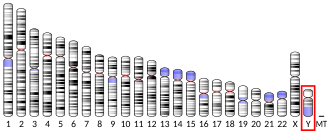
PCDH11Y is a Y-linked gene in the genus Homo that encodes protocadherin 11Y, a protein that guides the development of nerve cells. It is the Y-chromosomal paralog of PCDH11X, which is located on the X chromosome and thus common to both sexes in humans and some of our nearest relatives including chimpanzees.34 11X/Y are cadherin family genes, cell-adhesion molecules involved in neuronal signalling which attach to the surface of neurons.5 The X- and Y-isoforms respond in different ways to retinoic acid, a chemical involved in the development of embryos, which stimulates the activity of 11Y but suppresses that of 11X. It is one possible contributor towards the sex-biased neurophysiology of humans.3
Relevance to human evolution
It has been calculated that 11X transposed from the X to Y chromosome around three million years ago, perhaps coincident with the evolutionary expansion of human brain size and the first use of stone tools. A new intron and inversion also occurred in the 11Y around 120,000 to 200,000 years ago, coincident with the period of modern human expansion out of Africa (from which all non-African humans descend) and the onset of anthropologically modern culture termed behavioral modernity.5
British psychiatrist Tim Crow, who worked on the evolution of human psychiatric disease such as schizophrenia, proposed the gene is a major contributor to lateralisation, which he believed underlies human cognitive abilities. Humans are a strong outlier in brain lateralisation among primates, which among other effects gives rise to our relatively unique handedness trait.6 Further, there is a substantial bias towards right-handedness in all modern humans as compared to chimpanzees: 90% of humans will use their right hands for minor motor tasks, whereas chimpanzees display no preference.3 Crow suggested this precludes a random or cultural origin for right-preference, adding that true ambidexterity is associated with developmental delay and psychosis.7
References
References
- GRCh38: Ensembl release 89: ENSG00000099715 – Ensembl, May 2017
- "Human PubMed Reference:". National Center for Biotechnology Information, U.S. National Library of Medicine.
- "Science and Technology: The genetics of lateralisation". The Economist. 26 April 2001.
- Wilson ND, Ross LJ, Close J, Mott R, Crow TJ, Volpi EV (2007). "Replication profile of PCDH11X and PCDH11Y, a gene pair located in the non-pseudoautosomal homologous region Xq21.3/Yp11.2". Chromosome Research. 15 (4): 485–498. doi:10.1007/s10577-007-1153-y. PMC 2779385. PMID 17671842.
- Burne J (18 August 2001). "Y and Mighty". the Guardian. The Guardian.
- Püschel TA, Hurwitz RM, Venditti C (April 2026). "Bipedalism and brain expansion explain human handedness". PLoS Biology. 24 (4) e3003771. doi:10.1371/journal.pbio.3003771. PMC 13138751. PMID 42044164.
- "Why having it both ways is bad for you". The Guardian. 1999-07-20. ISSN 0261-3077. Retrieved 2026-06-26.