The PB 250 (later Raytheon 2501) was a general-purpose computer introduced in 1960 by the Packard Bell Corporation.23
Design
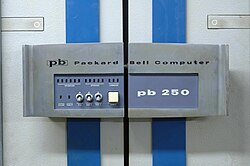
The word size was 22 bits and the memory could be expanded to a maximum of 16,000 words. The performance was 40,000 operations per second.4 It had the ability to operate as an I/O processor in tandem with another computer; at the time this was considered a "radically new feature" for a less expensive system.4 The Central Computer weighed 110 pounds (50 kg).567
The design started in November 1959. The computer was intended as a component in special purpose systems,2 for example, to control electric power plants.8 The logic design has similarities with the Bendix G-15 computer, which in turn was based on Alan Turing’s Pilot ACE.91011 The circuits were derived from the TRICE12 digital differential analyzer.513
People involved in development:
- Max Palevsky – general manager, started the development process.10
- Stanley Frankel – consultant on the design of the computer logic
- Robert Beck – designer of the computer logic1011
- Smil Ruhman – circuit design
- Jack Mitchell and Donald Cooper – management and coordination of the overall engineering project14
Features
The PB250 used a Flexowriter as a console.151617
It could be operated entirely from a battery power supply.51819
Software
- SNAP I (Symbolic Non-optimizing Assembly Program) assembler20
- ATRAN (Algebraic TRANslator), process oriented language21
- CINCH Interpreter, a floating point interpretive system, designed to permit rapid programming of scientific and engineering problems.522
- OUP III (Octal Utility Package III)23 which "allowed the operator to perform certain transfer functions, printout locations of memory, store single words into memory, and begin the execution of programs that had been stored in memory."1
- NELIAC compiler24
- Fortran II25
Uses
- By WANEF (Westinghouse Astronuclear Experiment Facility), whose task was to perform basic research and reactor analysis on the NRX series of nuclear reactors to be used in nuclear rocket engine.26
- In the Saturn 1 first stage checkout.1
- In TRICE models TC5108/250 and TC5036/25027 hybrid computers.
- In Hycomp 250 hybrid computer, later replaced by PB440.28
- In nuclear submarine training systems29 and in antisubmarine warfare trainers.30
- PB 250 was licensed to SETI (French: Société européenne de traitement de l'information, lit. 'European Information Processing Company').31 It could be connected to the SETI 2000 process control system.32
- In mobile (by van) monitoring and data processing services.333435
Bibliography
Bibliography
- Beck, Robert Mark (30 December 1960). PB-250 – A High Speed Serial General Purpose Computer Using Magnetostrictive Delay Line Storage. International Workshop on Managing Requirements Knowledge (AFIPS). p. 283. doi:10.1109/afips.1960.58.
The first production computer was delivered in October 1960.
- "The PB 250 General Purpose Digital Computer" (PDF). Computers and Automation. Vol. 9, no. 8. August 1960. pp. 1B–3B (9–11).
... was introduced by Packard Bell Computer Corporation at the Western Joint Computer Conference in May
- "PB-250 documents". www.bitsavers.org.
- "PB 250" (PDF). AUERBACH Standard EDP Reports. 7: 165–251.
- "Descriptions of Digital Computers" (PDF). Computers and Automation. Vol. XII, no. 6. June 1963. pp. 72, 82.
- "A Survey of New West-European Digital Computers (Part 1): France" (PDF). Computers and Automation. Vol. XII, no. 9. September 1963. p. 23.
- Kaisler, Stephen H. (2017). "Chapter Thirteen – Packard Bell". Birthing the Computer: From Drums to Cores. Cambridge Scholars Publishing. pp. 304–317. ISBN 978-1-4438-9625-2.
References
References
- Funderburk, B. J. (1 Jan 1968). "Automation in Saturn 1 first stage checkout". NASA Technical Note: 3, 6.
- Beck 1960, p. 283-284.
- Computers and Automation & Aug 1960, p. 1B (9). sfn error: no target: CITEREFComputers_and_AutomationAug_1960 (help)
- "Packard Bell Computer Corporation, PB250" (PDF). Digital Computer Newsletter. Vol. 12, no. 3. Office of Naval Research. July 1960. pp. 6–7. Retrieved 1 June 2022.
- Weik, Martin H. (Mar 1961). "PACKARD BELL 250". ed-thelen.org. A Third Survey of Domestic Electronic Digital Computing Systems.
For applications where power failures and resultant loss of memory cannot be tolerated a battery power supply is available which will operate the computer for several hours without line power.
- AUERBACH Standard EDP Reports & vol. 7, pp. 250.
- bitsavers, PBC1000r4_PB250techManVol1.pdf, p. 1-3 (13).
- "Packard Bell, Bailey Meter Sign Agreement". Los Angeles Times. Los Angeles. April 15, 1960.
Max Palevsky, Packard Bell Computer vice president, said power plants in the electric industry provide one of the most promising markets for digital computers.
- Smithsonian Lemelson Center (23 July 2014). "Computer Oral History Collection, 1969–1973, 1977: Harry Huskey and Mrs. Huskey". Lemelson Center for the Study of Invention and Innovation. AC0196_husk730419.pdf, pp. 15, 17, 19, 24.
- Smithsonian Lemelson Center (23 July 2014). "Computer Oral History Collection, 1969–1973, 1977: Max Palevsky". Lemelson Center for the Study of Invention and Innovation. AC0196_pale730215.pdf, pp. 4-5, 10-11.
- Palevsky, Max oral history | 102657969 | Computer History Museum. Computer History Museum. 29 August 2006. pp. 11, 14, 19 – via www.computerhistory.org.
- Weik, Martin H. (Jan 1964). "TRICE". ed-thelen.org. A Fourth Survey of Domestic Electronic Digital Computing Systems.
- Beck 1960, p. 285.
- Beck 1960, p. 287.
- Kaisler 2017, pp. 305, 309.
- Computers and Automation & Sep 1963. sfn error: no target: CITEREFComputers_and_AutomationSep_1963 (help)
-
- AUERBACH Standard EDP Reports & vol. 7, pp. 187–190, 199–200, 219
- bitsavers, SP-147_PB-250_RefMan.pdf, pp. 19-23
- bitsavers, PBC1002r1_PB250techManVol2.pdf, pp. 1-4 – 1-9 (16-18)
- bitsavers, PBC1004r1_PB250pgmRef_Mar61.pdf, pp. 4-1 – 4-7 (99-105)
- "Electronic Operations". Electronics Industries (2): 199. Feb 1961.
A battery-operated electronic computer, PB 250, has been shown by Packard Bell Computer Div., Packard Bell Electronics. In normal operation, it operates from a battery trickle charged from a 115-v. power line. If 115-v. input is interrupted, computer can continue operating for more than 1 hr.
- "BATTERY OPERATED COMPUTER" (PDF). Computers and Automation. 10 (2): 1B (17). Feb 1961. Retrieved 2020-09-05.
For the first time, we believe, an electronic computer can operate entirely from a battery power supply.
- Elliot 802 was an earlier computer with a battery:
- "Elliott 800 series and 503: 1957 onwards – Systems Architecture". www.ourcomputerheritage.org. pp. 2, 4. Archived from the original on 2015-10-02. Retrieved 2018-10-14.
- Elliot 802 was an earlier computer with a battery:
- AUERBACH Standard EDP Reports & vol. 7, pp. 170, 215–216, 227–228, 233–234.
- AUERBACH Standard EDP Reports & vol. 7, pp. 170, 213, 223–225, 235–237.
- AUERBACH Standard EDP Reports & vol. 7, pp. 170, 217, 229–231, 241–242.
- AUERBACH Standard EDP Reports & vol. 7, pp. 239
- bitsavers, PBC1004r1_PB250pgmRef_Mar61.pdf, pp. 129-155
- Computers and Automation & Jun 1963, p. 82. sfn error: no target: CITEREFComputers_and_AutomationJun_1963 (help)
- Fortran II for the Raytheon 250 Computer.
- Beene, J. L.; Rankin, W.D. (1 October 1964). Reactor experimentation and the Packard-Bell computer (Submitted manuscript). Office of Scientific and Technical Information (OSTI). doi:10.2172/4228429. OSTI 4228429. S2CID 108792184.
- Programming manual for TRICE and other material on DDA's 2nd edition | 102664334. Packard Bell Electronics. Packard Bell Computer. 3 May 1960 – via Computer History Museum.
- "HYCOMP 250—The first desk top hybrid analog/digital computing system". Packard Bell Computer. 1961 – via Computer History Museum.
- "Sperry orders two nuclear sub training systems" (PDF). "Across the editor's desk": Computer and Data Processing Newsletter. Computers and Automation. Vol. XII, no. 5. May 1963. p. 44. Retrieved 2020-09-05.
- Advances in Instrumentation: Proceedings of the ISA International Conference and Exhibit. Vol. 38. Instrument Society of America. 1983. p. 244. ISBN 9780876647806.
- Nieuwbourg, Philippe. "SETI Calculateur PB 250" [SETI Calculator PB 250]. Le blog de l'actualité du musée de l'informatique (in French).
- Computers and Automation 1963. sfn error: no target: CITEREFComputers_and_Automation1963 (help)
- "Chemical Plant Puts Computer on Wheels". Control Engineering. Vol. 8. Technical Publishing Company. 1961. p. 29.
- Business Automation. Vol. 8. Hitchcock Publishing Company. 1962. p. 48.
- "On-call data vans for hire" (PDF). "Across the editor's desk": New Firms, Divisions, and Mergers. Computers and Automation. Vol. XI, no. 7. July 1962. p. 28. Retrieved 2020-09-05.
External links
External links
- "the pb250 ad" (PDF). Computers and Automation. 9 (6): 76. Jun 1960. Retrieved 2020-09-05.
- "The PB-250". www.cca.org.
- "The Retro-Computing Society of RI, Inc". www.rcsri.org.