Pattin/Unqi | |||||||||
|---|---|---|---|---|---|---|---|---|---|
| Before 870 BC–738 BC | |||||||||
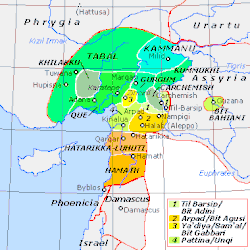 Pattin(a)/Unqi and its capital Kinalua among the Neo-Hittite states | |||||||||
| Capital | Kinalua | ||||||||
| Common languages | Luwian Aramaic | ||||||||
| Religion | Luwian religion | ||||||||
| Government | Monarchy | ||||||||
| Historical era | Iron Age | ||||||||
• Established | Before 870 BC | ||||||||
• Disestablished | 738 BC | ||||||||
| |||||||||
| Today part of | Turkey Syria | ||||||||


Pattin (also known as Pattina, Patina, Unqu and Unqi), was an ancient Luwian Neo-Hittite state at the beginning of the 1st millennium BC. It was known to the Assyrians as Unqi and Aramaeans as Unqu.
It was located at the north-western coast of ancient Syria, associated with the modern-day Hatay. The capital of the state was Kinalua (Kunalua, Kalneh, or Kinaluwa), which has been tentatively associated with Tell Tayinat1 in modern-day Turkey.
History
Iron Age
The state was formed in the 9th century BC towards the end of the Dark Age period, and shared a north-western border with the Neo-Hittite state of Quwê. Khazazu (modern-day Azaz) was one of Pattin's dependencies which was invaded by Assyria around 870 BC. The frontier fortress of Aribua (associated with the modern-day region of Idlib) within the land of Lukhuti to the immediate south of Pattin was also ravaged.23
List of kings
- Taita I (11th century)45
- Taita II (early 10th century)45
- Manana (10th century)4
- Suppiluliuma I (late 10th century)45
- Halparuntiya I (10th4 or early 9th century)5
- Lubarna I (c. 870/875 – 858?)46
- Suppiluliuma II (Assyrian Sapalulme, fl. 858–857)46
- Halparuntiya II (Assyrian Qalparunda, fl. 857–853)46
- Lubarna II (829,4 died 831)6
- Surri (831)6
- Sasi (from 831)6
- ...
- Tutammu (died 738)6
The name Suppiluliuma corresponds to the Assyrian Sapalalme and Halparuntiya to Qalparunda.4
References
References
- See the Tayinat Website by the Department of Near & Middle Eastern Civilizations at the University of Toronto
- Syria-Hittite, Pattin
- History files:Aleppo
- Mark Weeden (2013), "After the Hittites: The Kingdoms of Karkamish and Palistin in Northern Syria" (PDF), Bulletin of the Institute of Classical Studies, 56 (2): 15, doi:10.1111/j.2041-5370.2013.00055.x, JSTOR 44254129.
- Belkıs Dinçol; Ali Dinçol; J. D. Hawkins; Hasan Peker; Aliye Öztan (2015), "Two New Inscribed Storm-god Stelae from Arsuz (İskenderun): ARSUZ 1 and 2", Anatolian Studies, 65: 63, doi:10.1017/S006615461500006X.
- Trevor Bryce (2012), The World of the Neo-Hittite Kingdoms: A Political and Military History, Oxford University Press, pp. 130–133.