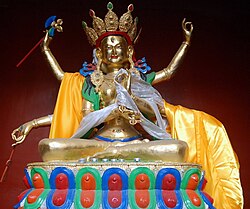
Parnashavari (IAST: Parṇaśabarī, Tibetan: Lomagyuma Sanskrit: पर्णशबरी), also spelt as Paranasavari (Paranasabari),12 is a Hindu deity adopted as Buddhist deity of diseases, worship of which is believed to offer effective protection against out-breaks of epidemics.3
Parnasabari is also depicted in some images of the Pala period found in Dhaka, as a main goddess and escorted by Hindu deities Jvarasura and Shitala.4 Both of these escorts are disease related Hindu deities.4 In India, the Kurkihar hoard contains seven bronze images of Parnasabari belonging to 10th–12th century AD.5
In Buddhism, Parnasabari is depicted as an attendant of the Mother Goddess Tara.1 Some say that the term Parnasabari is an attempt to connect the deity with Vindya region, as Sabaras held a stronghold over the region.1
References
References
- Reflections on the Tantras. S̄udhakar Chattopadhyaya. 1978. p. 76. ISBN 9788120806917.
- The social function of art by Radhakamal Mukerjee. Philosophical Library. 1954. p. 151. ISBN 9780802211682.
{{cite book}}: ISBN / Date incompatibility (help) - Bhattacharyya, Benoytosh (1958). The Indian Buddhist Iconography art. Aryan Books International. p. 520. ISBN 9788173053139.
{{cite book}}: ISBN / Date incompatibility (help) - Studies in Hindu and Buddhist art. By P. K. Mishra. 1999. p. 107. ISBN 9788170173687.
- History of the tantric religion: a historical, ritualistic, and philosophical study. Narendra Nath Bhattacharyya. 1982. p. 394. ISBN 9788173040252.