Article · Wikipedia archive · Last revised Jun 13, 2026

Parker variable wing

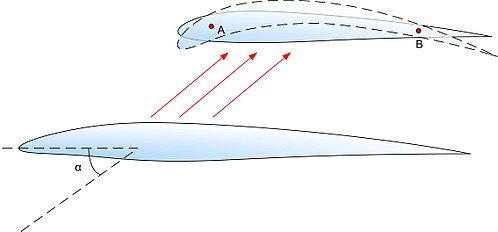
The Parker variable wing is a wing configuration in biplane or triplane aircraft designed by H.F. Parker in 1920. His design allows a supplement in lift while landing or taking-off. The system is depicted in the figure. The figure shows the biplane configuration. The lower airfoil is rigid. The upper airfoil is flexible. At high angle of attack the flow over the lower airfoil will cause the airflow to bend up and create an upward force at the lower surface of the upper airfoil. This upward force will cause the flexible section to be pushed upward. The flexible wing section is held at points A and B. The trailing edge is rigid and can rotate about point B. Due to this effect the camber of the airfoil is increased, and hence the lift it creates is increased.

Last revised
Jun 13, 2026
Read time
≈ 1 min
Length
176 w
Citations
1
Source
Parker Variable wing
Parker Variable wing source ↗

The Parker variable wing is a wing configuration in biplane or triplane aircraft designed by H.F. Parker in 1920.1 His design allows a supplement in lift while landing or taking-off. The system is depicted in the figure. The figure shows the biplane configuration. The lower airfoil is rigid. The upper airfoil is flexible. At high angle of attack the flow over the lower airfoil will cause the airflow to bend up and create an upward force at the lower surface of the upper airfoil. This upward force will cause the flexible section to be pushed upward. The flexible wing section is held at points A and B. The trailing edge is rigid and can rotate about point B. Due to this effect the camber of the airfoil is increased, and hence the lift it creates is increased.

See also

See also

References

References

  1. H. F Parker "The Parker Variable Camber Wing", NACA Report 77 (PDF), 1920. National Advisory Committee for Aeronautics. Retrieved 6 March 2026