Parashara | |
|---|---|
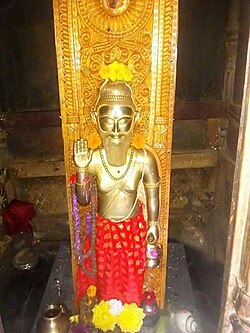 A sculpture of Parashara | |
| Personal life | |
| Children | Vyasa (with Satyavati)12 |
| Parents | |
| Religious life | |
| Religion | Hinduism |
Parashara (Sanskrit: पराशर; IAST: Parāśara) is a historical maharishi and credited as the author of several ancient Hindu texts, including the original Vishnu Purana (the first Purana), before his son Vyasa rewrote it.
He is the grandson of the sage Vasishtha and the son of the sage Shakti. Several texts refer to Parashara as an author or speaker. The texts attributed to him often present Parashara as speaking to a student.4
Origin of the Name
According to legend, Vasishtha, Parashara's grandfather attempted to commit suicide after Parashara's father Shakti and his other sons were devoured by the king Kalmashapada. He jumped from Mount Meru only to land on soft cotton. He then entered a forest fire only to remain unscathed, dove into the ocean but was cast ashore, and jumped in the overflowing river Vipasa only to end up on the banks. Finally, he jumped into the river Haimavat. The river, out of fear, split itself in several directions thus obtaining the name Satadru.
When he returned to his ashram, he saw that his daughter-in-law was pregnant. When the son was born, Vashistha acted as the child's father and gave up his attempts at suicide. The child was named Parashara which means enlivener of the dead.5
Genealogy
According to the Vedas, the god Brahma created Vasishtha (reborn to Mitra-Varuna), who, with his wife Arundhati, had a son named Shakti who sired Parashara. With Satyavati of the Kaivartta clan6, Parashara was the father of Vyasa. Vyasa sired Dhritarashtra and Pandu through his deceased half-brother's wives, Ambika and Ambalika, and Vidura through a hand-maiden of Ambika and Ambalika. Vyasa also sired Shuka through his wife, Jabali's daughter Pinjala. Thus Parashara was the biological grandfather of both the warring parties of the Mahabharata, the Kauravas and the Pandavas (though some think that the Pandavas were offspring of various gods and Kunti).
Legend
Parashara's biological father, the sage Shakti, died before Parashara's birth. As a result of this Vasishtha, Shakti's father, brought Adrushyanti (Parashara's biological mother and wife of Shakti) into his hermitage. When Vasishtha hears the chanting of the Vedas, Adrushyanti tells him that the sounds were coming from his unborn grandson in her womb, which gladdens Vasishtha. Adrushyanti gives birth to her son and the child grows up to become Parashara.7
Raised under the tutelage of his grandfather Vasistha, Parashara grows up in the shadow of a tragic legacy. His father, Shakti Muni, meets a gruesome end while traveling through a dense forest. There, he encounters King Kalmashapada, who has been transformed into a cannibalistic Rakshasa due to a curse; ironically which was curse originally provoked by a dispute with Shakti himself. Driven by demonic hunger and the weight of the spell, the Rakshasa devours Shakti, leaving the young Parashara fatherless. This profound loss kindles a fierce, vengeful fire within the boy. As recorded in the Vishnu Purana, Parashara’s resentment is so potent that he initiates a grand sacrificial ritual intended to annihilate every Rakshasa in existence, an act of retribution that only the wisdom and intervention of Vasishtha could eventually temper.
I had heard that my father had been devoured by a Rākṣasa employed by Vishwamitra: violent anger seized me and I commenced a sacrifice for the destruction of the Rākṣasas: hundreds of them were reduced to ashes by the rite, when, as they were about to be entirely exterminated, my grandfather Vasishtha said to me: Enough, my child; let thy wrath be appeased: the Rākṣasas are not culpable: thy father's death was the work of destiny. Anger is the passion of fools; it becometh not a wise man. By whom, it may be asked, is anyone killed? Every man reaps the consequences of his own acts. Anger, my son, is the destruction of all that man obtains by arduous exertions, of fame, and of devout austerities; and prevents the attainment of heaven or of emancipation. The chief sages always shun wrath: be not subject to its influence, my child. Let no more of these unoffending spirits of darkness be consumed. Mercy is the might of the righteous.8
Parashara once halted for a night in a little hamlet on the banks of the river Yamuna. He was put up in the house of the fisherman-chieftain Dasharaj. When dawn broke, the chief asked his daughter, Matsyagandha, whose name means "one with the smell of fish", to ferry the sage to his next destination. When in the ferry, Parashara who was also a pioneer in the field of vedic astrology, noticed the position of the stars and concluded that an auspicious time had begun in which the Lord had to descend onto this world, and asks her to fulfill his desire of helping the Lord descend by giving a son to her. Matsyagandha refuses fearing the other people and sages who were standing on the bank of river at the other side.1
He then creates an island within the river by his mystic potency and asks her to land the boat there. On reaching the other side, the sage once again chants the mantra to make her pregnant, but she declares that her body stank and Parashara grants her the boon that the finest fragrance may emit from her person. She was thereafter known as Satyavati (pure fragrance).1 Matsyagandha was transformed (by the powers of the sage) into Yojanagandha ("she whose fragrance can be smelled from across a yojana").9 She now smells of musk, and so was called Kasturi-Gandhi ("musk-fragrant").1 Then, she insists that the act of getting a child was not appropriate in broad daylight, as her father and others would see them from the other bank; they should wait till night. The sage, with his powers, shrouds the entire area in fog. Then, Parashara embraces her and by his mystic power, she becomes pregnant with Krishna Dvaipāyana Veda Vyasa, who is dark-complexioned and hence is called by the name Krishna (black) and also the name Dwaipayana, meaning 'island-born'. Later, Parashara takes him with himself and trains him in vedic studies. He later compiles the classic Vedic literatures of India, and so is called Vyasa who is the 17th incarnation of Lord Vishnu. Later, Satyavati returns to her father's house and in due course, marries Śantanu.1
In Anushasana Parva of Mahabharata, Parashara tells Yudhisthira that he prayed to Shiva. His desire is to obtain a son with great ascetic merit, endued with superior energy, earn world-wide fame, and arrange the Vedas. Shiva appears and grants him his wishes and in addition, he tells him that his son Krishna will be one of the Saptarshis of Savarni manvantara, be immortal by being freed of diseases, and he will be friend of Indra.10
Parashara is known as the "limping sage". He has his leg wounded during an attack on his āśrama. When a ṛṣi dies he merges back into an element or an archetype. When Sage Parashara is walking through a dense forest he and his students are attacked by wolves. He was unable to get away in his old age with a lame leg and he left this world merging into the wolves.11
Rigveda
In the Rigveda, Parashara, son of Shakti (Parāśara Śāktya), is the seer of verses 1.65-73 which are all in praise of Agni (the sacred fire), and part of 9.97 (v.31-44) which is in praise of Soma. Below is 1.73.2:
devo na yaḥ savitā satyamanmā kratvā nipāti vṛjanāni viṣvā
purupraṣasto amatirna satya ātmeva Sevo didhiṣāyyo bhūt
He who is like the divine Sun, who knows the truth (of all things), preserves by his actions (his votaries) in all encounters; like nature,
he is unchangeable and, like soul, is the source of all happiness: he is ever to be cherished.12
Texts attributed to Parashara
- Parashara Smriti (also called Parashara Dharma Samhita): a code of laws which is stated in the text (1.24) to be for Kali Yuga.13
- Speaker of Viṣṇu Purana to Maitreya.14
- Speaker in Brihada Vishnu Purana to Maitreya.15
- Speaker of the Bṛhat Parāśara Horāśāstra, abbreviated as BPHS. It is considered a foundational text of Hindu astrology.
- Speaker of the Vṛkṣāyurveda ("the science of life of trees"), one of the earliest texts on botany.16 This text was considered to be an ancient botany primer for students of Traditional Indian Medicine.
- Parashar Gita - philosophical dialogues with King Janaka.17
Notes
Notes
- Mani, Vettam (1975). Puranic Encyclopaedia: A Comprehensive Dictionary With Special Reference to the Epic and Puranic Literature. Delhi: Motilal Banarsidass. pp. 885 (Vyāsa). ISBN 0-8426-0822-2.
- Dalal, Roshen (18 April 2014). Hinduism: An Alphabetical Guide. Penguin UK. ISBN 9788184752779.
- Bhiḍe, Śrīpāda Raghunātha (1996). Wife of Sakti Maharsi. Dastanbe Ramchandra & Company. ISBN 9788185080987.
- "Rishi Parashara". www.speakingtree.in.
- Pratap Chandra Roy's Mahabharata Adi Parva Pages: 406-410
- Sen, Kshitimohan (1997). Jatived (in Bengali). Shantiniketan: Visva-Bharati University. pp. 46, 49.
- "Puranic encyclopaedia: comprehensive dictionary with special reference to the epic and Puranic literature". archive.org. 1975.
- "The Vishnu Purana: Book I: Chapter I". www.sacred-texts.com. Retrieved 25 June 2023.
- Bhattacharya, Pradip (May–June 2004). "Of Kunti and Satyawati: Sexually Assertive Women of the Mahabharata" (PDF). Manushi (142): 21–25.
- "The Mahabharata, Book 13: Anusasana Parva: Anusasanika Parva: Section XVIII". www.sacred-texts.com. Retrieved 13 November 2022.
- Munshi, K. M. The Book of VedaVyaasa: The Master.
- Rgveda 1.73.2 Translation by H.H.Wilson
- "There, at the beginning, he describes the precept of religion and its characteristics" (PDF).
- Flood, Gavin. An Introduction to Hinduism.
- धर्मनाथ शर्मा (1980). वृहद्विष्णुपुराणीय मिथिला माहात्म्यम्. कामेश्वर सिंह दरभंगा संस्कृत विश्वविद्यालय.
- A Concise History of Science in India (Eds.) D. M. Bose, S. N. Sen and B.V. Subbarayappa. Indian National Science Academy. 15 October 1971. p. 56.
- www.wisdomlib.org (25 October 2023). "Parāśara-gītā (Summary)". www.wisdomlib.org. Retrieved 20 November 2024.
References
References
- Flood, Gavin (1996). An Introduction to Hinduism. Cambridge: Cambridge University Press. ISBN 0-521-43878-0.
- Ganguli, Kisari Mohan. "The Mahabharata of Krishna-Dwaipayana Vyasa" published between 1883 and 1896, The Mahabharata, Book 12: Santi Parva: Section CCCL
- Monier-Williams, Sanskrit Dictionary (1899).
- Munshi, K.M. "The Book of VedaVyaasa: The Master". Bharatiya Vidya Bhavan, Bombay, 1971.
- Wilson, H. H. (2006). The Vishnu Purana: A System of Hindu Mythology and Tradition. Cambridge: Read Country Books. ISBN 1-84664-664-2.
- Translation and commentary Brihat Parāśara Hora Sastra
- Translation to Portuguese Brihat Parāśara Hora Shastra