| Paralouatta Temporal range: Early Miocene-Quaternary
| |
|---|---|
| |
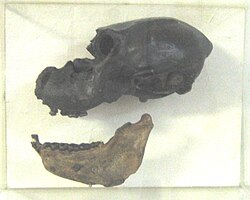
| Paralouatta marianae skull | |
Scientific classification 
| |
| Kingdom: | Animalia |
| Phylum: | Chordata |
| Class: | Mammalia |
| Infraclass: | Placentalia |
| Order: | Primates |
| Family: | Atelidae |
| Subfamily: | Alouattinae |
| Genus: | †Paralouatta Rivero & Arredondo 1991 |
| Type species | |
| †Paralouatta varonai Rivero & Arredondo 1991
| |
| Species | |
| |
Paralouatta is a platyrrhine genus that currently contains two extinct species of small primates that lived on the island of Cuba.
Description
Paralouatta varonai was described from a nearly complete cranium from the late Quaternary in 1991. This cranium and a number of isolated teeth and postcranial bones were found in the Cueva del Mono, a cave site in Pinar del Río Province. The initial description of the cranium included a proposal that Paralouatta varonai was a close Caribbean relative of the extant Alouatta (howler monkeys) of Central and South America,1 but this taxonomic placement was called into question with the analysis of the dental remains.2 Based on shared similarities with the three other Caribbean monkeys, Xenothrix mcgregori, Insulacebus toussaintiana, and Antillothrix bernensis, MacPhee and Horovitz have proposed that the Caribbean primates are part of a monophyletic radiation which entered the Caribbean at the Oligocene–Miocene boundary. Further research confirms this assessment and places these three species in the tribe Xenotrichini.3 However, more recent research restores its close relationship with Alouatta.4 The postcranial morphology of Paralouatta suggests that it was partly terrestrial,5 and a likely example of island gigantism.6
A second species of Paralouatta (P. marianae) has also been described from the Burdigalian (~18 million years old) Lagunitas Formation and is the largest Neotropic primate known of that epoch.6
Paleobiology
Paralouatta had an estimated body mass of 8.4 kg (19 lb).4 Analysis of postcranial morphology suggests that Paralouatta was at least somewhat semi-terrestrial, making it the most terrestrial platyrrhine genus known.7
References
References
- Rivero, M. & Arredondo, O. (1991). "Paralouatta varonai, a new Quaternary platyrrhine from Cuba". Journal of Human Evolution. 21 (1): 1–11. Bibcode:1991JHumE..21....1R. doi:10.1016/0047-2484(91)90032-Q.
- Horovitz, I. & MacPhee, R.D.E. (1999). "The quaternary Cuban platyrrhine Paralouatta varonai and the origin of the Antillean monkeys". Journal of Human Evolution. 36 (1): 33–68. Bibcode:1999JHumE..36...33H. doi:10.1006/jhev.1998.0259. PMID 9924133.
- MacPhee, R.D.E. & Horovitz, I. (2004). "New Craniodental Remains of the Quaternary Jamaican Monkey Xenothrix mcgregori (Xenotrichini, Callicebinae, Pitheciidae), with a Reconsideration of the Aotus Hypothesis". American Museum Novitates (3434): 1–51. doi:10.1206/0003-0082(2004)434<0001:NCROTQ>2.0.CO;2. S2CID 86051925.
- Silvestro, Daniele; Tejedor, Marcelo F.; Serrano-Serrano, Martha L.; Loiseau, Oriane; Rossier, Victor; Rolland, Jonathan; Zizka, Alexander; Höhna, Sebastian; Antonelli, Alexandre; Salamin, Nicolas (2019), "Early Arrival and Climatically-Linked Geographic Expansion of New World Monkeys from Tiny African Ancestors", Systematic Biology, 68: 78–92, bioRxiv 10.1101/178111, doi:10.1093/sysbio/syy046, PMC 6292484
- Püschel, Thomas A.; Marcé-Nogué, Jordi; Gladman, Justin; Patel, Biren A.; Almécija, Sergio; Sellers, William I. (2020). "Getting Its Feet on the Ground: Elucidating Paralouatta's Semi-Terrestriality Using the Virtual Morpho-Functional Toolbox". Frontiers in Earth Science. 8: 79. Bibcode:2020FrEaS...8...79P. doi:10.3389/feart.2020.00079. ISSN 2296-6463.
- MacPhee, R.D.E.; Iturralde-Vinent, M.A. & Gaffney, E.S. (February 2003). "Domo de Zaza, an Early Miocene Vertebrate Locality in South-Central Cuba, with Notes on the Tectonic Evolution of Puerto Rico and the Mona Passage". American Museum Novitates (3394): 1–42. doi:10.1206/0003-0082(2003)394<0001:DDZAEM>2.0.CO;2. hdl:2246/2820. S2CID 55615855.
- Püschel, Thomas A.; Marcé-Nogué, Jordi; Gladman, Justin; Patel, Biren A.; Almécija, Sergio; Sellers, William I. (2020). "Getting Its Feet on the Ground: Elucidating Paralouatta's Semi-Terrestriality Using the Virtual Morpho-Functional Toolbox". Frontiers in Earth Science. 8. Bibcode:2020FrEaS...8...79P. doi:10.3389/feart.2020.00079. ISSN 2296-6463.