| New Testament manuscript | |
 Recto John 8:14–18 | |
| Name | P. Oxy. XV 1780 |
|---|---|
| Text | John 8 † |
| Date | 3rd century |
| Script | Greek |
| Found | Egypt |
| Now at | The Green Collection |
| Cite | Grenfell & A. S. Hunt, Oxyrhynchus Papyri XV, 1922, pp. 7-8. |
| Size | 26 by 16 cm |
| Type | Alexandrian text-type |
| Category | I |
Papyrus 39 is an early copy of the New Testament in Greek. It is a papyrus manuscript of the Gospel of John in a fragmentary condition, containing only John 8:14-22. It is designated by the siglum 𝔓39 in the Gregory-Aland numbering of New Testament manuscripts. Using the study of comparative writing styles (palaeography), it has been assigned to the 3rd century CE.
Description
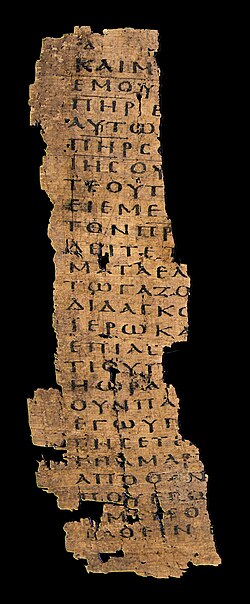
The manuscript was likely written by professional scribe, in 25 lines per page, in large, beautiful letters. It has numbered pages.1 Biblical scholar Don Barker proposes a wider and earlier range of dates for Papyrus 39, along with Uncial 0232, Papyrus 88 and Uncial 0206; and states that all four could be dated as early as the late second century or as late as the end of the fourth century.2
Text
The Greek text of this codex is considered a representative of the Alexandrian text-type (or more likely proto-Alexandrian). Biblical scholar Kurt Aland placed it in Category I of his New Testament manuscript classification system.3 𝔓39 shows agreement with Vaticanus and 𝔓75.1 There are no singular readings.4
Papyrologist Guglielmo Cavallo published a facsimile of 𝔓39 in 1967.5 The manuscript now resides in the Green Collection and is featured at the Museum of the Bible in Washington, D.C.
References
References
- Comfort, Philip Wesley; David P. Barrett (2001). The Text of the Earliest New Testament Greek Manuscripts. Wheaton, Illinois: Tyndale House Publishers. p. 147. ISBN 978-0-8423-5265-9.
- Barker, Don (2009). "How long and old is the codex of which P.Oxy 1353 is a leaf?". In Evans, Craig. A.; Zacharias, H. Daniel (eds.). Jewish and Christian Scripture as Artifact and Canon. London: T&T Clark. pp. 192–202. ISBN 978-0-567-58485-4.
- Aland, Kurt; Aland, Barbara (1995). The Text of the New Testament: An Introduction to the Critical Editions and to the Theory and Practice of Modern Textual Criticism. Translated by Erroll F. Rhodes. Grand Rapids: William B. Eerdmans Publishing Company. p. 98. ISBN 978-0-8028-4098-1.
- Head, Peter M. (2004). "The Habits of New Testament Copyists Singular Readings in the Early Fragmentary Papyri of John". Biblica. 85: 399-408.
- Cavallo, Guglielmo (1967). Ricerche sulla Maiuscola Biblica. Vol. 2. Florence: Le Monnier. p. plate 27.
Further reading
Further reading
- Grenfell, Bernard Pyne; Hunt, Arthur Surridge (1922). Oxyrhynchus Papyri. Vol. XV. London: Exploration Egypt Fund. pp. 7–8.
External links
External links
- Digital Images of 𝔓39 online at the CSNTM
- Robert B. Waltz. 'NT Manuscripts: Papyri, Papyri 𝔓39.'