| Panulirus marginatus | |
|---|---|

| |
Scientific classification 
| |
| Kingdom: | Animalia |
| Phylum: | Arthropoda |
| Clade: | Pancrustacea |
| Class: | Malacostraca |
| Order: | Decapoda |
| Suborder: | Pleocyemata |
| Family: | Palinuridae |
| Genus: | Panulirus |
| Species: | P. marginatus
|
| Binomial name | |
| Panulirus marginatus | |
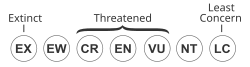
Panulirus marginatus, also known as the Hawaiian spiny lobster, banded spiny lobster, or ula in Hawaiian, is a species of spiny lobster in the family Palinuridae which is endemic to the Hawaiian Islands. It is the subject of extensive commercial and recreational fisheries.
Description
P. marginatus can reach a total body length of about 40cm, with its carapace length reaching about 12cm2. They have an exoskeleton that encases them and protects them from predators3. This exoskeleton is molted periodically as the lobster grows and ages4. Shortly after molting, the lobsters are in a more vulnerable state and therefore go deep into their hiding so that they can be safer until their carapace hardens once again4. Spiny lobsters do not have the large claws like some other lobster species4.
Distribution & habitat
P. marginatus is endemic to the Hawaiian Islands, as its colloquial name, Hawaiian spiny lobster, implies. They can be found anywhere from the Hawaiian Islands to the Pearl and Hermes Atoll, and have also been found around Laysan Island4.
They are usually found in shallow, warm waters around 62m deep and between 23 - 24°C (73.4 - 75.2°F)5. They are nocturnal and known to hide in protected spaces under rocks and in crevices4.
Human consumption
P. marginatus are often eaten, raw or cooked6. They are easy to find and catch due to often being found in shallow waters4. They are now a protected species in Hawaii, and regulations work to maintain their population4. These regulations state that no spiny lobsters may be caught between May and August, and no females with eggs may ever be taken6.
Cultural significance
P. marginatus was sometimes used in place of pigs during religious sacrificial offerings6.
References
References
- Butler, M.; Cockcroft, A.; MacDiarmid, A. (2011). "Panulirus marginatus". IUCN Red List of Threatened Species. 2011 e.T170067A6724412. doi:10.2305/IUCN.UK.2011-1.RLTS.T170067A6724412.en. Retrieved 20 November 2021.
- "Haw. Code R. § 13-95-53 - Spiny lobster". LII / Legal Information Institute. Retrieved 2026-04-09.
- Sarita (2025-08-17). "The Anatomy of a Lobster - Learn More". Burger & Lobster. Retrieved 2026-04-09.
- "Hawaiian Spiny Lobster". Waikīkī Aquarium. 2013-11-21. Retrieved 2026-04-02.
- "Spiny Lobster Survival in a Warming Ocean: The Role of Temperature in Altering Lobster Metabolism and Predation". Marine Biology 4 All. Retrieved 2026-04-02.
- "Spiny Lobster | Hawiian Marine LIfe". Maui Ocean Center. Retrieved 2026-04-02.
External links
External links
- https://spo.nmfs.noaa.gov/sites/default/files/pdf-content/MFR/mfr552/mfr5525.pdf
- https://www.waikikiaquarium.org/experience/animal-guide/invertebrates/crustaceans/hawaiian-spiny-lobster/
- https://mauioceancenter.com/marine-life/spiny-lobster/
- http://species-identification.org/species.php?species_group=lobsters&menuentry=soorten&id=158&tab=refs
- https://reefguide.org/bandedspinylobster.html