| Pandaceae | |
|---|---|
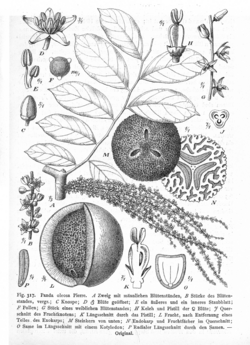
| |
| Panda oleosa | |
Scientific classification 
| |
| Kingdom: | Plantae |
| Clade: | Embryophytes |
| Clade: | Tracheophytes |
| Clade: | Spermatophytes |
| Clade: | Angiosperms |
| Clade: | Eudicots |
| Clade: | Rosids |
| Order: | Malpighiales |
| Family: | Pandaceae Engl. & Gilg1 |
| Genera | |
|
See text | |
The family Pandaceae consists of three genera that were formerly classified as the tribe Galearieae in the subfamily Acalyphoideae of family Euphorbiaceae. Those are:
These genera contain 17 species,2 which especially live in West Africa or Southeast Asia.3
Species in this family are dioecious trees or shrubs, with alternate, simple leaves.4
The genus Centroplacus was formerly included in the Pandaceae and had also been recognized in the tribe Centroplaceae of family Phyllanthaceae. The APG III system recognized this genus as a part of the family Centroplacaceae.1
References
References
- Angiosperm Phylogeny Group (2009), "An update of the Angiosperm Phylogeny Group classification for the orders and families of flowering plants: APG III", Botanical Journal of the Linnean Society, 161 (2): 105–121, doi:10.1111/j.1095-8339.2009.00996.x, hdl:10654/18083
- Christenhusz, M. J. M.; Byng, J. W. (2016). "The number of known plants species in the world and its annual increase". Phytotaxa. 261 (3). Magnolia Press: 201–217. doi:10.11646/phytotaxa.261.3.1.
- Stephens, P.F. (2001 onwards). Angiosperm Phylogeny Website. Version 9, June 2008. http://www.mobot.org/MOBOT/Research/APweb/
- Wurdack, Kenneth J.; Hoffmann, Petra; Samuel, Rosabelle; Bruijn, Anette; Bank, Michelle; Chase, Mark W. (2004). "Molecular phylogenetic analysis of Phyllanthaceae (Phyllanthoideae pro parte, Euphorbiaceae sensu lato) using plastid RBCL DNA sequences". American Journal of Botany. 91 (11): 1882–1900. doi:10.3732/ajb.91.11.1882. PMID 21652335.