 Molecular structure of paltusotine | |
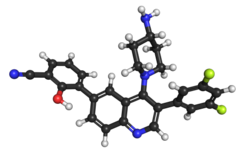 3D representation of a paltusotine molecule | |
| Clinical data | |
|---|---|
| Trade names | Palsonify |
| AHFS/Drugs.com | Multum Consumer Information |
| MedlinePlus | a625106 |
| License data |
|
| Routes of administration | By mouth |
| Drug class | Somatostatin receptor agonist |
| ATC code | |
| Legal status | |
| Legal status | |
| Identifiers | |
| |
| CAS Number |
|
| PubChem CID | |
| DrugBank | |
| ChemSpider | |
| UNII |
|
| KEGG | |
| PDB ligand | |
| Chemical and physical data | |
| Formula | C27H22F2N4O |
| Molar mass | 456.497 g·mol−1 |
| 3D model (JSmol) | |
| |
| |
Paltusotine, sold under the brand name Palsonify, is a medication used for the treatment of acromegaly.1 It is a somatostatin receptor 2 agonist.1 It is taken by mouth.1 It was developed by Crinetics Pharmaceuticals.
The most common side effects include diarrhea, abdominal pain, nausea, decreased appetite, bradycardia, hyperglycemia, and gastroenteritis (stomach inflammation).4
Paltusotine was approved for medical use in the United States in September 2025.4
Medical uses
Paltusotine is indicated for the treatment of adults with acromegaly who had an inadequate response to surgery and/or for whom surgery is not an option.14
Acromegaly is a rare endocrine disorder that causes some bones, organs, and other tissue to grow bigger.4 The pituitary gland in the brain causes these changes by making too much growth hormone due to the presence of a non-cancerous tumor.4
Adverse effects
Paltusotine increases the risk of cholelithiasis (gallstones); hyperglycemia (high blood sugar); hypoglycemia (low blood sugar); bradycardia (low heart rate); thyroid function abnormalities; steatorrhea (excessive fat in the stool) and malabsorption of dietary fats; and changes in vitamin B12 levels.4
The most common side effects are diarrhea, abdominal pain, nausea, decreased appetite, bradycardia, hyperglycemia, and gastroenteritis (stomach inflammation).4
History
The safety and efficacy of paltusotine were evaluated in two randomized, double-blind, placebo-controlled, phase III studies.4
In study 1, 111 adults with acromegaly received paltusotine or placebo.4 The primary endpoint was the proportion of participants achieving biochemical control (defined as insulin-like growth factor [IGF-1] and GH levels within the normal range).4 At 24 weeks, 56% of participants who received paltusotine had achieved biochemical control compared to 5% of participants who had received placebo.4
In study 2, 58 adults with acromegaly who were previously treated with and responded to other medical therapy received paltusotine or placebo.4 At 36 weeks, 83% of participants switching to paltusotine in study 2 maintained biochemical control compared to 4% of participants receiving placebo.4
Society and culture
Legal status
Paltusotine was approved for medical use in the United States in September 2025.5
Names
Paltusotine is the international nonproprietary name.6
Paltusotine is sold under the brand name Palsonify.1
References
References
- "Palsonify- paltusotine tablet, film coated". DailyMed. 16 September 2025. Retrieved 12 July 2026.
- "Palsonify EPAR". European Medicines Agency (EMA). 27 February 2026. Retrieved 7 June 2026.
- "Palsonify PI". Union Register of medicinal products. 27 April 2026. Retrieved 7 June 2026.
- "FDA approves new treatment for acromegaly, a rare endocrine disorder". U.S. Food and Drug Administration (FDA). 26 September 2025. Retrieved 27 September 2025. This article incorporates text from this source, which is in the public domain.
- "Crinetics Announces FDA Approval of Palsonify (paltusotine) for the Treatment of Adults with Acromegaly" (Press release). Crinetics Pharmaceuticals. 25 September 2025. Retrieved 27 September 2025 – via GlobeNewswire.
- "International nonproprietary names for pharmaceutical substances (INN): recommended INN: list 83". WHO Drug Information. 34 (1). 2020. hdl:10665/339768.
Further reading
Further reading
- Gadelha, Monica R; Gordon, Murray B; Doknic, Mirjana; Mezősi, Emese; Tóth, Miklós; Randeva, Harpal; et al. (April 2023). "ACROBAT Edge: Safety and Efficacy of Switching Injected SRLs to Oral Paltusotine in Patients With Acromegaly". The Journal of Clinical Endocrinology & Metabolism. 108 (5): e148–e159. doi:10.1210/clinem/dgac643. PMC 10099171. PMID 36353760. S2CID 253445337.
- Madan, Ajay; Markison, Stacy; Betz, Stephen F.; Krasner, Alan; Luo, Rosa; Jochelson, Theresa; et al. (April 2022). "Paltusotine, a novel oral once-daily nonpeptide SST2 receptor agonist, suppresses GH and IGF-1 in healthy volunteers". Pituitary. 25 (2): 328–339. doi:10.1007/s11102-021-01201-z. PMC 8894159. PMID 35000098.
- Zhao, Jian; Wang, Shimiao; Markison, Stacy; Kim, Sun Hee; Han, Sangdon; Chen, Mi; et al. (January 2023). "Discovery of Paltusotine (CRN00808), a Potent, Selective, and Orally Bioavailable Non-peptide SST2 Agonist". ACS Medicinal Chemistry Letters. 14 (1): 66–74. doi:10.1021/acsmedchemlett.2c00431. PMC 9841592. PMID 36655128.
- Zhao, Jie; Fu, Hong; Yu, Jingjing; Hong, Weiqi; Tian, Xiaowen; Qi, Jieyu; et al. (February 2023). "Prospect of acromegaly therapy: molecular mechanism of clinical drugs octreotide and paltusotine". Nature Communications. 14 (1): 962. Bibcode:2023NatCo..14..962Z. doi:10.1038/s41467-023-36673-z. ISSN 2041-1723. PMC 9944328. PMID 36810324.
External links
External links
- Clinical trial number NCT05192382 for "A Study to Evaluate the Safety and Efficacy of Paltusotine for the Treatment of Acromegaly (PATHFNDR-2) (PATHFNDR-2)" at ClinicalTrials.gov
- Clinical trial number NCT04837040 for "A Study to Evaluate the Safety and Efficacy of Paltusotine for the Treatment of Acromegaly (PATHFNDR-1)" at ClinicalTrials.gov