| Palpita vitrealis | |
|---|---|

| |
| Moth of Palpita vitrealis | |
Scientific classification 
| |
| Kingdom: | Animalia |
| Phylum: | Arthropoda |
| Clade: | Pancrustacea |
| Class: | Insecta |
| Order: | Lepidoptera |
| Family: | Crambidae |
| Genus: | Palpita |
| Species: | P. vitrealis
|
| Binomial name | |
| Palpita vitrealis (Rossi, 1794)
| |
| Synonyms123 | |
|
List
| |
Palpita vitrealis, common name jasmine moth or white pearl, is a species of moth of the family Crambidae.
Distribution
This species occurs worldwide, including Africa (Equatorial Guinea, Gambia, Kenya, Sierra Leone, South Africa),2Asia, Australia and Europe.4 In Europe, it is mainly found in southern Europe, but may be found further north.35
Description
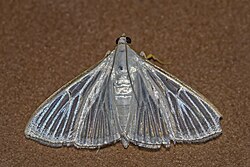
The wingspan of Palpita vitrealis can reach 27–31 mm. The body and the wings are translucent with a slight sheen. Eyes are large and reddish-brown. On the upper edge of the forewings is present a rather broad orange or brown border. The forewings also show two black spots in the middle. Legs are white and brown ringed.6
Biology
These moths mainly fly from August till late October, depending on the location. They feed on nectar of various flowers, including ivy and buddleia.67 This species shows a migratory nature. The larvae are initially yellow, later becoming green. They can grow to a length of about 2 cms. They feed on the leaves of the host plants, mainly jasmine (Jasminum officinale), privet (Ligustrum species), Forsythia, Arbutus unedo and european olive (Olea europaea).7 In Africa the preferred host plants are Sida rhombifolia, Grewia, Helicteres isora, Schima noronhae and Randia scortechinii.2 The larvae are considered a pest of olive fields, as they attack the leaves and fruits. The final instar of the larvae spins some leaves together and form a silky cocoon to pupate.5
References
References
Further reading
Further reading
- Mark Parsons, Sean Clancy, David Wilson A Guide to the Pyralid and Crambid Moths of Britain and Ireland: Atropos, England. ISBN 9780955108648
External links
External links
- Data related to Palpita vitrealis at Wikispecies
- Media related to Palpita vitrealis at Wikimedia Commons
- Lepiforum.de
- Paolo Mazzei, Daniel Morel, Raniero Panfili Moths and Butterflies of Europe and North Africa
- iNaturalist
- Lepinet
- Papillons de Poitou-Charentes
- Lepidoptera Larvae of Australia