| Palaeosyops | |
|---|---|
| |
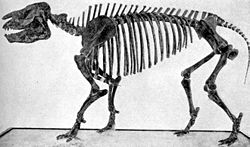
| P. robustus skeleton | |
Scientific classification 
| |
| Kingdom: | Animalia |
| Phylum: | Chordata |
| Class: | Mammalia |
| Infraclass: | Placentalia |
| Order: | Perissodactyla |
| Family: | †Brontotheriidae |
| Genus: | †Palaeosyops |
| Species | |
| |
Palaeosyops (Greek: "old" (paleos), "boar" (kapros), "face" (ops)2) is a genus of small brontothere which lived during the early to middle Eocene.3
Biology and size
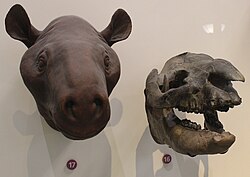
It was about the size of small cattle, with an estimated weight of 408.5 kilograms (901 lb).4
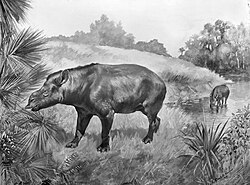
These animals are commonly found in Wyoming fossil beds primarily as fossilized teeth. P. major was the largest species, reaching the size of a small cow. Its describer, Joseph Leidy, erroneously thought that Palaeosyops consumed both plants and animals after examining the fang-like canines. However, it is now known that all brontotheres were strict herbivores, and that many, if not most genera of hornless brontotheres had fang-like canines, possibly for both defense from predators, and intraspecific competition.
References
References
- Hodnett, John-Paul M.; Welsh, Edward T.; Santucci, Vincent L.; Tweet, Justin S. (2022). "A Middle Eocene brontothere (Mammalia; Perissodactyla; Brontotheriidae) from Yellowstone National Park, Wyoming". FOSSIL RECORD 8. New Mexico Museum of Natural History and Science. p. 211.
- "Glossary. American Museum of Natural History". Archived from the original on 20 November 2021.
- "Fossilworks: Palaeosyops".
- Sanisidro, Oscar; Mihlbachler, Matthew C.; Cantalapiedra, Juan L. (2023). "A macroevolutionary pathway to megaherbivory". Science. 380 (6645): 616–618. doi:10.1126/science.ade1833. Supplemental Material (Data S1, Sheet 6)