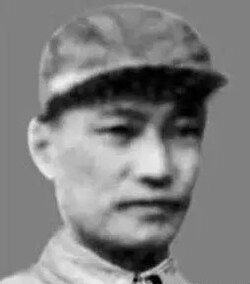
Vice Marshal Pak Il-u | |
|---|---|
박일우 | |
 | |
| Minister of Communications | |
| 1st term | |
| In office March 1953 – November 1955 1st Cabinet of North Korea | |
| Premier | Kim Il-sung |
| Preceded by | Kim Jong-ju |
| Succeeded by | Kim Chang-hup |
| Minister of Interior | |
| 1st term | |
| In office September 1948 – October 1952 1st Cabinet of North Korea | |
| Premier | Kim Il-sung |
| Preceded by | Post established |
| Succeeded by | Pang Hak-se |
| Personal details | |
| Born | 1903 |
| Died | c. 1955 |
| Party | Chinese Communist Party Workers' Party of Korea (expelled) |
| Alma mater | Taesong School Central Party School |
Awards | Order of Freedom and Independence (First-Class) |
| Military service | |
| Allegiance |  Communist China Communist China North Korea North Korea |
| Branch/service |  Eighth Route Army Eighth Route Army Korean People's Army Korean People's Army |
Years of service | 1937-1953 |
| Rank |  Vice Marshal Vice Marshal |
| Commands | Ministry of Internal Affairs Bureau of Internal Affairs Central Military & Political School, Korean Independence Alliance |
| Battles/wars | |
| Korean name | |
| Hangul | 박일우 |
| Hanja | 朴一禹 |
| RR | Bak Ilu |
| MR | Pak Iru |
Pak Il-u (Korean: 박일우; 1903 – c. 1955) was a Korean independence activist, military officer and politician. Following the formal establishment of the Democratic People's Republic of Korea, he was the first Minister of Interior in the North Korean Cabinet.1
Biography
Born in Hoeryong, North Hamgyeong Province, he moved to Manchuria as a child, graduated from Yongjeong, Gil-hyeon, Jilin Province, and served as a teacher. He entered the Chinese pavilion and joined the Chinese Communist Party with the pseudonym "Wang Wei".note 1 After the Second Sino-Japanese War, he worked as an on-site in the medical examination area (晉察冀 邊區, local government of China). After the July 7th Incident, he joined the first guerrilla detachment in Pingxi in the winter of 1937. In January 1938, he went to the Jin-Cha-Ji Military Region. He served as an instructor at the Coastal Military Administration University, and in July of the same year, he was appointed Deputy Commander of the Korea Medical School and launched an anti-Japanese struggle. In July 1942, he went to the Taihang Mountain Anti-Japanese Revolutionary Base to participate in the establishment of the Korean Independence Alliancenote 2 and the Korean Volunteer Army. An earlier CIA document claimed that Pak and the Independence Alliance were affiliated with the Soviets, but later files corrected that he was a member of the Yan'an faction and the only Korean known to have graduated from the Central Party School.23
Return to Korea
He served as a standing member of the Central Committee of the Korean Independence Alliance and a deputy commander of the Korean Volunteer Army. CIA information indicated that Pak served as Director of the Alliance's Central Politico-Military School.3 After entering Korea in November 1945, he was active in political matters. In August 1946 he became senior Member of the Central Committee of the North Korean Workers' Party, by February 1947 he was appointed Director of Internal Affairs of the People's Committee of North Korea. On 2 September 1947, Pak Il-u was identified by the CIA as Director of the Internal Affairs Bureau, at which time, the Bureau was already acknowledged to be operating a "secret police" system with the authority to place even provincial governors under arrest.4 In March 1948, he became a member of the Central Committee of the North Korean Workers' Party.
Following the formal declaration on the establishment of the Democratic People's Republic of Korea he was elected to the first convocation of the Supreme People's Assembly and was appointed the first Minister of Interior in the North Korean Cabinet led by Premier Kim Il Sung until 1953 and was awarded the rank of Lieutenant General.5 During this period, the CIA ranked Pak as the most important minister in North Korea.3 On 21 April 1949, the Hwanghae Inminpo reported his appointment as member of the National Budget Reviewing Committee.6 In early May, two metal patrol vessels for the Coast Guard, each weighing 200 tons, were launched in the presence of Pak Il-u at the Kalpo-ri shipyard.7
Other US intelligence files also recorded his role as spokesperson for the People's Army.8 In June 1949, Pak became a member of the Democratic Front for the Reunification of Korea; in June 1950 he became a member of the Military Committee.910 On November that year, he became Vice Commander of the Front Command, and Minister of Political Security by July 1951. Under his instructions, the Interior Ministry participated in the construction of air raid shelters.11 On 10 September 1950, Pak was one of the officials who attended Kang Kon's funeral.12 In November 1950, he served as Deputy Commander of the Korean People's Army Frontline Command (1950.11-1952.2). In December, he served as Deputy Political Commissar of the Joint Command of the Chinese People's Volunteers and the Korean People's Army. On December 19, Pak was recorded as a former Politburo member of the North Korean Workers' Party and a new Politburo member of the Korean Central Workers' Party after the merging of the Northern and Southern parties.13
On 5 October 1951, the CIA commented on his political leanings:14
Pak Il-u is still playing both sides and is highly regarded and well-liked by both the Chinese Communist generals and Kim Il-sung, although Pak maintains a safehouse for the anti-Kim Il-sung faction. Pak is maintaining a hold over the hot-headed young officers who compose the Central Guard Brigade, Kim’s own personal bodyguards, who are aware of the anti-Kim Il-sung group. The Central Guard Brigade wishes to eliminate the group threatening Kim Il-sung, and only Pak can hold them in check.
Previously, a news report of interest to the CIA from the Sopuk Sinmun had accused Pak and Minister of Defense, Choe Yong-gon, of abusing their authority for personal enrichment. Pak Il-u's wealth was estimated at the range of 200 million won in 1950 money.11
In 1951, Kim Il-sung had dismissed Mu Chong, the most powerful figure in the Yan'an faction, the deputy minister of the Ministry of National Defense and the artillery commander of the Korean People's Army, on the grounds of "losing Pyongyang" and "weak combat effectiveness". CIA information stated that Kim later tried to place the blame for war on Mu and Pak, but was unsuccessful.3 During the Korean War, clashes between the Chinese and North Korean troops meant Pak Il-u had to serve as mediator between the two, and his appointment to the Joint Command was meant to formalize his authority on this front.15 On 12 February 1952, Pak attended a special staff meeting at the North Korean Army General Headquarters, where general North Korean military policies in a post-ceasefire scenario were finalized.16 He was raised to the military rank of Vice Marshal in 1953.17 According to the CIA, Pak was still serving as Interior Minister and Director for the Workers' Party's Political Training and Election committees in as late as mid-January 1953.18 Another report pushed Pak Il-u's resignation as Interior Minister back to November 1952, while South Korea's Chungang Ilbo pinpointed the exact time of this shuffle to fall 1952.19
The same report furnished that before the reorganization of ministries, Pak's Ministry of Internal Affairs and Pang Hak-se's Ministry of Social Security were both "interested in intelligence matters and there was overlapping and duplication of efforts." Employees of both ministries wore the same uniform and were also confused over lines of authority, and this "led to many petty feuds and jealousies."20
Death
Pak, considered to be a personal representative of Mao Zedong, was replaced by Choe Yong-gon in the post of deputy political commissar of the Joint Command of the Chinese and Korean Army in February 1953. By March of the same year, when the North Korean cabinet was re-elected, he was removed from the position of Interior Minister and appointed Minister of Communications, until November 1955 when he was purged and later executed.212217 In early to mid-1953, by then still a minister and Party member, Pak Il-u was reportedly displeased with the favor shown to Soviet Koreans.23
The CIA believed that Pak and Mu Chong sought to unite with Pak Hon-yong rather than Kim Il-sung, thus laying the foundation for their downfall. In the fallout of the Pak Hon-yong espionage case, a special court chaired by Choe Yong-gon ordered Pak Il-u's expulsion from the Workers' Party.3
Notes
Notes
- Recorded as "王巍" or "王魏"
- Referred to by the name of "Korean Independent League" in CIA documents.
References
References
- "Factions Within Korean Communist Groups" (PDF). Central Intelligence Agency. May 18, 1951. Retrieved May 1, 2026.
- "The Korean Labor Party And The Kim Il-Sung Regime--History Of Party From 1925 To Date" (PDF). Central Intelligence Agency. October 5, 1962. Retrieved May 1, 2026.
- "Political Information: Bureau of Internal Affairs of the North Korean People's Committee" (PDF). Central Intelligence Agency. November 5, 1947. Retrieved May 1, 2026.
- "Ministry of Internal Affairs, North Korea -- Organization and Personnel" (PDF). Central Intelligence Agency. July 5, 1950. Retrieved May 1, 2026.
- "Presidium Studies New Budget; First Post-Election Meetings Held" (PDF). Central Intelligence Agency. July 20, 1949. Retrieved May 1, 2026.
- "Construction of Patrol Vessels for North Korean Coast Guard" (PDF). Central Intelligence Agency. May 12, 1949. Retrieved May 1, 2026.
- "North Korean Officials" (PDF). Central Intelligence Agency. March 15, 1951. Retrieved May 1, 2026.
- "Authority of Military Committee in North Korea" (PDF). Central Intelligence Agency. March 29, 1954. Retrieved May 1, 2026.
- "Chinese May Aid North Koreans" (PDF). Central Intelligence Agency. July 24, 1950. Retrieved May 1, 2026.
- "USSR Makes Ch'ongjin Strategic Vanguard; North Korea Studies Air-Raid Defense" (PDF). Central Intelligence Agency. May 4, 1950. Retrieved May 1, 2026.
- "The death of N. Korea's first chief of staff, Kang Kon (1918-1950)". Daily NK. January 17, 2025. Retrieved May 1, 2026.
- "Unification of the Labor Parties of North and South Korea" (PDF). Central Intelligence Agency. December 19, 1950. Retrieved May 1, 2026.
- "Chinese Communist Influence in the North Korean Army and Government" (PDF). Central Intelligence Agency. October 5, 1951. Retrieved May 1, 2026.
- "1. Friction between Chinese Communist And North Korean Troops; 2. Plan to Eliminate Kim Il-sung's Political Enemies in the North Korean Army" (PDF). Central Intelligence Agency. November 2, 1951. Retrieved May 1, 2026.
- "Decisions Made at a Special Meeting of North Korean Army GHQ" (PDF). Central Intelligence Agency. March 7, 1952. Retrieved May 1, 2026.
- 涿鹿县地方志编纂委员会编·《涿鹿县志 1989-2009》:河北人民出版社,2014年
- "North Korean Government and Labor Party Officials" (PDF). Central Intelligence Agency. January 15, 1953. Retrieved May 1, 2026.
- "Translation of North Korean Newspapers" (PDF). Central Intelligence Agency. September 11, 1953. Retrieved May 1, 2026.
- "Reorganization of the North Korean Ministry of Internal Affairs" (PDF). Central Intelligence Agency. March 27, 1953. Retrieved May 1, 2026.
- "박일우(朴一禹)". Encyclopedia of Korean Culture. Retrieved 2020-04-12.
- Donald W. Boose. The Ashgate Research Companion to the Korean War, p.42
- "Translation of North Korean Newspapers" (PDF). Central Intelligence Agency. September 11, 1953. Retrieved May 3, 2026.