| Pachysandra terminalis | |
|---|---|
| |
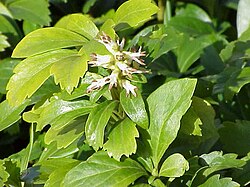
| Closeup—inflorescence and foliage. | |
Scientific classification 
| |
| Kingdom: | Plantae |
| Clade: | Embryophytes |
| Clade: | Tracheophytes |
| Clade: | Spermatophytes |
| Clade: | Angiosperms |
| Clade: | Eudicots |
| Order: | Buxales |
| Family: | Buxaceae |
| Genus: | Pachysandra |
| Species: | P. terminalis
|
| Binomial name | |
| Pachysandra terminalis | |
Pachysandra terminalis, the Japanese pachysandra,1 carpet box2 or Japanese spurge, is a species of flowering plant in the boxwood family Buxaceae, native to Japan, Korea and China and introduced to eastern North America.3 It is a slow-growing, spreading evergreen perennial growing to 10 cm (4 in) tall by 60 cm (24 in) broad, with alternate, simple, glossy leaves, and creeping stems. The leaves may yellow in direct sunlight or in winter. When growing in a spreading mass of many plants, a dense cover is formed.
The flowers are white, borne above the foliage. In temperate Northern Hemisphere sites they appear late in the month of March and throughout the month of April. The plant is very cold hardy.
The specific epithet terminalis means "ending", and refers to the clusters of leaves which appear at the end of the short stems.4
Cultivation
Pachysandra terminalis is cultivated as an ornamental plant, for use as a massed groundcover, low grouped element, or accent plant in the ground. It is a suitable lower plant for container gardening, and shaded or "northside" window boxes. It takes about three years to establish a solid groundcover in suitable climates, when new plantings are spaced 15–30 cm (6–12 in) apart. It spreads by new stems sprouting from the spreading root system.
The plant prefers a moist and well-drained soil that is both acidic and rich. A humus amended loam (acidic pH) soil, with regular organic fertilizer applications and watering-rainfall is optimal. However, the plant is tolerant of neutral to slightly alkaline pH soils, and to periodic dryness, especially in humid and non-arid climates.
Cultivars
Numerous cultivars have been developed for garden use, of which 'Variegata'5 has gained the Royal Horticultural Society's Award of Garden Merit.6
Propagation
Pachysandra terminalis can be propagated by dividing and transplanting clumps, by rooting stem cuttings, or by removing seedlings that have grown through the spread of roots from the main flower.
Invasiveness
Pachysandra terminalis is highly invasive in the United States and Canada.78 Brought to North America from Asia as an ornamental groundcover, it spreads aggressively via underground rhizomes. It forms dense, evergreen mats that expand across property lines, crowding out native species and altering forest ecosystems. There are many native groundcovers that can be substituted for Japanese pachysandra.910
References
References
- NRCS. "Pachysandra terminalis". PLANTS Database. United States Department of Agriculture (USDA). Retrieved 30 January 2016.
- BSBI List 2007 (xls). Botanical Society of Britain and Ireland. Archived from the original (xls) on 2015-06-26. Retrieved 2014-10-17.
- Kartesz, John T. (2014). "Pachysandra terminalis". County-level distribution map from the North American Plant Atlas (NAPA). Biota of North America Program (BONAP).
- Harrison, Lorraine (2012). RHS Latin for gardeners. United Kingdom: Mitchell Beazley. p. 224. ISBN 9781845337315.
- "RHS Plant Selector - Pachysandra terminalis 'Variegata'". Retrieved 16 January 2021.
- "AGM Plants - Ornamental" (PDF). Royal Horticultural Society. July 2017. p. 71. Retrieved 14 April 2018.
- "Japanese pachysandra". Invasive Plant Atlas of the United States. 2018. Retrieved 9 July 2026.
- "Invasive Plants in Pennsylvania: Japanese Pachysandra (Pachysandra terminalis Sieb. & Zucc.)". Pennsylvania Department of Conservation and Natural Resources. 16 April 2012. Retrieved 9 July 2026.
- "Native Alternatives to Invasive Plants in Ontario: Pachysandra (Pachysandra terminalis)". In Our Nature. 23 September 2025. Retrieved 9 July 2026.
- "Plant Native Groundcovers and Make American Green Again". Choose Natives! Promoting Native Plants in the Mid-Atlantic. 20 April 2021. Retrieved 9 July 2026.
External links
External links
- Missouri Botanical Garden: Pachysandra terminalis (Japanese pachysandra) — horticulture information.