 | |
| Type | Subsidiary (A/S) |
|---|---|
| Industry | Medical devices |
| Founded | 1904 (1904) |
| Founder | Hans Demant |
| Headquarters | Smørum, Egedal , Denmark |
| Products | Hearing aids |
Number of employees | 3,000+ |
| Parent | Demant A/S |
| Website | oticon |
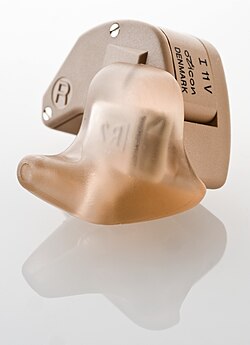
Oticon is a Danish hearing aid manufacturer based near Copenhagen in Denmark. The company is a subsidiary of Demant A/S. It was founded in 1904 by Hans Demant, whose wife was hearing impaired.
Oticon has branches in several countries, including a production plant in Poland, with more than 3,000 employees worldwide.1 The company claims to be the world's second-largest manufacturer of hearing aids, and it uses a management style known as "spaghetti organization",23 which was introduced by Lars Kolind456 under his leadership between 1988 and 1998.789
In 2018 Oticon was fined AUD$2.5 million and they were forced to apologise for misleading customers in Australia about hearing aids and their technology.10
Oticon Medical
Oticon Medical is a sister company of Oticon, both being subsidiaries of the Demant Group.11 Whereas Oticon specialises in hearing aids, Oticon Medical specialises in hearing implants and released its first products in 2009.12 The company's Ponto bone conduction implant is now in its fifth generation.13
In 2013, Oticon Medical acquired Neurelec, a French producer of cochlear implants.14
In April 2022, Demant announced it had agreed to sell Oticon Medical to Australian company Cochlear Limited for DKK850 million and would exit the hearing implant business.15
References
References
- "Oticon Hearing Aids". Apex Hearing. Archived from the original on 20 January 2021. Retrieved 6 May 2014.
- "Oticon A/S: Spaghetti Organization and Beyond". IBS Center for Management Research. Retrieved 12 September 2012.
- "Case Study: Revolution at Oticon A/S: The Spaghetti Organization (Condensed)". Harvard Business Review. Retrieved 10 September 2012.
- Peters, Tom (January 1994). Liberation Management. United States: Ballantine Books. p. 880. ISBN 0-449-90888-7.
- Ewing, Jack (6 August 2007). "Denmark's Masters of E-Mail Marketing". Bloomberg Businessweek. Archived from the original on 9 July 2012. Retrieved 12 September 2012.
- Poulsen, Per Thygesen (1993). Tænk det utænkelige: Revolutionen i Oticon. Denmark: Schultz Erhvervsbøger. p. 174. ISBN 87-569-7920-7.
- Tænk det utænkelige: Revolutionen i Oticon. 1993. ISBN 9788756979207. Retrieved 12 September 2012.
- "Think the Unthinkable (in Danish: Tænk det utænkelige!)". Kolind Kuren. Archived from the original on 6 December 2019. Retrieved 12 September 2012.
- Morsing, Mette; Eiberg, Kristian (1998). Managing the Unmanageable for a Decade. Denmark: Oticon A/S. p. 244.
- Commission, Australian Competition and Consumer (6 September 2018). "ACCC takes action against hearing aid retailers for misleading pensioners". www.accc.gov.au. Retrieved 12 November 2025.
- "Oticon Medical – A company founded on care". earcommunity.org. Retrieved 24 March 2022.
- "Our history". www.demant.com. Retrieved 24 March 2022.
- "Oticon Medical bone-anchored hearing devices". Healthy Hearing. Retrieved 24 March 2022.
- Apr 2; Ear, 2013 | Behind the; Implants, Cochlear; News | 0 |, Industry (2 April 2013). "William Demant Acquires Neurelec, a French Manufacturer of Cochlear Implants". The Hearing Review. Retrieved 24 March 2022.
{{cite web}}: CS1 maint: numeric names: authors list (link) - Ogg, Matt (27 April 2022). "Cochlear to acquire loss-making Oticon Medical for $170 million". Business News Australia. Retrieved 6 May 2022.
External links
External links
- Oticon's official website
- Oticon's official UK site for NHS (Oticon NHS), which includes information and training resources for NHS hearing care professionals and the general public