| Osiris blue | |
|---|---|
| |
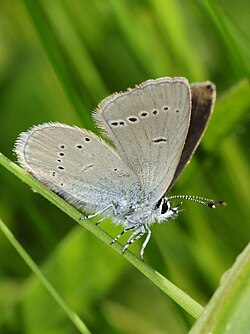
| Female Osiris blue | |
Scientific classification 
| |
| Kingdom: | Animalia |
| Phylum: | Arthropoda |
| Clade: | Pancrustacea |
| Class: | Insecta |
| Order: | Lepidoptera |
| Family: | Lycaenidae |
| Genus: | Cupido |
| Species: | C. osiris
|
| Binomial name | |
| Cupido osiris Meigen, 1829
| |
| Synonyms | |
| |
The Osiris blue (Cupido osiris) is a butterfly in the family Lycaenidae. It is found in South Europe, Asia Minor, southern Siberia, the Alay Mountains, Tian-Shan, Dzhungarsky Alatau, the Altai Region, the Sayan Mountains, Lake Baikal and Mongolia. It is often confused with the small blue, a closely related species.
The larvae feed on Onobrychis and Leguminosae species.
Description from Seitz
L. sebrus Bdv. (82 c). Above dull violet-blue (male) or black-brown (female). with the markings of the underside feebly shining through, narrow black margin and white fringes; beneath light ashy grey, the base dusted with blue, the ocelli and the median spot being very delicate. In the Alps, locally plentiful, southwards to Italy, south-eastwards to Asia Minor and eastwards to the Altai. Specimens with the ocelli prolonged occur also in this species, as proved by a fine specimen in Courvoisier's collection: ab. elongata Courv. i. l. — Larva on Onobrychis and Orobus, until April and again in June. The butterflies in the mountains, sporadic, in May and again from the end of June onwards.1
References
References
- Adalbert Seitz in Seitz, A. ed. Band 1: Abt. 1, Die Großschmetterlinge des palaearktischen Faunengebietes, Die palaearktischen Tagfalter, 1909, 379 Seiten, mit 89 kolorierten Tafeln (3470 Figuren)