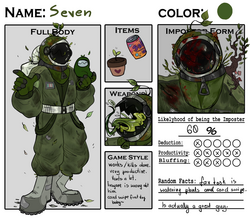
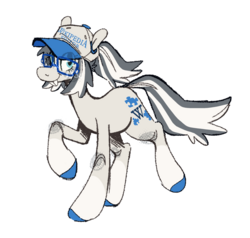
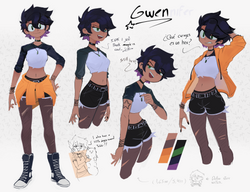

An original character (OC) is a fictional character created by an author or artist, as opposed to being adapted from an existing work. The term has two main applications: within fan works (such as fan fiction or fan art), it denotes a non-canonical character inserted into an established fictional universe; within original works (including literature, comics, and games), it refers to any character that is the intellectual property of its creator.12345 Acronyms can also be gender-specific, like OMC (original male character) and OFC (original female character).65
OCs are used in various subcultures including the Star Wars fandom, the Harry Potter fandom,1 the My Little Pony fandom, and the Sonic the Hedgehog fandom. Takashi Iizuka mentioned that the character customization system in Sonic Forces was influenced by the Sonic community's tendency to create original characters;7 tools for creating Sonic OCs exist on sites like Newgrounds.8 Cosplayers create original characters based on their imaginations, fan fiction, and other works.9 For cosplayers, OCs can give them a larger range of choices of characters to cosplay as.10
OCs have been used in the furry fandom.11 A majority of furries have a fursona,12 defined as a personally claimed persona resembling an anthropomorphic animal.1314 According to a 2020 survey in The New Science of Narcissism, 95% of furries have a fursona.15: 180 Some members of the My Little Pony: Friendship Is Magic fandom uses pony OCs as personas called ponysonas.16 According to researchers studying the fandom, 39% of bronies have a ponysona. 46% of bronies reported having an original character, and their ponysona was among the first original characters they created.17
OCs can serve as protagonists1 or as minor characters in a story.18 A writer may add another author's OC into their own work.19 An OC can provide a different point of view to a fictional universe; for instance, a fan fiction author can create an OC that is a student at one of Hogwarts’ rival schools.1
See also
See also
- Mary Sue – Overly competent fictional character
- Rule 63 – Internet slang regarding gender swapped versions of characters
- Self-insertion – Literary device where the author writes themself into their fictional story
- SCP Foundation – Online collaborative writing project
References
References
Footnotes
- Vicente, Vann (2021-11-14). "What Does "OC" Mean, and How Do You Use It?". How-To Geek. Retrieved 2024-06-02.
- Whitehead 2018, p. 73.
- Barner 2017, p. 188.
- Franceschi 2017, p. 81.
- Carson, C. (2017). "What is fanfiction and where to find it: Definitions and fan archives". Beyond the Book:fanfiction. S2CID 63070065.
- Richard, Moriah (2022-06-25). "What Is Fan Fiction in Writing?". Writer's Digest. Retrieved 2024-06-12.
- Frank, Allegra (September 25, 2017). "Sonic Forces' Custom Hero mode might not be the wish fulfillment you want". Polygon. Archived from the original on December 27, 2019.
- Feldman, Brian (2020-02-14). "The Staff of New York Shows Off Its Sonic OCs". Intelligencer. Retrieved 2024-06-04.
- Winge 2018, pp. 118–119.
- Crawford 2019, p. 173.
- Adams 2023, p. 101.
- Reysen 2021, p. 96.
- "Words We're Watching: 'Furry' and 'Fursona'". Merriam-Webster. Retrieved 2021-06-30.
- "Definition of FURSONA". www.merriam-webster.com. Retrieved 2024-03-31.
- Campbell, W. Keith; Crist, Carolyn (2020-09-29). The New Science of Narcissism: Understanding One of the Greatest Psychological Challenges of Our Time—and What You Can Do About It. Sounds True. ISBN 978-1-68364-403-3.
- Alexandratos 2017, p. 67-68.
- Kosnáč, Pavol (2016). Fiction, Invention and Hyper-reality: From Popular Culture to Religion. Taylor & Francis. pp. 79–97. ISBN 9781317135494.
- Schott 2023, p. 49.
- Black 2008, p. 40.
Bibliography
- Whitehead, Carrie (June 15, 2018). Teen Fandom and Geek Programming:A Practical Guide for Librarians. Rowman & Littlefield Publishers. ISBN 9781538107539.
- Winge, Therèsa (November 2018). Costuming Cosplay:Dressing the Imagination. Bloomsbury Publishing. ISBN 9781350035928.
- Crawford, Garry (June 4, 2019). Cosplay and the Art of Play:Exploring Sub-Culture Through Art. Springer International Publishing. ISBN 978-3-030-15966-5.
- Alexandratos, Jonathan (March 31, 2017). Articulating the Action Figure: Essays on the Toys and Their Messages. McFarland & Company. ISBN 978-1-4766-6427-9.
- Barner, Ashley (October 31, 2017). The Case for Fanfiction:Exploring the Pleasures and Practices of a Maligned Craft. McFarland. ISBN 9781476668772.
- Schott, Christine (January 30, 2023). Canon Fanfiction:Reading, Writing, and Teaching with Adaptations of Premodern and Early Modern Literature. Walter de Gruyter GmbH & Co KG. ISBN 9781501515989.
- Franceschi, Valeria (June 20, 2017). Exploring Plurilingualism in Fan Fiction:ELF Users as Creative Writers. Cambridge Scholars. ISBN 9781443896085.
- Black, Rebecca (2008). Adolescents and Online Fan Fiction. Peter Lang. ISBN 9780820497389.
- Adams, Camielle (December 8, 2023). Furscience: A Decade of Psychological Research on the Furry Fandom. Stephen Reysen. ISBN 9780997628838.
- Reysen, Stephen (April 19, 2021). Transported to Another World:The Psychology of Anime Fans. Stephen Reysen. ISBN 978-0-9976288-1-4.