Article · Wikipedia archive · Last revised Jul 19, 2026

Oregonator

The Oregonator is a theoretical model for a type of autocatalytic reaction. The Oregonator is the simplest realistic model of the chemical dynamics of the oscillatory Belousov–Zhabotinsky reaction. It was created by Richard Field and Richard M. Noyes at the University of Oregon. It is a portmanteau of Oregon and oscillator.

Last revised
Jul 19, 2026
Read time
≈ 2 min
Length
385 w
Citations
6
Source
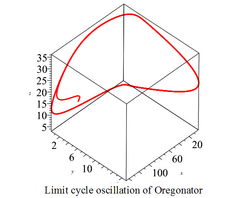
Limit cycle oscillation of Oregonator
Limit cycle oscillation of Oregonator source ↗

The Oregonator is a theoretical model for a type of autocatalytic reaction. The Oregonator is the simplest realistic model of the chemical dynamics of the oscillatory Belousov–Zhabotinsky reaction.1 It was created by Richard Field and Richard M. Noyes at the University of Oregon.2 It is a portmanteau of Oregon and oscillator.

Earlier, the Brusselator model was proposed by Ilya Prigogine and his collaborators at the Free University of Brussels3 as a portmanteau of Brussels and oscillator.

The Oregonator is a reduced model of the FKN mechanism (developed by Richard Field, Endre Kőrös, and Richard M. Noyes) which still involved 11 reactions and 12 species (21 intermediate species and 18 elementary steps). The Oregonator is characterized by the reactionsnote 1

I A + Y X + P II X + Y 2 P III A + X 2 X + 2 Z IV 2 X A + P V B + Z 1 2 f Y d [ X ] d t = k I [ A ] [ Y ] k I I [ X ] [ Y ] + k I I I [ A ] [ X ] 2 k I V [ X ] 2 d [ Y ] d t = k I [ A ] [ Y ] k I I [ X ] [ Y ] + 1 2 f k V [ B ] [ Z ] d [ Z ] d t = 2 k I I I [ A ] [ X ] k V [ B ] [ Z ] {\displaystyle {\begin{aligned}{\text{I}}\quad &A+Y\longrightarrow X+P\\[5pt]{\text{II}}\quad &X+Y\longrightarrow 2P\\[5pt]{\text{III}}\quad &A+X\longrightarrow 2X+2Z\\[5pt]{\text{IV}}\quad &2X\longrightarrow A+P\\[5pt]{\text{V}}\quad &B+Z\longrightarrow {\frac {1}{2}}fY\\[5pt]&{\frac {d[X]}{dt}}=k_{I}[A][Y]-k_{II}[X][Y]+k_{III}[A][X]-2k_{IV}[X]^{2}\\[5pt]&{\frac {d[Y]}{dt}}=-k_{I}[A][Y]-k_{II}[X][Y]+{\frac {1}{2}}fk_{V}[B][Z]\\[5pt]&{\frac {d[Z]}{dt}}=2k_{III}[A][X]-k_{V}[B][Z]\end{aligned}}}
See also

See also

Notes

Notes

  1. The mechanism below as well as the rate equations are from the Scholarpedia article.1 Some of the stoichiometric coefficients in the original equations were different.2
References

References

  1. Field, Richard (2007). "Oregonator". Scholarpedia. 2 (5): 1386. Bibcode:2007SchpJ...2.1386F. doi:10.4249/scholarpedia.1386.
  2. Field, Richard J.; Noyes, Richard M. (1974). "Oscillations in chemical systems. IV. Limit cycle behavior in a model of a real chemical reaction". J. Chem. Phys. 60 (5): 1877–1884. Bibcode:1974JChPh..60.1877F. doi:10.1063/1.1681288. hdl:10338.dmlcz/104338.
  3. "IDEA – Internet Differential Equations Activities". Washington State University. Archived from the original on 2017-09-09. Retrieved 2010-05-16.