| Apeirogonal tiling | |
|---|---|
 | |
| Type | Regular tiling |
| Vertex configuration | ∞.∞ [[File:|40px]] |
| Face configuration | V2.2.2... |
| Schläfli symbol(s) | {∞,2} |
| Wythoff symbol(s) | 2 | ∞ 2 2 2 | ∞ |
| Coxeter diagram(s) |    
|
| Symmetry | [∞,2], (*∞22) |
| Rotation symmetry | [∞,2]+, (∞22) |
| Dual | Apeirogonal hosohedron |
| Properties | Vertex-transitive, edge-transitive, face-transitive |
In geometry, an order-2 apeirogonal tiling, apeirogonal dihedron, or infinite dihedron1 is a tessellation (gap-free filling with repeated shapes) of the plane consisting of two apeirogons. It may be considered an improper regular tiling of the Euclidean plane, with Schläfli symbol {∞, 2}. Two apeirogons joined along all their edges can completely fill the entire plane, as an apeirogon is infinite in size and has an interior angle of 180°, which is half of a full 360°.
Related tilings and polyhedra
Similarly to the uniform polyhedra and the uniform tilings, eight uniform tilings may be based from the regular apeirogonal tiling. The rectified and cantellated forms are duplicated, and as two times infinity is also infinity, the truncated and omnitruncated forms are also duplicated, therefore reducing the number of unique forms to four: the apeirogonal tiling, the apeirogonal hosohedron, the apeirogonal prism, and the apeirogonal antiprism.
| (∞ 2 2) | Wythoff symbol |
Schläfli symbol |
Coxeter diagram |
Vertex config. |
Tiling image | Tiling name |
|---|---|---|---|---|---|---|
| Parent | 2 | ∞ 2 | {∞,2} | 
|
∞.∞ | 
|
Apeirogonal dihedron |
| Truncated | 2 2 | ∞ | t{∞,2} |
|
2.∞.∞ | ||
| Rectified | 2 | ∞ 2 | r{∞,2} |
|
2.∞.2.∞ | ||
| Birectified (dual) |
∞ | 2 2 | {2,∞} |
|
2∞ | 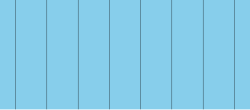
|
Apeirogonal hosohedron |
| Bitruncated | 2 ∞ | 2 | t{2,∞} |
|
4.4.∞ | 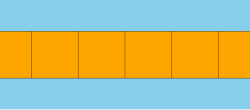
|
Apeirogonal prism |
| Cantellated | ∞ 2 | 2 | rr{∞,2} |
| |||
| Omnitruncated (Cantitruncated) |
∞ 2 2 | | tr{∞,2} |
|
4.4.∞ | 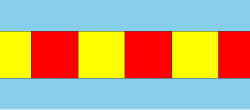
| |
| Snub | | ∞ 2 2 | sr{∞,2} | 
|
3.3.3.∞ | 
|
Apeirogonal antiprism |
See also
See also
- Order-3 apeirogonal tiling - hyperbolic tiling
- Order-4 apeirogonal tiling - hyperbolic tiling
Notes
Notes
References
References
- Conway (2008), p. 263
- The Symmetries of Things 2008, John H. Conway, Heidi Burgiel, Chaim Goodman-Strauss, ISBN 978-1-56881-220-5