Article · Wikipedia archive · Last revised Jun 9, 2026

One-sided limit

In calculus, a one-sided limit refers to either one of the two limits of a function of a real variable as approaches a specified point either from the left or from the right.

Last revised
Jun 9, 2026
Read time
≈ 10 min
Length
2,244 w
Citations
12
Source
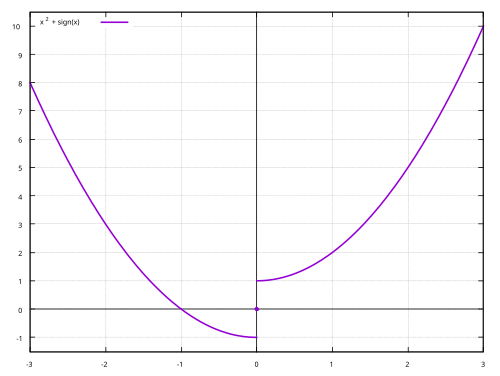
At x = 0 , {\displaystyle x=0,} the function f ( x ) = x 2 + sign ( x ) , {\displaystyle f(x)=x^{2}+\operatorname {sign} (x),} where sign ( x ) {\displaystyle \operatorname {sign} (x)} denotes the sign function, has a left limit of 1 , {\displaystyle -1,} a right limit of + 1 , {\displaystyle +1,} and a function value of 0. {\displaystyle 0.} source ↗

In calculus, a one-sided limit refers to either one of the two limits of a function f ( x ) {\displaystyle f(x)} of a real variable x {\displaystyle x} as x {\displaystyle x} approaches a specified point either from the left or from the right.12

The limit, as x {\displaystyle x} decreases in value approaching a {\displaystyle a} ( x {\displaystyle x} approaches a {\displaystyle a} "from the right"3 or "from above"), is denoted:12

lim x a + f ( x )  or  lim x a f ( x )  or  lim x a f ( x )  or  f ( a + ) . {\displaystyle \lim _{x\to a^{+}}f(x)\quad {\text{ or }}\quad \lim _{x\,\downarrow \,a}\,f(x)\quad {\text{ or }}\quad \lim _{x\searrow a}\,f(x)\quad {\text{ or }}\quad f(a+).}

The limit, as x {\displaystyle x} increases in value approaching a {\displaystyle a} ( x {\displaystyle x} approaches a {\displaystyle a} "from the left"45 or "from below"), is denoted:12

lim x a f ( x )  or  lim x a f ( x )  or  lim x a f ( x )  or  f ( a ) . {\displaystyle \lim _{x\to a^{-}}f(x)\quad {\text{ or }}\quad \lim _{x\,\uparrow \,a}\,f(x)\quad {\text{ or }}\quad \lim _{x\nearrow a}\,f(x)\quad {\text{ or }}\quad f(a-).}

If the limits from the left and right both exist and are equal, then the limit of f ( x ) {\displaystyle f(x)} as x {\displaystyle x} approaches a {\displaystyle a} exists. Conversely, if the limit of f ( x ) {\displaystyle f(x)} as x {\displaystyle x} approaches a {\displaystyle a} exists, then the limits from left and right both exist and are equal. Consequently, the limit as x {\displaystyle x} approaches a {\displaystyle a} is sometimes called a "two-sided limit". It is denoted: lim x a f ( x ) . {\displaystyle \lim _{x\to a}f(x).}

In some cases in which the two-sided limit does not exist, the two individual one-sided limits nonetheless exist and they are then necessarily unequal.

It is possible for only one of the two one-sided limits to exist. It is also possible for neither of the two one-sided limits to exist.

Formal definition

Definition

If I {\displaystyle I} represents some interval that is contained in the domain of a function f {\displaystyle f} and if a {\displaystyle a} is a point in I {\displaystyle I} , then the right-sided limit as x {\displaystyle x} approaches a {\displaystyle a} can be rigorously defined as the value R {\displaystyle R} that satisfies:6

for all ε > 0 {\displaystyle \varepsilon >0} there exists some δ > 0 {\displaystyle \delta >0} such that for all x I {\displaystyle x\in I} , if 0 < x a < δ {\displaystyle 0<x-a<\delta } then | f ( x ) R | < ε {\displaystyle |f(x)-R|<\varepsilon } ,

and the left-sided limit as x {\displaystyle x} approaches a {\displaystyle a} can be rigorously defined as the value L {\displaystyle L} that satisfies:

for all ε > 0 {\displaystyle \varepsilon >0} there exists some δ > 0 {\displaystyle \delta >0} such that for all x I {\displaystyle x\in I} , if 0 < a x < δ {\displaystyle 0<a-x<\delta } then | f ( x ) L | < ε {\displaystyle |f(x)-L|<\varepsilon } .

These definitions can be represented more symbolically as follows: Let I {\displaystyle I} represent an interval, where I d o m a i n ( f ) {\displaystyle I\subseteq \mathrm {domain} (f)} and a I {\displaystyle a\in I} , then lim x a + f ( x ) = R ε R + , δ R + , x I , 0 < x a < δ | f ( x ) R | < ε , lim x a f ( x ) = L ε R + , δ R + , x I , 0 < a x < δ | f ( x ) L | < ε . {\displaystyle {\begin{aligned}\lim _{x\to a^{+}}f(x)=R&\iff \forall \varepsilon \in \mathbb {R} _{+},\exists \delta \in \mathbb {R} _{+},\forall x\in I,0<x-a<\delta \longrightarrow |f(x)-R|<\varepsilon ,\\\lim _{x\to a^{-}}f(x)=L&\iff \forall \varepsilon \in \mathbb {R} _{+},\exists \delta \in \mathbb {R} _{+},\forall x\in I,0<a-x<\delta \longrightarrow |f(x)-L|<\varepsilon .\end{aligned}}}

Intuition

In comparison to the formal definition for the limit of a function at a point, the one-sided limit (as the name would suggest) only deals with input values to one side of the approached input value.

For reference, the formal definition for the limit of a function at a point is as follows:

lim x a f ( x ) = L             ε R + , δ R + , x I , 0 < | x a | < δ | f ( x ) L | < ε . {\displaystyle \lim _{x\to a}f(x)=L~~~\iff ~~~\forall \varepsilon \in \mathbb {R} _{+},\exists \delta \in \mathbb {R} _{+},\forall x\in I,0<|x-a|<\delta \implies |f(x)-L|<\varepsilon .}

To define a one-sided limit, we must modify this inequality. Note that the absolute distance between x {\displaystyle x} and a {\displaystyle a} is

| x a | = | ( 1 ) ( x + a ) | = | ( 1 ) ( a x ) | = | ( 1 ) | | a x | = | a x | . {\displaystyle |x-a|=|(-1)(-x+a)|=|(-1)(a-x)|=|(-1)||a-x|=|a-x|.}

For the limit from the right, we want x {\displaystyle x} to be to the right of a {\displaystyle a} , which means that a < x {\displaystyle a<x} , so x a {\displaystyle x-a} is positive. From above, x a {\displaystyle x-a} is the distance between x {\displaystyle x} and a {\displaystyle a} . We want to bound this distance by our value of δ {\displaystyle \delta } , giving the inequality x a < δ {\displaystyle x-a<\delta } . Putting together the inequalities 0 < x a {\displaystyle 0<x-a} and x a < δ {\displaystyle x-a<\delta } and using the transitivity property of inequalities, we have the compound inequality 0 < x a < δ {\displaystyle 0<x-a<\delta } .

Similarly, for the limit from the left, we want x {\displaystyle x} to be to the left of a {\displaystyle a} , which means that x < a {\displaystyle x<a} . In this case, it is a x {\displaystyle a-x} that is positive and represents the distance between x {\displaystyle x} and a {\displaystyle a} . Again, we want to bound this distance by our value of δ {\displaystyle \delta } , leading to the compound inequality 0 < a x < δ {\displaystyle 0<a-x<\delta } .

Now, when our value of x {\displaystyle x} is in its desired interval, we expect that the value of f ( x ) {\displaystyle f(x)} is also within its desired interval. The distance between f ( x ) {\displaystyle f(x)} and L {\displaystyle L} , the limiting value of the left sided limit, is | f ( x ) L | {\displaystyle |f(x)-L|} . Similarly, the distance between f ( x ) {\displaystyle f(x)} and R {\displaystyle R} , the limiting value of the right sided limit, is | f ( x ) R | {\displaystyle |f(x)-R|} . In both cases, we want to bound this distance by ε {\displaystyle \varepsilon } , so we get the following: | f ( x ) L | < ε {\displaystyle |f(x)-L|<\varepsilon } for the left sided limit, and | f ( x ) R | < ε {\displaystyle |f(x)-R|<\varepsilon } for the right sided limit.

Examples

Example 1. The limits from the left and from the right of g ( x ) := 1 x {\textstyle g(x):=-{\frac {1}{x}}} as x {\displaystyle x} approaches a := 0 {\displaystyle a:=0} are, respectively lim x 0 1 x = +  and  lim x 0 + 1 / x = . {\displaystyle \lim _{x\to 0^{-}}-{\frac {1}{x}}=+\infty \qquad {\text{ and }}\qquad \lim _{x\to 0^{+}}{-1/x}=-\infty .} The reason why lim x 0 1 x = + {\textstyle \lim _{x\to 0^{-}}-{\frac {1}{x}}=+\infty } is because x {\displaystyle x} is always negative (since x 0 {\displaystyle x\to 0^{-}} means that x 0 {\displaystyle x\to 0} with all values of x {\displaystyle x} satisfying x < 0 {\displaystyle x<0} ), which implies that 1 / x {\displaystyle -1/x} is always positive so that lim x 0 1 x {\textstyle \lim _{x\to 0^{-}}-{\frac {1}{x}}} divergesnote 1 to + {\displaystyle +\infty } (and not to {\displaystyle -\infty } ) as x {\displaystyle x} approaches 0 {\displaystyle 0} from the left. Similarly, lim x 0 + 1 x = {\textstyle \lim _{x\to 0^{+}}-{\frac {1}{x}}=-\infty } since all values of x {\displaystyle x} satisfy x > 0 {\displaystyle x>0} (said differently, x {\displaystyle x} is always positive) as x {\displaystyle x} approaches 0 {\displaystyle 0} from the right, which implies that 1 / x {\displaystyle -1/x} is always negative so that lim x 0 + 1 x {\textstyle \lim _{x\to 0^{+}}-{\frac {1}{x}}} diverges to . {\displaystyle -\infty .}

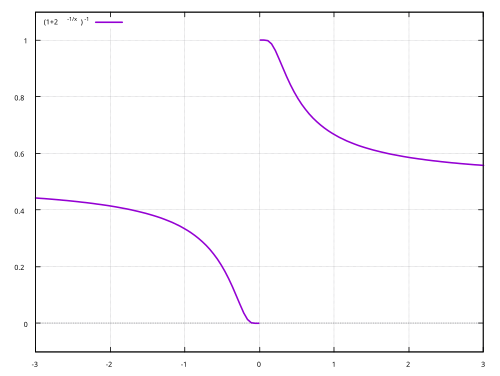
Plot of the function f ( x ) = 1 1 + 2 1 / x {\textstyle f(x)={\frac {1}{1+2^{-1/x}}}} . source ↗

Example 2. One example of a function with different one-sided limits is f ( x ) = 1 1 + 2 1 / x {\textstyle f(x)={\frac {1}{1+2^{-1/x}}}} , where the limit from the left is lim x 0 f ( x ) = 0 {\displaystyle \lim _{x\to 0^{-}}f(x)=0} and the limit from the right is lim x 0 + f ( x ) = 1. {\displaystyle \lim _{x\to 0^{+}}f(x)=1.} To calculate these limits, first show that lim x 0 2 1 / x =  and  lim x 0 + 2 1 / x = 0 , {\displaystyle \lim _{x\to 0^{-}}2^{-1/x}=\infty \qquad {\text{ and }}\qquad \lim _{x\to 0^{+}}2^{-1/x}=0,} which is true because lim x 0 1 / x = + {\textstyle \lim _{x\to 0^{-}}{-1/x}=+\infty } and lim x 0 + 1 / x = {\textstyle \lim _{x\to 0^{+}}{-1/x}=-\infty } so that consequently, lim x 0 + 1 1 + 2 1 / x = 1 1 + lim x 0 + 2 1 / x = 1 1 + 0 = 1 {\displaystyle \lim _{x\to 0^{+}}{\frac {1}{1+2^{-1/x}}}={\frac {1}{1+\displaystyle \lim _{x\to 0^{+}}2^{-1/x}}}={\frac {1}{1+0}}=1} whereas lim x 0 1 1 + 2 1 / x = 0 {\textstyle \lim _{x\to 0^{-}}{\frac {1}{1+2^{-1/x}}}=0} because the denominator diverges to infinity; that is, because lim x 0 1 + 2 1 / x = {\displaystyle \lim _{x\to 0^{-}}1+2^{-1/x}=\infty } . Since lim x 0 f ( x ) lim x 0 + f ( x ) {\displaystyle \lim _{x\to 0^{-}}f(x)\neq \lim _{x\to 0^{+}}f(x)} , the limit lim x 0 f ( x ) {\displaystyle \lim _{x\to 0}f(x)} does not exist.

Relation to topological definition of limit

The one-sided limit to a point p {\displaystyle p} corresponds to the general definition of limit, with the domain of the function restricted to one side, by either allowing that the function domain is a subset of the topological space, or by considering a one-sided subspace, including p . {\displaystyle p.} 1 Alternatively, one may consider the domain with a half-open interval topology.
Abel's theorem

A noteworthy theorem treating one-sided limits of certain power series at the boundaries of their intervals of convergence is Abel's theorem.

Notes

Notes

  1. A limit that is equal to {\displaystyle \infty } is said to diverge to {\displaystyle \infty } rather than converge to . {\displaystyle \infty .} The same is true when a limit is equal to . {\displaystyle -\infty .}
References

References

  1. "One-sided limit - Encyclopedia of Mathematics". encyclopediaofmath.org. Archived from the original on 18 March 2023. Retrieved 7 August 2021.
  2. Fridy, J. A. (24 January 2020). Introductory Analysis: The Theory of Calculus. Gulf Professional Publishing. p. 48. ISBN 978-0-12-267655-0. Retrieved 7 August 2021.
  3. Hasan, Osman; Khayam, Syed (2014-01-02). "Towards Formal Linear Cryptanalysis using HOL4" (PDF). Journal of Universal Computer Science. 20 (2): 209. doi:10.3217/jucs-020-02-0193. ISSN 0948-6968.
  4. Gasic, Andrei G. (2020-12-12). Phase Phenomena of Proteins in Living Matter (Thesis thesis).
  5. Brokate, Martin; Manchanda, Pammy; Siddiqi, Abul Hasan (2019), "Limit and Continuity", Calculus for Scientists and Engineers, Industrial and Applied Mathematics, Singapore: Springer Singapore, pp. 39–53, doi:10.1007/978-981-13-8464-6_2, ISBN 978-981-13-8463-9, S2CID 201484118, retrieved 2022-01-11{{citation}}: CS1 maint: work parameter with ISBN (link)
  6. Swokowski, Earl W. (1979). Calculus with Analytic Geometry (2nd ed.). Taylor & Francis. p. 72–73. ISBN 978-0-87150-268-1.
See also

See also