  | |
| Observation data Epoch J2000 Equinox ICRS | |
|---|---|
| Constellation | Ophiuchus |
| A | |
| Right ascension | 17h 18m 00.68112s1 |
| Declination | −24° 17′ 12.8535″1 |
| Apparent magnitude (V) | 5.142 |
| B | |
| Right ascension | 17h 18m 00.60620s3 |
| Declination | −24° 17′ 02.8150″3 |
| Apparent magnitude (V) | 6.592 |
| Characteristics | |
| A | |
| Spectral type | G8III2 |
| U−B color index | 0.984 |
| B−V color index | 1.046±0.0052 |
| B | |
| Spectral type | F6IV-V2 |
| U−B color index | 0.054 |
| B−V color index | 0.510±0.0152 |
| Astrometry | |
| A | |
| Radial velocity (Rv) | −28.97±0.131 km/s |
| Proper motion (μ) | RA: −57.5441 mas/yr Dec.: −7.7251 mas/yr |
| Parallax (π) | 11.5763±0.1756 mas1 |
| Distance | 282 ± 4 ly (86 ± 1 pc) |
| Absolute magnitude (MV) | 0.382 |
| B | |
| Radial velocity (Rv) | −29.705 km/s |
| Proper motion (μ) | RA: −56.5613 mas/yr Dec.: −12.4573 mas/yr |
| Parallax (π) | 11.6213±0.0603 mas3 |
| Distance | 281 ± 1 ly (86.0 ± 0.4 pc) |
| Absolute magnitude (MV) | 1.662 |
| Details | |
| A | |
| Radius | 12.30+0.20 −0.321 R☉ |
| Luminosity | 75.3±1.31 L☉ |
| Surface gravity (log g) | 2.696 cgs |
| Temperature | 4,849+63 −401 K |
| Metallicity [Fe/H] | 0.336 dex |
| B | |
| Radius | 2.99+0.10 −0.123 R☉ |
| Luminosity | 12.629±0.0863 L☉ |
| Temperature | 6,296+130 −1053 K |
| Metallicity [Fe/H] | 0.23±0.082 dex |
| Other designations | |
| ο Oph, 39 Ophiuchi, CD−24°13255, CCDM J17180-2417, WDS J17180-2417 | |
| A: GC 23344, HD 156349, HIP 84626, HR 6424, SAO 1852387 | |
| B: GC 23343, HD 156350, HIP 84625, HR 6425, SAO 1852378 | |
| Database references | |
| SIMBAD | AB |
| A | |
| B | |
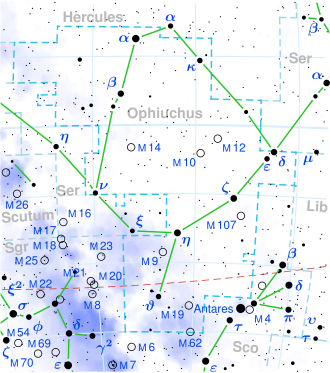
ο Ophiuchi, Latinized as Omicron Ophiuchi, is a wide double star in the equatorial constellation of Ophiuchus. The co-moving pair are visible to the naked eye as a dim point of light, with the two components having apparent visual magnitudes of 5.14 and 6.59.2 As of 2015, they had an angular separation of 10.0″ along a position angle of 354°.9 The distance to both stars is approximately 281 light years based on parallax, and they are drifting closer to the Sun with a radial velocity of around −29 km/s.5
The brighter member of the pair, designated component A, is an aging giant star with a stellar classification of G8III.2 With the supply of hydrogen at its core exhausted, it has expanded to 121 times the radius of the Sun. The star is radiating 751 times the Sun's luminosity from its enlarged photosphere at an effective temperature of 4,849 K.1 The secondary star, component B, has a class of F6IV-V,2 matching an F-type star with a luminosity class that is a blend of traits from a main sequence and a subgiant star. It has three3 times the Sun's radius and is radiating 12.6 times the Sun's luminosity at 6,296 K.3
References
References
- Brown, A. G. A.; et al. (Gaia collaboration) (August 2018). "Gaia Data Release 2: Summary of the contents and survey properties". Astronomy & Astrophysics. 616. A1. arXiv:1804.09365. Bibcode:2018A&A...616A...1G. doi:10.1051/0004-6361/201833051. Gaia DR2 record for this source at VizieR.
- Anderson, E.; Francis, Ch. (2012). "XHIP: An extended hipparcos compilation". Astronomy Letters. 38 (5): 331. arXiv:1108.4971. Bibcode:2012AstL...38..331A. doi:10.1134/S1063773712050015. S2CID 119257644.
- Brown, A. G. A.; et al. (Gaia collaboration) (August 2018). "Gaia Data Release 2: Summary of the contents and survey properties". Astronomy & Astrophysics. 616. A1. arXiv:1804.09365. Bibcode:2018A&A...616A...1G. doi:10.1051/0004-6361/201833051. Gaia DR2 record for this source at VizieR.
- Mermilliod, J.-C. (1986). "Compilation of Eggen's UBV data, transformed to UBV (unpublished)". Catalogue of Eggen's UBV Data. Bibcode:1986EgUBV........0M.
- Gontcharov, G. A. (2006). "Pulkovo Compilation of Radial Velocities for 35 495 Hipparcos stars in a common system". Astronomy Letters. 32 (11): 759–771. arXiv:1606.08053. Bibcode:2006AstL...32..759G. doi:10.1134/S1063773706110065. S2CID 119231169.
- Luck, R. Earle (2014). "Parameters and Abundances in Luminous Stars". The Astronomical Journal. 147 (6): 137. Bibcode:2014AJ....147..137L. doi:10.1088/0004-6256/147/6/137.
- "omi Oph A". SIMBAD. Centre de données astronomiques de Strasbourg.
- "omi Oph B". SIMBAD. Centre de données astronomiques de Strasbourg.
- Mason, Brian D.; et al. (2001). "The 2001 US Naval Observatory Double Star CD-ROM. I. The Washington Double Star Catalog". The Astronomical Journal. 122 (6): 3466. Bibcode:2001AJ....122.3466M. doi:10.1086/323920.